Wednesday, October 21, 2015

First Results of Flawed US Policy in Syria

Nikolai BOBKIN | 21.10.2015 | 00:00

Three weeks have passed since the Russian Aerospace Forces launched an operation in Syria. It’s unclear what the United States will do next. The recent events have made the administration split on the issue. Some want the President to take more resolute actions, while others share his caution about escalating the situation against the background of joint actions undertaken by Russia and Syria. Top US officials – State Secretary John Kerry, Defense Secretary Ashton Carter and CIA Director John Brennan – are among those who criticize the President.
The White House plans to expand NATO and introduce new sanctions against Russia. It’s trying to make the conflict between Moscow and Kiev linger on for many years. But, although the situation in Syria has gone through drastic changes, the United States appears to have no response plan. 
Washington has not even tried to make the United Nations Security Council condemn Russia’s military operation. Russia is the only country taking part in the hostilities against the Islamic State in accordance with the norms of international law. That’s the major difference between Moscow and all other actors involved in the Syria’s conflict. 
The US leading role in the fight against international terrorism in the Middle East has proven to be a myth. US Air Force pilots fly no more than one-two sorties a day. Sometimes they are joined by Canadians. This effort evidently pales in comparison with the flight intensity of Russian Aerospace Forces. The Pentagon distorts the truth when it says that the Russian aviation does not concentrate its effort on striking Islamic State targets. Russian military is ready to include the targets indicated by the US into the hit list, but Washington refuses to share its intelligence data. 
Perhaps, the United States does not have detailed information. Presumably, this is another weak point adding to the list of negative results produced by the US fight against the Islamic State. The US intelligence has ignored the fact that during the war years the country has turned into a testing ground used not only by Syrian militants but also by foreign armed groups. Opposition groups are simultaneously fighting against the regime of Assad and each other as well. The United States has not made a final decision on whom to support in Syria. The special services had a mission to topple the current Syrian government at any price siding with any force pursuing the same goal. That’s what they have been doing…
The United States has supported the Islamic State (or the Islamic State of Iraq and Levant – ISIS) since the very start of civil war in Syria. Now it has to reject the cooperation with the group while all other terrorist groups and multiple al-Qaeda cells remain to be US allies.
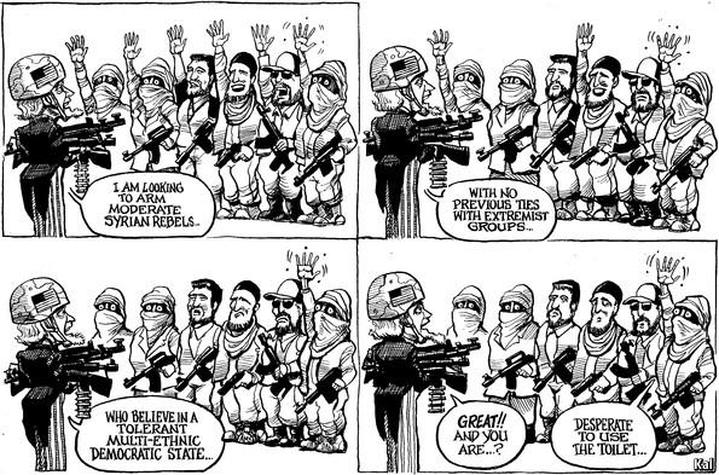
Today the US public opinion does not support the «hawks». For instance, the New York Times, offers its own view on the goals the United States should pursue in Syria. First, bring order to those parts of the country that the Islamic State does not control. Second, strive to build a coalition of forces that can contain the Islamic State. It comes to the conclusion that the Russia’s «intrusion» could offer a chance to achieve both. That is if the US mission is to fight terrorism in Syria, something many Americans have started to doubt.
Rasmussen Reports, a media company specializing in the collection, publication and distribution of public opinion information, conducted a survey of 1000 likely voters on October 4-5. 46% respondents said terrorists are winning over the US and its allies. Only 26% hold the opposite point of view. More voters than ever (during 11 years) think terrorists have the advantage over the United States and its allies.
Ralph Peters, a Fox News’ strategic analyst and an author, writes on the pages of the New York Post, that, «Never before has a US presidential administration combined such naked cowardice, intellectual arrogance and willful blindness. We don’t have a president – we have a scared child covering his eyes at a horror movie.» 
The events in Syria make Americans draw a comparison between the US and Russian leaders. It has become a hot topic in public discourse. Obviously, the comparison does not favor Obama. Republican presidential frontrunner Donald Trump highly appraised personal qualities of President Putin compared to the weakness demonstrated by the US President: «I will tell you that, in terms of leadership, he's getting an "A" and our president is not doing so well», he said. «They did not look good together», Trump added referring to their recent meeting at the United Nations General Assembly in New York.
Another Republican presidential racerunner Jeb Bush called Vladimir Putin an "agile adversary", who is exploiting a vacuum of US leadership in Syria. But it’s not what makes his statement stand out. The Republican candidate Bush said that if elected in 2016 he would seek to build a coalition of European and Arab partners to work for the ouster of Syrian President Bashar al-Assad. The world should wait till Republicans win the presidential election. But the GOP, as well, as the Democratic Party, is deeply split on Syria.
Even the supporters of Senator John McCain, who says«Putin must be stopped» before he «crushes out partners», don’t see eye to eye on the issue. For instance Meghan McCain, who is often called in the United States a rising star of GOP, has her own views on many problems which often do not coincide with the opinion of party leadership. She emphasized the fact that the Russian President acts while the US administration reacts. «When it comes to leadership. If you don't believe that Putin is now the world's leader, the national world reader – excuse me, international leader right now, he is acting, we are reacting», said  he daughter of the leading congressional advocate for confrontational approach toward Russia during the Democratic presidential preview on Fox channel. In a way, McCain shares the views of his daughter. «The administration warned Russia not to send its forces to Syria. Russia did it anyway. The administration then tried to block Russia’s access op airspace en route to Syria. It failed», says the Chairman of the Senate Committee on Armed Services to express his indignation.
McCain wants Washington to continue combat actions in Syria while exerting pressure on Russia. «However this conflict ends, it must not involve Putin shoring up his partners, crushing ours, destroying our remaining credibility in the Middle East, and restoring Russia as a major power in this vital region», he says.
The concern expressed by the US Senator is justified. He and the current US administration do not understand that in Syria Russia strives to do away with terrorism, put an end to bloodshed and reach a peaceful political settlement to the conflict preserving the prerogatives of legal government. Can the United States find arguments to substantiate objections?
Source: http://www.strategic-culture.org/news/2015/10/21/first-results-flawed-us-policy-syria.html

Sign Support Letter to Putin And Assad for Serious Anti-Terror Struggle

If you support Russian aviation in Syria, please, sign this, please http://dearputin.com/ 

Dear President Putin and Russian People

Dear President Putin,

As members of the global reality-based community, we’d like to extend our appreciation and support for the Russian Federation’s decision to provide humanitarian and military assistance to Syria, its armed forces and its democratically elected leader, President Bashar al-Assad, in their fight against international US-backed terrorists.
The launch of airstrikes directed against ISIL terrorists in Syria comes at a critical time,1 just as did Russia’s pivotal role in preventing a Western military intervention in 2013. As a voice of reason and a force for justice, you have the thanks and support of Syrians, Russians and all people of conscience around the world.
Since 2011, Western leaders have been determined to turn Syria into a failed state. They have gone to the extent of providing funding, training and weaponry to foreign mercenaries who have waged a brutal campaign of terror on the Syrian people and their legitimate government.2 These terrorist forces and religious fanatics do not represent the will of the Syrian people, the majority of whom support President Assad. As you said in your speech at the United Nations General Assembly, it is for the Syrian people and only the Syrian people to decide who should lead them.
In 2013, when the West was primed to launch a military campaign on Syria, Russia stepped in to broker a peaceful, diplomatic solution. In a sane world, this would be the natural response to international problems, and Russia would not stand alone. Unfortunately, the West continues its dead-end policy of supporting violence, coercion and illegal intervention in the affairs of sovereign nations.
While the West pushes for destabilization, war and chaos, Russia stands firm in its commitment to dialogue, cooperation, international law and order. Your reaction to the crisis in Syria demonstrates exactly that.
Like you, President Assad has proven himself to be a man of intelligence, courage and good will. And like most public figures who possess such qualities, he has been relentlessly defamed and slandered by Western governments and media. One example is the Houla massacre in May 2012, in which 108 Syrians were killed, including 49 children. The Syrian military was blamed for this atrocity but it was later revealed that the massacre was perpetrated by forces aligned with the US-backed ‘Free Syrian Army’ (FSA), and that the victims were supporters of the Syrian government.3 Later in 2012, the FSA was observed killing kidnapped civilians and off-duty soldiers.4
This is the ‘moderate opposition’ group that Western government officials support in their illegal aggression against Mr. Assad, and whom they now accuse Russia of targeting with airstrikes. These facts and others show clearly that the US government and its allies merely profess to fight terror when in fact they directly create and support it in a futile attempt to secure US global hegemony. They do this without the support of the United Nations and without the support of the legitimate governments of the countries they attack.
The second Secretary-General of the United Nations, Dag Hammarskjold, whom John F. Kennedy considered the greatest statesman of his time, clearly saw the problems facing not only the UN, but the world at large. In 1958 he wrote:
“The conflict to different approaches to the liberty of man and mind or between different views of human dignity and the right of the individual is continuous. The dividing line goes within ourselves, within our own peoples, and also within other nations. It does not coincide with any political or geographical boundaries. The ultimate fight is one between the human and the subhuman. We are on dangerous ground if we believe that any individual, any nation, or any ideology has a monopoly on rightness, liberty, and human dignity.”5
We are on dangerous ground. The United States’ self-professed monopoly on rightness, liberty, and human dignity has led to wrongness, oppression and suffering on a massive scale. The Western mentality on display in Libya and Syria is truly subhuman6 — psychopathic7 — embracing the basest aspects of human nature.8
Naturally, the subhuman is reflected in the results of U.S. policy in Ukraine and Syria. In Ukraine, neo-Nazis are members of Parliament and form battalions which have tortured and murdered men, women and children in the Donbass, with the sanction of the government in Kiev. In Syria, the West’s policy of destruction and the support of terrorism have resulted in ISIL and other terror groups whose methods are publicly condemned but privately supported by Western leaders.9 This is not the vision humanity is desperate to embrace. This is not the vision we seek.
As long as world leaders continue to submit to the will of political psychopaths, humanity will never build a world of peace.10 We pray that more people will follow your example, by speaking truth to power, by acting firmly on their convictions and by refusing to be controlled by fear and ignorance. We hope that by doing so, we may all do our part to create a truly multipolar world free from the destructive influence of psychopaths and fanatics, and the toxic political structures they create that make peace impossible.
Sincerely,
  • Татьяна Мирзаева - Russia
  • Owtschinnikow Katharina - Germany
  • Manfred Meyer - Germany
  • Marco Kulhanek - Germany
  • Eduard Wagner - Germany
  • sotiris koulafa - Cyprus
  • Alexander Scurtu - Israel
  • K. Oliver Sprenger - Germany
  • Виталий Егоров - Russia
  • Eberhard Gollnick - Germany
  • Владислав Антонов - Russia
  • Хыдыр Мирзаев - Russia
  • Татьяна Сексяева - Russia
  • Siegfried Braunstein - Austria
  • Raik Schulz - Germany
  • Михаил Коршунов - Russia
  • Udo Wagner - Germany
  • Галина Шафранова - Russia
  • Hermann Kiesel - Germany
  • Александр Борисов - Lithuania
  • Klaus Marcinkowski - Germany
  • Georg Oehlerking - Germany
  • Lesław Kubisz - Poland
  • Lutz Boettger - Germany
  • Галина Маринова - Russia
If you support Russian aviation in Syria, please, sign this, please

Dear President Putin and Russian People

http://dearputin.com/ 
I fully support the Russian intervention and support to the people of Syria. The arguments expressed below are striking. Fighting  terrorism in Syria full heartedly and with all available means is in our interest, too and will eventually stop and even reverse the influx of refugees. I have signed and encourage everybody to express his or her gratitude towards Russia and Syria. In solidarity Irene Eckerthttp://dearputin.com

Dear President Putin and Russian People

http://dearputin.com/ 

Assad Moscow visit: Syria leader in surprise visit

News | 21.10.2015 | 11:04
BBC - Syria's President Bashar al-Assad has held talks with Russian President Vladimir Putin on an unannounced visit to Moscow.
Russian presidential spokesman Dmitry Peskov said Mr Assad "came on a working visit to Moscow" on Tuesday evening and held talks with Mr Putin.
Russia began air strikes in Syria at the end of last month.
Moscow says it is targeting Islamic State and other militant groups fighting Mr Assad's government.
Mr Peskov told reporters that the two leaders had discussed the fight against what he called terrorist groups, the continuation of Russian air strikes and Syria's plans for its troops.
It was the first overseas visit made by Mr Assad since the civil war broke out in Syria in 2011, Syrian state TV reports.


US Caught Faking It in Syria

Posted By Thomas S. Harrington On October 12, 2015 @ 2:00 am In articles 2015,Leading Article 
syrian-civil-war-3-years-146000-dead-and-no-end-in-sight
The great danger of faking your ability to do something in the public square is that someone with an actual desire to the job you are pretending to do might come along and show you up.
This is what has just happened to the US in Syria with the entrance of Russia into the fight against ISIL.
And as is generally the case with posers caught with their pants down, the US policy elites are not happy about it.
You see, the US strategic goal in Syria is not as your faithful mainstream media servants (led by that redoubtable channeler of Neo-Con smokescreens at the NYT Michael Gordon) might have you believe  to  save the Syrian people from the ravages of the long-standing Assad dictatorship, but rather to heighten the level of internecine conflict in that country to the point where it will not be able to serve as a bulwark against Israeli regional hegemony for at least another generation.
How do we know? Because important protagonists in the Israelo-American policy planning elite have advertised the fact with a surprising degree of clarity in documents and public statements issued over the last several decades.
The key here is learning to listen to what our cultural training has not prepared us to hear.
In 1982, as the Likud Party (which is to say, the institutional incarnation of the Revisionist Zionist belief, first articulated by Jabotinsky in the ”Iron Wall”  that the only way to deal with “the Arabs” in and around Israel was through unrelenting force and the inducement of cultural fragmentation) was consolidating its hold on the foreign policy establishment of Israel, a journalist named Oded Yinon, who had formerly worked at the Israeli Foreign Ministry,  published an article in which he outlined the strategic approach his country needed to take in the coming years.
What follows are some excerpts from Israel Shahak’s English translation of that text:
“Lebanon’s total dissolution into five provinces serves as a precedent for the entire Arab world including Egypt, Syria, Iraq and the Arabian Peninsula and is already following that track. The dissolution of Syria and Iraq later on into ethnically or religiously unique areas such as in Lebanon, is Israel’s primary target on the Eastern front in the long run, while the dissolution of the military power of those states serves as the primary short term target. Syria will fall apart, in accordance with its ethnic and religious structure, into several states such as in present day Lebanon….”
“Iraq, rich in oil on the one hand and internally torn on the other, is guaranteed as a candidate for Israel’s targets. Its dissolution is even more important for us than that of Syria. Iraq is stronger than Syria. In the short run it is Iraqi power which constitutes the greatest threat to Israel. An Iraqi-Iranian war will tear Iraq apart and cause its downfall at home even before it is able to organize a struggle on a wide front against us. Every kind of inter-Arab confrontation will assist us in the short run and will shorten the way to the more important aim of breaking up Iraq into denominations as in Syria and in Lebanon. In Iraq, a division into provinces along ethnic/religious lines as in Syria during Ottoman times is possible. So, three (or more) states will exist around the three major cities: Basra, Baghdad and Mosul, and Shi’ite areas in the south will separate from the Sunni and Kurdish north.”
“If Egypt falls apart, countries like Libya, Sudan, or even the more distant states will not continue to exist in their present form and will join the downfall and dissolution of Egypt.
“There is no chance that Jordan will continue to exist in its present structure for a long time, and Israel’s policy, both in war and in peace, ought to be directed at the liquidation of Jordan under the present regime and the transfer of power to the Palestinian majority.”
Yinon’s vision reappeared in the now infamous “Clean Break” document from 1996, authored by a consortium of US and Israeli “strategic thinkers” that included Richard Perle, Douglas Feith and David and Meyrav Wurmser, which was meant to serve as a foreign policy blueprint for the first administration  of Benjamin Netanyahu.
The text is nothing if not obsessive regarding the need to seriously debilitate Syria’s ability to act in any way is a pole of regional influence in the in the area .
“Israel can shape its strategic environment, in cooperation with Turkey and Jordan, by weakening, containing, and even rolling back Syria. This effort can focus on removing Saddam Hussein from power in Iraq – an important Israeli strategic objective in its own right – as a means of foiling Syria’s regional ambitions.”
“Most important, it is understandable that Israel has an interest supporting diplomatically, militarily and operationally Turkey’s and Jordan’s actions against Syria, such as securing tribal alliances with Arab tribes that cross into Syrian territory and are hostile to the Syrian ruling elite.”
And as Dan Sanchez has recently shown, David Wurmser went into even greater detail about the need to balkanize Israel’s northeastern neighbor in articles published in approximately the same time period, talking quite openly in one essay about “expediting the chaotic collapse“ of Baathist Syria.
Then there is Wesley Clark’s famous interview, given in 2007, in which he revealed the true strategic aims of those running US foreign policy in the wake of the September 11th attacks.  In it, he tells of a conversation he had at that time with a Pentagon official who admitted that the real plan was “to attack and destroy the governments in seven countries in five years”.
Those countries, according to Clark, were: Iraq, Syria, Lebanon, Libya, Somalia, Sudan, and Iraq. In the same speech, he explicitly ties the hatching of the plan to Richard Perle, head of the cadre of people who wrote in the “Clean Break” document of the paramount importance of putting Israel in position to “shape its strategic environment”.
On September 5th, 2013, Alon Pinkas, the former Israeli Consul General in New York and well-connected member of Tel Aviv’s conservative policy elite described the Syrian conflict in the following terms in the New York Times:
“This is a playoff situation in which you need both teams to lose, but at least you don’t want one to win – we’ll settle for a tie,….Let them both bleed, hemorrhage to death: that’s the strategic thinking here. As long as this lingers, there’s no real threat from Syria.”
I don’t think it can get much clearer than that. The US-Israeli plan in Syria has never been about helping anyone in that country, but rather insuring its effective dismemberment so as to further the perceived “strategic interests” of the Jewish state.
As Tomás Alcoverro, the longtime Mideast correspondent of Barcelona’s La Vanguardia newspaper wrote on 9 October 2015, in reference to the combined Russian and Syrian government attacks carried out during the previous week: “If this joint offensive is successful, the US plan for continuing the war of attrition until both sides are exhausted will lie in ruins”.
Yes, the US and Israelis, have been “faking it” in Syria for a good long time now.  And Putin has come along and called their bluff.
And they are not happy about it.   Which is why the ongoing campaign of demonization against the Russian leader is being ratcheted up – if that’s possible – to still higher levels of intelligence-insulting hyperbole.

Tuesday, October 20, 2015

Das US-Imperium ist ein „Imperium der Illusionen“ geworden Der Saker

18.11. 2014

Ein Kommentar von The Saker (1)
Es ist bizarr. Die zwei jüngsten Gipfel (APEC und G20) sind, würde ich meinen, mit einer Katastrophe für die USA und ihre Alliierten zu Ende gegangen, während Russland, China und der Rest der BRICS-Länder die Situation unter Kontrolle haben. Dennoch gibt es Leute, die den westlichen Mainstreammedien (MSM) glauben, die Russlands Putin als „schwach“ darstellen.
Ich nehme an, in unserem Zeitalter der virtuellen Realitätswahrnehmung ist alles, und in diesem Fall diese Auffassung, deutlich geformt vermittels der Brainwashing-Künste der MSM, die wahrlich bewundernswert sind. Aber schauen wir die Fakten an.
Die eine größte Entwicklung, die sich auf diesen Gipfeln zeigte, ist, dass Xi Jinping ganz eindeutig und zum ersten Mal offen bewiesen hat, dass er Putin und Russland voll unterstützt.
Ich erinnere mich, dass es früher in diesem Jahr viele gab, die an der Politik Chinas gegenüber Russland zweifelten, und sagten, dass der „Walmart-Effekt“ (der Umfang der ökonomischen Bande zwischen US und China) es China niemals erlauben würde, an die Seite Russlands gegen die USA zu treten, und dennoch ist genau dies auf mindestens drei Ebenen geschehen:
1. Ökonomisch: Nicht nur haben Russland und China Mega-Verträge (anders kann man das nicht nennen) unterzeichnet, sondern China war auch mehr als glücklich, den russischen Banken (die unter den US/EU-Sanktionen stehen) Zugang zu chinesischen Krediten zu geben. China hilft Russland auch, SWIFT zu ersetzen.
2. Politisch: Wenn irgendetwas, dann scheuten die Chinesen keine Mühe zu zeigen, dass Russland nicht nur nicht isoliert ist, sondern dass Putin der Ehrengast bei der APEC war – womit die US/EU offen herausgefordert wurde.
3. Militärisch: Russland und China führen jetzt reguläre sehr große Militär-Übungen zu Wasser und zu Lande durch. Sie üben nicht nur zusammen, sondern sie praktizieren auch regelmäßig die Schaffung eines gemeinsamen Oberkommandos.
Dies hätte für niemanden eine Überraschung sein müssen: China und Russland sind wahrhaft „ideale“ Partner, die sich perfekt ergänzen. Was der eine braucht, hat der andere und umgekehrt. Nicht nur das, sondern beide wurden – und werden – von den USA derart schikaniert, dass ich behaupten würde, das Imperium treibe beide geradezu einander in die Arme. Obama hat wiederholt und offen sowohl Russland als auch China gedroht, hat ihnen alle Arten von Ultimaten geschickt, versuchte, gegen sie Koalitionen zu schmieden und hat natürlich beide mit Militärbasen und Anti-Raketen-Systemen umgeben.
Was Obama und seinen Beratern entgangen ist, ist dies: Russland und China – unterstützt von den BRICS-Staaten, der Shanghaier Organisation für Zusammenarbeit, der Organisation des Vertrags über kollektive Sicherheit und der Eurasischen Wirtschaftsunion (2) – sind weit mächtiger als der US/EU-Block in politischer, ökonomischer und militärischer Hinsicht. Das ist die große Neuigkeit, die wichtige strategische Entwicklung, die geopolitische tektonische Verschiebung, was die MSM des Imperiums verzweifelt versuchen zu verschleiern. Was die westlichen Führer angeht, so sind sie schlicht im Wahn und sind offenbar in die alte Falle getappt, ihrer eigenen Propaganda zu glauben. Aber, wie es in dem Ausdruck heißt, „wenn dein Kopf im Sand steckt, ist der Arsch in der Luft“, und die Realität hat dies erneut bewahrheitet mit einem kräftigen und schmerzhaften Tritt.
Der lächerlichste Moment auf dem Gipfel vergangener Woche kam, als Obama, nachdem ihm keins seiner Ziele gegen Russland und China geglückt war, eine Rede hielt, in der er im Ernst von der Bedeutung der „amerikanischen Führung“ sprach. Es war komisch bis hin zur Peinlichkeit. Im russischen Fernsehen haben Kommentaren echt gelacht, als sie dies berichteten.
Was Putin betrifft, offenbar sicher seiner Stellung, so machte er sich lustig über die Idiotie der US/EU-Führer: „Haben sie überhaupt darüber nachgedacht, was sie tun oder nicht? Oder hat die Politik sie blind gemacht? Wie wir wissen, sind die Augen ein peripherer Bestandteil des Gehirns. Ist irgendetwas in ihren Gehirnen abgestellt worden?“ Verbunden mit einer jetzt offenen Warnung, dass Russland der US/EU keinesfalls erlauben wird, den Widerstand in Noworossija zu zerschlagen. Putins Botschaft ist unverblümt und klar: die westlichen Führer fahren ihr Imperium gegen die Wand.
Das US-Imperium ist wahrlich ein „Imperium der Illusionen“ geworden, um den Ausdruck von Chris Hedges zu benutzen (3), wo Fakten viel weniger bedeuten als Meinugnsmache, wo der normale Weg des Umgangs mit Herausforderungen in Leugnung ihrer Existenz verwandelt wird, wo Selbsttäuschung ein way of life ist.
Die Schrift steht an der Wand. Sie steht dort bereits recht lange.
Das Problem ist, dass sie niemand lesen will.


Interview von Präsident Wladimir Putin mit ARD-Reporter Hubert Seipel am 13. November 2014 – Quelle: The Presidential Press and Information Office, kremlin.ru/video/2753
Wenn Sie es noch nicht getan haben, dann sollten Sie jetzt das jüngste ARD-Interview mit Putin lesen und analysieren (4). 
DER SCHLÜSSELSATZ IM ARD-INTERVIEW MIT PUTIN
„Heute gibt es Kampfhandlungen im Osten der Ukraine, die ukrainische Regierung hat die Armee eingesetzt. Es kommen sogar ballistische Geschoße (5) zum Einsatz, aber wird es erwähnt? Mit keinem Wort. Was bedeutet das? Was heißt das? Das heißt, dass sie wollen, dass die ukrainische Regierung dort alle vernichtet, sämtliche politischen Gegner und Widersacher. Wollen Sie das? Wir wollen das nicht. Und wir werden dies nicht erlauben.“ (6)
Dies ist eine sehr kategorische Erklärung, die warnt, dass Russland vorausschauend ein solches Ereignis verhüten wird.
Russland wird es nicht erlauben, dass Noworossija von der ukrainischen Junta und ihren Helfeshelfern überrannt wird.
__________
(1) vineyardsaker.blogspot.se/2014/11/the-anglozionist-empire-has-truly.html ; www.vineyardsaker.de/saker-auf-deutsch/das-anglozionistische-imperium-ist-wahrlich-ein-imperium-der-illusionen-geworden/
(2) de.wikipedia.org/wiki/BRICS-Staaten; de.wikipedia.org/wiki/Shanghaier_Organisation_für_Zusammenarbeit; de.wikipedia.org/wiki/Organisation_des_Vertrags_über_kollektive_Sicherheit; de.wikipedia.org/wiki/Eurasische_Wirtschaftsunion
(3) Chris Hedges: Empire of Illusion: The End of Literacy and the Triumph of Spectacle; www.amazon.com/Empire-Illusion-Literacy-Triumph-Spectacle/dp/1568586132
(4) kremlin.ru/video/2753, eng.kremlin.ru/news/23253
(5) Gemeint sind Lenkwaffen; in der in deutschen Medien verbreiteten Übersetzung des Textes heißt es hingegen ungenau „Raketengeschoße“. Wir folgen hier dem russischen Original bzw. der amtlichen englischen Übersetzung.
(6) In der deutschen Übersetzung etwas lasch: „Und wir lassen es nicht zu.“

Ähnliche Themen:

Geostrategische Umwälzung Russlands Intervention gegen den »Islamischen Staat« weist die USA in die Schranken.

 Moskau festigt Bündnis zwischen Iran, Syrien und Libanon Von Rainer Rupp


Aus außenpolitischer Perspektive gibt es kaum einen größeren Erfolg, als vor den Augen der Weltöffentlichkeit die unglaublichen Fehler, die bodenlose Inkompetenz, die hartnäckige Resistenz gegen jegliche Vernunft und nicht zuletzt die scheinheilige Verantwortungslosigkeit seiner Gegner vorzuführen und daraus zugleich einen geostrategischen Vorteil zu ziehen, der einem Paradigmenwechsel gleichkommt. Die USA und ihre westlichen Verbündeten, zusammen mit Saudi Arabien und Katar haben in Syrien und der Region all »diese Fehler mit schrecklichen Ergebnissen gemacht, mit Hunderttausenden Toten und Millionen Flüchtlingen«, urteilte am Wochenende Zero Hedge, das in den USA bekannte Internetportal für Finanzanalysen. Daher sollte einem »vergeben werden, wenn man sich angesichts der jüngsten Entwicklungen ein bisschen in die Russen verliebt«, hieß es dort weiter. Denn in einem »außergewöhnlich eleganten, geopolitischen Schachzug« habe Russlands Präsident Wladimir Putin erstens die wahren Absichten der USA entlarvt, und damit auch, warum sie an einer Eliminierung des »Islamischen Staats« nicht interessiert sind. Zweitens markiere seine Politik eine triumphale Rückkehr Russlands auf die Weltbühne. Drittens habe Putin dadurch seine Beziehungen zu Teheran verstärkt – das zu einem Zeitpunkt, da Iran wieder seinen Platz als bedeutender Faktor in der Weltenergiewirtschaft einnimmt. Und viertens schließlich habe Putin sehr effektiv dem syrischen Präsidenten Baschar Al-Assad den Rücken gestärkt und zugleich eine bedeutende russische Präsenz im Nahen Osten wiederhergestellt. »Und das alles im Zeitraum von nur drei Wochen«, konstatierte Zero Hedge mit unverhohlener Bewunderung. Die findet man derzeit auch bei anderen Analytikern im englischsprachigen Raum – nicht selten gepaart mit Häme für die Obama-Administration und die US-Falken. Das geht aufrechten Hurra-Patrioten wie dem Chefnachrichtensprecher von CNN, Fareed Zakaria, offensichtlich zu weit. Am Sonntag ist er in einem Meinungsartikel in der Washington Post unter dem Titel: »Hört mit dem Schwärmen für Putin auf!« mit all jenen ins Gericht gegangen, die die »Entschlossenheit« des russischen Präsidenten bewundern, die ihn im Nahen Osten »in den Fahrersitz« katapultiert hat. (rwr)
Hat der russische Präsident Wladimir Putin mit seiner Rede am 28. September in New York anlässlich des 70. Jahrestags der Gründung der Vereinten Nationen den Anfang vom Ende der US-Hegemonie eingeleitet? Dieser Meinung ist zumindest Paul Craig Roberts, ehemaliger Staatssekretär unter US-Präsident Ronald Reagan (1981–1989). Und damit steht er nicht allein. Auf der ganzen Welt freuen sich Kommentatoren darüber, dass endlich jemand die scheinheiligen USA auf der Weltbühne in die Schranken gewiesen hat. In den vergangenen Jahrzehnten hatte Washington immer ungezügelter und willkürlicher seine Macht ausgenutzt, um anderen Ländern, die sich nicht fügen wollten, zu schaden oder sie einzuschüchtern. Widerstand gegen den US-Willen brachte rasche Vergeltung. Im Nahen Osten und in Afrika bedeutete das wirtschaftliche Sanktionen und militärische Invasionen, die ganze Länder zerstörten.

Schon wenige Tage nach seinem wegweisenden Appell zur Respektierung des Völkerrechts und der nationalen Souveränität der Staaten, des Rechts auf eigene Entwicklung und der klaren Ansage, dass Russland keine weiteren von westlichen Sponsoren angeleitete »Farbenrevolutionen« mehr dulden wird, hat Putin in Syrien seinen Worten Taten folgen lassen: in politischer und militärischer Zusammenarbeit mit der rechtmäßigen Regierung in Damaskus und deren regulärer Armee sowie deren verbündeten Milizen, wie z.B. der im Häuserkampf erfahrenen libanesischen Hisbollah und mit irakischen und iranischen Truppen. Die Präzision und Wirkung der russischen Luftangriffe auf schwer befestigte Positionen des »Islamischen Staats« (IS), den syrischen Al-Qaida-Ableger Al-Nusra-Front und andere, vom Westen offen unterstützte »moderate« Terrorgruppen, die Koordination von Luft- und Bodenangriffen und das reibungslose Zusammenspiel bei den gemeinsamen Operationen zur Befreiung der von Aufständischen unterschiedlichster Couleur besetzten und ausgeplünderten Gebiete hat alle verblüfft.
Noch bevor die eigentliche Bodenoffensive der syrischen Regierungsarmee und der verbündeten Kräfte begonnen hatte, erreichten drei Tage andauernde Angriffe der russischen Luftwaffe offensichtlich mehr gegen IS und Al-Qaida, als die mächtige U.S. Air Force in über einem Jahr geschafft hatte. Teilweise in chaotischer Auflösung flohen die IS- und Al-Qaida-Angehörigen zu Hunderten aus ihren Festungen.

Der »Kaiser in Washington« war mit einem Mal nackt vor den Augen der Welt. Schließlich hatten die USA dem »Islamischen Staat« zum Nimbus der Unbesiegbarkeit verholfen, weil es, so sah es aus, selbst der schier allmächtigen Luftwaffe im Laufe von 13 Monaten nicht gelungen war, dessen Vormarsch zu stoppen. Nicht nur im Irak wurde nach dem durchschlagenden Erfolg der Russen die Frage gestellt, ob die USA überhaupt ernsthaft gegen die Terrormiliz vorgehen wollten?
Bezeichnend ist die Reaktion im Westen. Wegen der überzeugenden Resultate der russischen Luftwaffe und der koordinierten Bodenoffensive der syrischen Armee und ihrer Verbündeten sehen die USA, Frankreich, Großbritannien, die Türkei, Saudi-Arabien und Katar den syrischen Präsidenten Baschar Al-Assad, mit dessen Ende sie schon fest gerechnet hatten, wieder gestärkt. Wütend heulen sie, Russland bombardiere ihre gemäßigten Terroristen und drohten Moskau alle möglichen Konsequenzen an. Zu deren Vollzug sind sie jedoch kaum in der Lage, wenn sie nicht noch größere Risiken eingehen wollen.
Durch die politisch-militärische Kooperation zwischen Iran und Russland, die übrigens auch von China politisch unterstützt wird, ist das Fundament für ein feste Verbindung von Teheran über Bagdad und Damaskus bis zu Beirut gelegt worden. Die geostrategischen Karten im Nahen Osten sind dadurch neu verteilt worden. Iran ist auf dem besten Weg, Saudi-Arabien als tonangebende Regionalmacht zu verdrängen. Zugleich ist Russlands Stern im Aufstieg begriffen, im Nahen Osten und darüber hinaus, während das Ansehen der USA immer mehr schwindet. Washington bleibt entweder, sich noch stärker und offener an der Seite der Terroristen einzusetzen und damit einen Krieg mit Russland zu riskieren, den die Obama-Administration jedoch nicht will. Oder die USA retten ihr Gesicht und bekämpfen an der Seite Russlands, Irans und Syriens den IS und Co.
Quelle:https://www.jungewelt.de/2015/10-20/008.php us: Ausgabe vom 20.10.2015, Seite 3 / 

Russia’s Actions Spell Hope For Turning Point in War on Terror

Russians in Syria: Goals Determined, Objectives Set

Yuriy RUBTSOV | 20.10.2015 | 00:00

Russia’s active intervention into the events in Syria has given rise to all manner of speculation about both the reasons behind it as well as Moscow’s goals. During the first days of the attacks by Russia’s Aerospace Defense Forces and Navy on Islamic State (IS) positions inside Syria, it seems as though the political commentators hashed over everything – from Moscow’s desire to prop up the regime of the Middle East’s «last dictator» – Bashar al-Assad – to Russia’s use of Syria as a test site for their latest weaponry.
Speak on the CBS program 60 Minutes, Barack Obama tried to convince his listeners that «Mr. Putin now is devoting  –  his own troops, his own military [into Syria - YU. R.], just to barely hold together by a thread his sole ally». Which, according to Obama, is evidence of the Russian president’s weakness.
However, no matter what Obama has said about this alleged «weakness», once the first Russian barrages began, his administration shut down the Pentagon’s $500-million program to train and arm the «moderate» Syrian opposition. It became clear that once Russian airmen and sailors joined the fight against IS, any further money spent supporting the armed Syrian opposition would only be squandered.
Russian President Vladimir Putin quieted all speculation about the purpose of Russia’s intervention into the events in Syria during an Oct. 11 interview with the journalist Vladimir Solovyov. «Our task... is to stabilize the legitimate government and to create a conducive environment for political compromise», he stated.
In the first place, Russia’s actions in Syria are in full compliance with international law and are being taken at the official request of the Syrian government – unlike all the other countries that are interfering in Syrian affairs without any legal basis. Second, Russia’s actions are based on the premise that Syria’s ultimate fate should be up to the Syrian people and not Western powers that have appropriated the right to determine the nature of Syria’s political regime. Third, the Western coalition’s fight against the Islamic State terrorist organization has thus far been nothing but a sham, which is unacceptable.
«Everything that is taking place [in Syria – YU. R.] in the air or on the ground is not spontaneous action, but the implementation of plans prepared in advance», claimed Vladimir Putin. «We did a lot of close, long-term intelligence gathering from space and from the air, and then we analysed all of the information obtained through various channels. Our General Staff specialists, working in coordination with our Syrian partners and other countries in the region have established an information centre in Baghdad, as you know. The data exchanged through this centre has added to our overall information».
For several years Russia has urged the West to face the truth and admit that the so-called «Arab Spring» has led to bloody chaos, death, and has forced hundreds of thousands of people to flee their homes, as well as contributing to the rise in terrorism under the banner of Islam and an unprecedented escalation in interethnic and interreligious conflicts. And the emergence of the Islamic State has been the cherry on top of the Arab Spring. Given this backdrop, Syria, led by President Assad, is a lone island in a region where a difficult and intransigent war is being waged against an international terrorist movement. Assad’s removal would potentially give terrorists the upper hand in the Middle East, allowing them to fan out to every corner of the globe, from Europe to China. Supporting Assad means rooting out this nest of terror.
During the UN General Assembly in New York, Vladimir Putin seems to have managed to confound Barack Obama’s insistence that the Syrian leader should immediately withdraw from the political arena. However, the US and its allies are proving unable to take the next step recommended by Putin – «to join our efforts and thereby legitimize their own actions in Syria».
Fortunately the US military understands the danger of inadvertently taking a course of action directly at odds with Russia’s, and so in order to avoid misunderstandings, operational contacts have been set up between the two countries’ defense departments.
Turkey is still working to weaken the current anti-terror coalition consisting of Russia, Syria, Iran, and Iraq by launching air strikes on the Kurdish armed forces that are fighting against IS. And it’s true that the actions of the Russian Aerospace Defense Forces have objectively limited the scope of the Turkish and American air operations.
According to Yaakov Kedmi, the former head of the Israeli intelligence agency Nativ, a Syrian army that is on the offensive will be able to accomplish a key objective of the first phase of the confrontation – to regain control of the Syrian-Turkish border, which will make it possible to halt the influx of weapons and manpower from Turkey intended for the terrorists. It will be far easier to defeat those who remain, if they are not getting reinforcements of new combatants. «And then the anti-ISIL operation will begin moving toward Iraq», suggests Mr Kedmi. «There’s a good reason Russia’s coordination center was established there in Baghdad».
As we see, some of the Iraqi politicians are already making the suggestion that the Russian Aerospace Defense Forces should be invited to attack IS headquarters, strongholds, and warehouses located inside Iraq itself.
Russia’s actions in Syria could do more than just radically alter the course of the war on terror. They are bringing Moscow back to the region where for decades its voice was not only influential, but at times critically important (the 1956 Arab-Israeli conflict springs to mind, as one example).
The mission Russia has undertaken to stand up to IS has manifestly polarized the global community. There are a growing number of countries that see that Russia’s actions could spell hope for a turning point in the fight against international terrorism. And the opponents of Moscow’s policy are becoming quite visible as well. We «will not agree to cooperate with Russia so long as they continue to pursue this mistaken strategy», stated US Secretary of Defense Ashton Carter on Oct. 7. That is understandable: after all, Russia’s dynamic moves to battle IS are dooming all attempts to isolate it internationally as the West is trying to do, as retaliation for Crimea and the Donbass.
Source: http://www.strategic-culture.org/news/2015/10/20/russians-syria-goals-determined-objectives-set.html