Friday, December 21, 2018


Trump’s bold geopolitical pivot, will the Deep State retaliate?

The Duran Quick Take: Episode 44.
Alex Christoforou
Published
 
on
 
479 Views

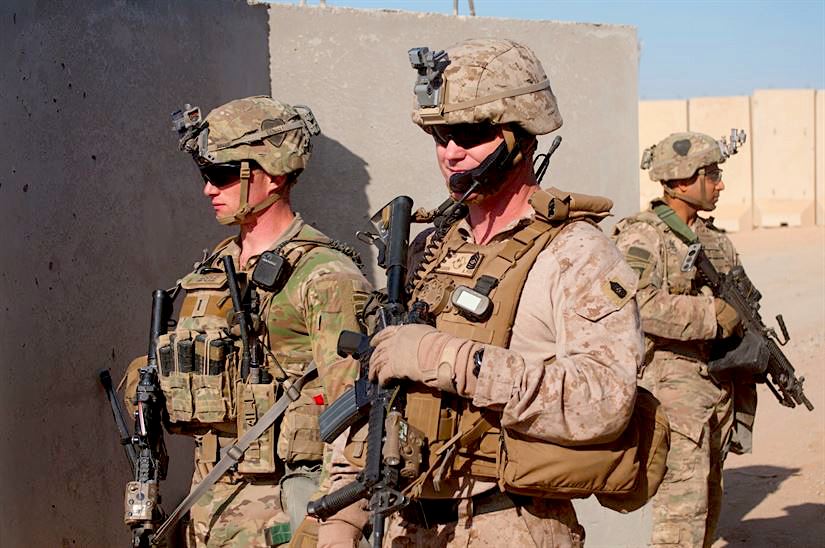
The Duran’s Alex Christoforou and former U.S. Army Special Operations Officer and global psychological warfare counter-terrorism analyst Scott Bennett take a quick look at US President Donald Trump decision to disengage from Syria and bring American troops home. Does this mark a major turning point and pivot away from years of a failed and disastrous US foreign policy dogma in the Middle East that has left the region in ruins.
How will the Deep State and neocon warmongers react and retaliate to US President Trump’s decision to deliver what he promised during his presidential campaign…an end to the military industrial complex wars.
Meanwhile, Trump continues a bold US military disengagement in never ending, bullshit wars started by Bush and Obama. Zerohedge that US President Trump has ordered a major Afghan drawdown with 7,000 troops set to return to the US in the coming weeks…

CNN warns “officials brace for Trump announcement on Afghanistan” after Trump’s Wednesday bombshell Syria troop pullout announcement. He’s now initiated “a major drawdown” of forces in Afghanistan too, and while inside the beltway neocon heads might continue to explode, the broader public for which the seventeen year long Afghan war is deeply unpopular will no doubt cheer the move. And already NBC reports Thursday evening based on defense sources the White House has asked the Pentagon to draw up plans presenting “multiple options” including a “complete withdrawal”. Following the “options” order it now appears Trump has pulled the trigger and “ordered the start of a reduction of American forces in Afghanistan” according to a breaking WSJ report:
More than 7,000 American troops will begin to return home from Afghanistan in the coming weeks, a U.S. official said. The move will come as the first stage of a phased drawdown and the start of a conclusion to the 17-year war that officials say could take at least many months. There now are more than 14,000 U.S. troops in Afghanistan.
Further the WSJ reports it marks “the start of a total pullout that could take at least many months.”
The major reduction of U.S. troops in the country will begin as soon as within several weeks, according to sources cited in The Wall Street Journal. Currently there are about 14,000 troops in Afghanistan in continuation of a NATO advise, train and assist mission as part of the longest running war in United States history.
Trump reportedly stoked “anger and confusion” among some lawmakers and Pentagon officials over his Syria pullout decision; however, he appears to be sticking to his prior “bring the troops home” promises made on the campaign trail in 2016. In a series of Tweets, the president defended the 180 degree shift in Syria policy, which as of only less than a week ago was was expressed by US special envoy for Syria, Ambassador James Jeffrey, as “countering Iran”.
In a Thursday Tweet that could have just as well been about Afghanistan, Trump stated: “So hard to believe that Lindsey Graham would be against saving soldier lives & billions of $$$.” And added, “Time to focus on our Country & bring our youth back home where they belong!”

Meanwhile it shouldn’t be forgotten that even the generals responsible for executing the Afghan war have been critics of late, including the commander of NATO’s Resolute Support Mission and U.S. Forces in Afghanistan.
Speaking to NBC News in early November, Gen. Austin Scott Miller made deeply pessimistic public statements after taking charge of American operations, and shocked with his frank assessment that that the Afghan war cannot be won militarily and peace will only be achieved through direct engagement and negotiations with the Taliban — the very terror group which US forces sought to defeat when it first invaded in 2001. “This is not going to be won militarily,” Gen. Miller said. “This is going to a political solution.”
He explained further to NBC at the time:
My assessment is the Taliban also realizes they cannot win militarily. So if you realize you can’t win militarily at some point, fighting is just, people start asking why. So you do not necessarily wait us out, but I think now is the time to start working through the political piece of this conflict.
So it appears Trump is actually heeding his general’s assessment in ordering the significant drawdown.
Currently the State Department is conducting on-again off-again shaky negotiations (since last summer) with Taliban officials with the help of intermediary countries Pakistan and Qatar.
The United States has spent well over $840 billion fighting the Taliban insurgency while also paying for relief and reconstruction in an “endless war” that has become more expensive, in current dollars, than the Marshall Plan, which was the reconstruction effort to rebuild Europe after World War II.

Don’t Hold Your Breath on US Troop Withdrawal from Syria


Merken
It would be nice to think the president has final say on foreign policy, given the U.S. Constitution. But the misleading troop withdrawal announcement, followed by Trump’s boastful tweet, suggests the exact opposite, says Patrick Lawrence.
By Patrick LawrenceSpecial to Consortium News
The announcement on Wednesday that the U.S. will withdraw all remaining troops from Syria within the next month looked at first like a rare victory for Donald Trump in his admittedly erratic opposition to senseless wars of adventure. “We have defeated ISIS in Syria, my only reason for being there,” the president tweeted with an unmistakable air of triumph.
Don’t get your hopes up. Just about everything in these initial reports is either wrong or misleading. One, the U.S. did not defeat the Islamic State: The Syrian Arab Army, aided by Russia, Iran, and Hezbollah militias did. Two, hardly was ISIS the only reason the U.S. has maintained a presence in Syria. The intent for years was to support a coup against the Assad government in Damascus—in part by training and equipping jihadists often allied with ISIS. For at least the past six months, the U.S. military’s intent in Syria has been to counter Iranian influence. 
Last and hardly least, the U.S. is not closing down its military presence in Syria. It is digging in for an indefinite period, making Raqqa the equivalent of the Green Zone in Baghdad. By the official count, there are 503 U.S. troops stationed in the Islamic State’s former capital. Unofficially, according to The Washington Post and other press reports, the figure is closer to 4,000—twice the number that is supposed to represent a “full withdrawal” from Syrian soil. 
It would be nice to think Washington has at last accepted defeat in Syria, given it is preposterous to pretend otherwise any longer. Damascus is now well into its consolidation phase. Russia, Iran, and Turkey are currently working with Staffan de Mistura, the UN’s special envoy for Syria, to form a committee in January to begin drafting a new Syrian constitution.

U.S. forces conducted a precision airstrike near Sarmada in northwest Syria Nov. 18 that Pentagon says killed a senior al-Qaida leader. (Army photo by 1st Lt. Daniel Johnson)
It would also be nice to think the president and commander-in-chief has the final say in his administration’s policies overseas, given the constitution by which we are supposed to be governed. But the misleading announcement on the withdrawal of troops, followed by Trump’s boastful tweet, suggest something close to exactly the opposite. 
As Trump finishes his second year in office, the pattern is plain: This president can have all the foreign policy ideas he wants, but the Pentagon, State, the intelligence apparatus, and the rest of what some call “the deep state” will either reverse, delay, or never implement any policy not to its liking.
Blocking Few Good Ideas
Syria is a case in point, but one among many. Trump announced in March that he would withdraw American troops as soon as the fight against ISIS was finished. By September the Pentagon was saying no, U.S. forces had to stay until Damascus and its political opponents achieved a full settlement. From the new HQ in Raqqa, The Washington Post tells us, U.S. forces will extend “overall control, perhaps indefinitely, of an area comprising nearly a third of Syria.” 
This is how 2018 has gone for Trump. This president has very few good ideas, but we can count on his foreign policy minders to block those he does have if they fail to conform to the orthodox playbook—the foreign policy “blob,” as Barack Obama famously called it.
Reversal on Military Budget
Earlier this month Trump complained about the Pentagon’s out-of-control budget and pledged to cut it, if marginally, from its current $716 billion to $700 billion in the 2020 fiscal year. “I am certain that, at some time in the future,” he said in one of his inevitable tweets, “President Xi and I, together with President Putin of Russia, will start talking about a meaningful halt to what has become a major and uncontrollable Arms Race. The U.S. spent 716 Billion Dollars this year. Crazy!”

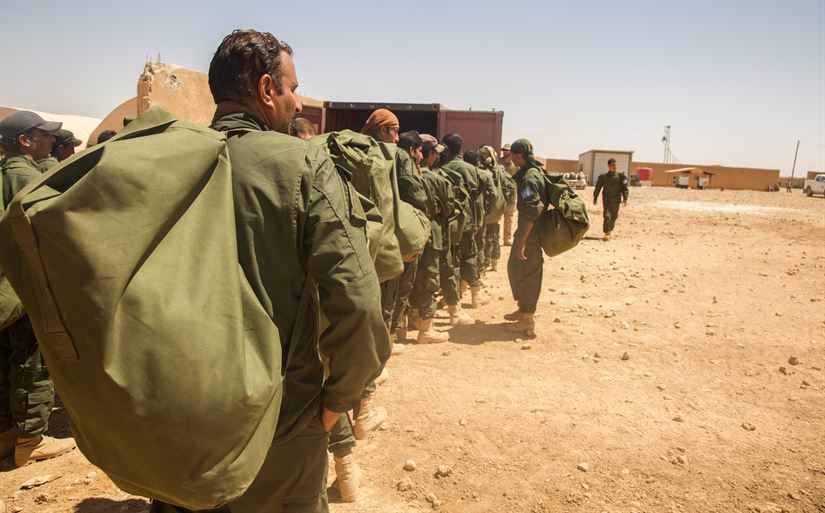
Raqqa Internal Security Force Training Class receive their initial issue of equipment after training in Ayn Issa, Syria, July 31 2017. (U.S. Army photo by Sgt. Mitchell Ryan)
Days later the president had a meeting with Defense Secretary James Mattis and the chairmen of the House and Senate Armed Services Committee. The White House announced immediately afterward that the three had agreed on a 2020 defense budget of $750 billion: from a 2 percent cut to an increase of nearly 5 percent in the course of one meeting.
Please give to our end-of-year fund drive, by clicking Donate.
Trump’s idea of improving relations with Russia has faced a wall of opposition from the first, needless to say. His summit with President Putin in Helsinki last July ignited a fresh uproar—and his suggestion that Putin come to Washington in the autumn still another. With Director of National Intelligence Dan Coats in the lead, that invitation was mocked to death within days. A New Year’s prediction: There will be no second summit with Putin, probably for the duration of Trump’s term in office. 
Among the biggest disappointments of the year has been the administration’s failure to build on Trump’s effort to advance a settlement with North Korea after seven decades of tension in Northeast Asia. The Trump–Kim summit in Singapore last May did what initial encounters between heads of state are supposed to do: It established a working rapport. By that measure, any detached judgment of the meeting would have to count it a success. 
But the U.S. press uniformly criticized Trump nonetheless for not coming home with the full details of the North’s nuclear disarmament. These same media have since treated us to the usual stories, sourced from the intelligence agencies, that the North is misleading us once again. Result: A second summit appears to have fallen off the White House’s agenda despite Trump’s statement at the UN last autumn that the two leaders would meet again “quite soon.” 
One does not have to entertain any liking for Donald Trump to find this pattern disturbing. It suggests that our foreign policy cliques, wedded to an orthodoxy devoted more or less entirely to U.S. primacy, have positioned themselves—over the course of many administrations—to dictate America’s conduct abroad even to our presidents. There is danger in this, no matter who the occupant of the White House happens to be.
Patrick Lawrence, a correspondent abroad for many years, chiefly for the International Herald Tribune, is a columnist, essayist, author, and lecturer. His most recent book is Time No Longer: Americans After the American Century (Yale). Follow him @thefloutist. His web site is www.patricklawrence.us. Support his work via www.patreon.com/thefloutist. https://consortiumnews.com/2018/12/19/dont-hold-your-breath-on-us-troop-withdrawal-from-syria/

Sunday, December 16, 2018

"Friede auf Erden und den Menschen ein Wohlgefallen!"

Weihnachtsbotschaft 2018 

Der nahende Winter meint es vorläufig freundlich mit uns. Die trockene Kälte erleichtert die Weihnachtseinkäufe. Die nähere Welt scheint in Frieden zu ruhen. Bescheidene Bedürfnisse einfacher Leute im Lande sind abgedeckt. Und dennoch: Trotz überfüllter Regale und jahreszeitlichem Gedudel ahnen die Menschen auch in unserem hochpotenten Industrieland die globalen und immer näher rückenden Bedrohungen. Die Sorge um den Friedenserhalt, um eine Politik der echten Bürgernähe, um Gerechtigkeit und Wahrhaftigkeit ist auch 2018 Jahre nach der Geburt des „Heilands“ gegenwärtiger denn je.


So sehr uns die allseits beschworene Bedrohung des Klimas nach diesem trockenen Sommer und Herbst noch bewusster geworden ist, so wissen wir doch auch, dass den Menschen das sprichwörtliche Hemd näher ist als der Rock. Wir wissen auch, dass nach einem Zusammenprall mit Russland und China es all diese Besorgnis nicht mehr geben würde.

Russlands besonnene Diplomatie hat es angesichts der bis dicht an seine Grenzen vorgerückten NATO-Aggressoren überdeutlich gemacht, auf einen direkten Angriff werden sie mit ihrem atomaren Arsenal antworten. 

Unsere Aufgabe als besonnene Deutsche, unsere Bezugnahme auf die Friedens- und Gerechtigkeitsbotschaft Jesu Christi an die Herrschenden dieser Tage, muss also lauten: Stoppt die Russlandphobie!Beendet die kriegerische Hetze und die gewalthaltigen Provokationen gegen dieses große Land. Besinnen wir uns, wir haben im letzten Jahrhundert die Russen zweimal angegriffen und nicht umgekehrt. Das leider weithin ausgebliebene Gedenken an die verlorene Schlacht von Stalingrad vor 75 Jahren gebietet es uns geradezu, den Russen die Hand zum Friedensdialog zu reichen.

Wir müssen im Interesse des Friedens ebenso wie im wirtschaftlichen  Interesse unserer Nation nach politischen Kräften Ausschau halten, die sich nicht in den Fängen transatlantischer Netzwerke verhaspelt haben. Politiker sind gefragt, die nicht mehr den immer aberwitzigeren Weisungen aus Washington Folge leisten. Wir brauchen unabhängige, selbstbewusste Menschen, die eine dem deutschen Volke dienende Politik zu machen bereit sind. Verständigung mit Russland tut Not! Der Hetze gegen den russischen Präsidenten Putin ist ebenso entgegenzuwirken wie der Hetze gegenüber dem US-amerikanischen Präsidenten Trump. Während der erste allerdings selbstbewusst die Geschicke seine Volkes lenkt, dessen Vertrauen er genießt, wird der US-Präsident vom „Tiefen Staat“ im eigenen Land  fehlgelenkt. Er wird von seiner unmittelbaren eigenen Umgebung daran gehindert, die Interessen des amerikanischen Volkes zu verfolgen und versöhnlichere Töne gegenüber Russland anzuschlagen.

Auch deswegen ist Distanz zu US-Amerika ein Friedens-Gebot.  Für einen Neubeginn deutscher, NATO-unabhängiger Verständigungs-Politik gilt es unabdingbar zweierlei zu durchschauen. Sowohl die Auschwitz- als auch die Stasi-Keule gehören auf den Müllhaufen deutscher Geschichte. Sie dienen am Ende beide dem gleichen transatlantischen Zweck. Sie sollen deutsche Bürger, deutsche Politiker, ja das ganz Volk davon abhalten, souverän und selbst bewusst seine nationalen Interessen zu verfolgen.

Die auch von neu-rechten oppositionellen Kräften stets geschwungene Stasi-Keule dient darüber hinaus dazu, den Sozialismus und am Ende die ganze Gerechtigkeitsidee in Verruf zu bringen. Sie ist der verlängerte Arm der Stalin-Keule! 

Der Name Stalin aber, soviel sollte im Stalingrad-Jahr1wenigstens abschließend ins Gedächtnis gerufen werden, steht für die Zertrümmerung des Faschismus, für das Ende deutscher Großmachtfantasien.2

Für den Neubeginn einer wahrhaft christlich-sozialen Politik, für die Neuentwicklung einer den arbeitenden Menschen im Lande dienlichen „Linken“, einer Politik für jede Branche, für Kopf- und Handarbeiter, für das nationale mittelständische Gewerbe, für eine solche Politik ist es fast 30 Jahre nach dem tragisch zu nennenden Niedergang des Sozialismus überfällig, diese Keule endlich zu entsorgen. 

Das gleiche gilt auch für die Faschismuskeule, mit deren Hilfe eine gebeutelte, nutzlos gewordene Pseudo-Linke auf eine neue Opposition von Rechts eindrischt. Sie tut dies ironischer Weise im Chore mit genau jenen Rechtskräften am Staatsruder, die das Land in eine falsche Richtung lenken. In dem sie deren Sichtweisen adaptiert, kann sie die wirklich volksfeindlichen, pro-imperialistischen Kräfte nicht mehr bekämpfen und wird folglich untergehen. Linke und rechte Prügelknabenpolitik dient ausschließlich transatlantischen, imperialen Interessen, deren Ziehkind sie ist.

Die einstige Siegernation definiert noch immer für uns wie wir unsere Geschichte zu lesen haben, sie definiert unsere nationalen Belange. Einst half  sie uns auf die Beine, solange es ihren Interessen dienlich schien. Nun werden diese neu definiert und man ist bereit, uns zu zertreten. Das wiederum entspricht einer US-Tradition, deren erklärte Überheblichkeit es mühelos erlaubt, andere souveräne Nationen gewaltsam zu zerschmettern. Eine solche Politik der imperialen Selbstüberhebung kann scheinbar problemlos  von ihr geschaffene multinationale Institutionen und alle internationalen Verträge auch wieder entsorgen, sofern sie ihre hegemonialen Ziele einengen. Ein solches Vorgehen seitens „Gottes eigener Nation“3erscheint zwar nicht sehr christlich, aber das Christentum wurde für staatlich imperiale Interessen instrumentalisiert, seit es unter dem römischen Kaiser Konstantin zur Staatsreligion4erhoben wurde.

Die frühen Christen trotzten solcher Repression. Ähnlich wie Jahrhunderte später die frühen Sozialdemokraten des 19. Jahrhunderts wurden sie durch offene, brutale Verfolgung immer stärker. Da die Unterdrückungs-Methode scheiterte, hat man ihre Ideen staatstauglich zurechtgebogen und ihre Vertreter durch Verlockungen der Macht-Teilhalbe korrumpiert.

Gerechte Ideen sind trotz alledem nicht auszurotten, menschlicher Fortschritt auf lange Sicht nicht aufhaltbar. Davon zeugt der Wiederaufstieg des volkreichen China unter kommunistischer Führung genauso wie die Standhaftigkeit des kleinen Kuba und der immer wieder erwachende Kampfgeist der Völker Lateinamerikas, sowie der Widerstandswille andernorts wie etwa gegenwärtig in Frankreich. Wenn die Unterdrückung unerträglich wird, besinnen sich die Völker auf ihre  fortschrittlichen und auf ihre  revolutionären Traditionen. Davon zeugt auch die Stabilisierung Russlands seit 1999 unter Putins weiser, staatsmännischer Führung.. Davon zeugen menschheitliche, dem Weltfrieden dienende Entwicklungen wie die Integration Eurasiens und das chinesische Projekt der Neuen Seidenstraße.

Vom Fortbestand wertvoller Ideen zeugt auch die Weihnachtsbotschaft, deren wahren Sinn es allerdings unter dem Müllberg unnützer Geschenke wiederzuentdecken gilt.

Frohe Weihnacht und ein mit Aufklärung gesegnetes Jahr 2019 wünscht Irene Eckert

Fußnoten:

1Am 4. Februar 1943 begann im Deutschen Reich eine 4 tägige Staatstrauer, alle Kinos und Theater blieben geschlossen,der Rundfunk intonierte 'ernste' Musik, selbigen Tages vermeldet die Prawda den Ausgang der Schlacht von Stalingrad und den Untergang einer 330 000 Mann starken deutschen Armee. Jochen Hellbeck S. 523
2Stalins Politik war die konsequente Fortsetzung der Politik Lenins. Wer über diese großen Staatsmänner und Humanisten etwas Objektives, etwas Realitätsgerechtes erfahren will, der tut gut daran, ihre Schriften im Original zu studieren. Hilfreich sind auch Zeugnisse von Zeitgenossen, die  bis 1956 erschienen sind. Danach nimmt die weltweit orchestrierte, propagandistische Verleumdung solche Ausmaße an, dass äußerstes Misstrauen angebracht ist. Die PR-Masche zur Verteufelung alles dessen, was den Hauch von echtem Sozialismus aufweist, fand 1956 mit dem XX. Parteitag der KPdSU ihren Höhepunkt, wo Chruschtschow, der Ukrainer seine bösartigen Unterstellungen und Projektionen gegen Stalin vortrug. Seine erstmals in den USA von der New York Times veröffentlichte Rede war den Parteitagsdelegierten ebenso untergeschoben worden, wie derselbe Mann illegal die Krim an die Ukraine "verschenkt" hat.
Der Trotzkist (!), also Stalin- und Sowjetgegner Isaac Deutscher war der letzte, der dem großen sowjetischen Staatsmann trotz aller Verleumdungen und Negativurteile, die auch er über ihn vorbringt, noch annähernd Gerechtigkeit widerfahren ließ, das war 1947. Henri Barbusse, der große französische Schriftsteller und Friedenskämpfer schrieb 1937 eine Stalin-Biografie, die ein ganz anderes, nämlich sehr positives Bild des Mannes zeichnet. Der Belgier Ludo Martens liefert in seinem Buch „Stalin anders betrachtet“ („Un autre regard sur Staline“ 1994) ebenfalls Hinweise auf einen anderen Menschen. Auch der italienische Historiker und Philosoph Domenico Losurdo begann 2008 mit seiner „Storia e critice de una leggenda nera“, das Negativimage aufzubrechen. Auch beim Russlandhistoriker Jochen Hellbeck, der in den USA forscht und lehrt (Rutgers Universität), findet man in den „Stalingrad-Protokollen sowjetische Augenzeugen berichten aus der Schlacht“ (2012) wertvolle Hinweise auf ein anders Stalinbild. Frappierend ist das Studium der von Stalin hinterlassenen schriftlichen Zeugnisse selber. Der Mann war ein Humanist, das krassest denkbare Gegenstück zu einem Herrn Hitler

3„God's own nation“ so lautet die Selbstdefiniton der US-Amerikaner, „we are the indispensable nation. We stand tall and we see further“ (1990) Madeleine Korbel Albright (born Marie Jana Korbelová on May 15, 1937) is an American politician. She served as United States Ambassador to the United Nations (1993–1997) and as the U.S. Secretary of State (1997–2001)

4Im Jahr 380 erklärte Theodosius I. in einem Edikt, welches die Gesamtbevölkerung des Römischen Reiches ansprach, das nicaenische Christentum (d.h. das christliche Glaubensbekenntnis, wie es beim Konzil von Nicaea im Jahr 325 festgelegt worden war) zurStaatsreligion. Ab 324 regierte er als Alleinherrscher. Konstantins Aufstieg zur Macht vollzog sich im Rahmen der Auflösung der römischen Tetrarchie („Viererherrschaft“), die Kaiser Diokletian errichtet hatte. 


Saturday, December 15, 2018

Why Western Media & CIA Turned Against Saudi MBS


The problem with MBS isn’t that he is a mass murdering war criminal, 
it is that he is too “independent” for the United States’ liking.
RT
Published
 
on
 
2,379 Views


Forces are aligning against Saudi Arabia’s Crown Prince, lead by elements within the CIA and strong players in the mainstream media. But what is really behind this deterioration in relationship, and what are its implications?
Following the brutal murder of Washington Post columnist Jamal Khashoggi, western media and various entities, including the CIA, appear to have turned their back on Saudi Crown Prince Mohammad Bin Salman (MBS). In response to the scandal, the Guardian released a video which its celebutante, Owen Jones, captioned“Saudi Arabia is one of the biggest threats on Earth. Time to stop propping up its repulsive regime.”
The Guardian was not alone in its condemnation. “It’s high time to end Saudi impunity,” wrote Hana Al-Khamri in Al-Jazeera. “It’s time for Saudi Arabia to tell the truth on Jamal Khashoggi,” the Washington Post’s Editorial Board argued. Politico called it “the tragedy of Jamal Khashoggi.”
Even shadowy think-tanks like the Council on Foreign Relations (CFR) and the Atlantic Council released articles criticising Saudi Arabia in the wake of Khashoggi’s death.
A number of companies began backing away from Saudi money after the journalist’s death, including the world’s largest media companies such as the New York Times, the Economist’s editor-in-chief Zanny Minton Beddoes, Arianna Huffington, CNN, CNBC, the Financial Times, Bloomberg, Google Cloud CEO, just to name a few.
The CIA concluded that MBS personally ordered Khashoggi’s death, and was reportedly quite open in its provision of this assessment. Antonio Guterres, secretary-general of the UN, also took time out of his schedule to express concern over Saudi Arabia’s confirmation of the killing.
At the time of the scandal, former CIA director John Brennan went on MSNBC to state that the Khashoggi’s death would be the downfall of MBS. Furthermore, the US Senate just voted in favour of ending American involvement in Saudi Arabia’s war in Yemen (a somewhat symbolic victory, though this is a topic for another article), but nonetheless was a clear stab at MBS personally.
The only person who appeared to continue to uphold America’s unfaltering support for MBS, even after all the publicly made evidence against MBS, was the US president himself. So after years of bombarding Yemen, sponsoring terror groups across the Middle East, Asia, the Pacific and beyond, why is it only now that there has been mounting opposition to Saudi Arabia’s leadership? Let’s just bear in mind that western media had spent years investing in a heavy PR campaign to paint MBS as a “reformer.”
Former national security adviser under Barack Obama’s second term, Susan Rice, wrote an article in the New York Times, in which she called MBS a “partner we can’t depend on.” Rice concludes that MBS is “not and can no longer be viewed as a reliable partner of the United States and our allies.” But why is this? Is it because MBS is responsible for some of the most egregious human rights abuses inside his own kingdom as well as in Yemen? Is it because of MBS’ support for groups such as ISIS and al-Qaeda? No, according to Rice, we “should not rupture our important relationship with the kingdom, but we must make it clear it cannot be business as usual so long as Prince Mohammad continues to wield unlimited power.”
One will observe that the latter segment of Rice’s article almost mirrors former CIA director Brennan’s word on MSNBC word for word who stated that:
“I think ultimately this is going to come out. And it’s very important for us to maintain the relations with Saudi Arabia. And if it’s Mohammed bin Salman who’s the cancer here, well, we need to be able to find ways to eliminate the cancer and to move forward with this relationship that is critical to regional stability and our national interests.”
In reality, this is probably the issue that western media and government advisors have taken up with MBS. Aside from the fact he allegedly held a huge hand in the brutal murder of one of their own establishment journalists (Saudi Arabia reportedly tortured and killed another journalist not long after Khashoggi, but western media was eerily silent on this incident) MBS is not opposed for his reckless disregard for human rights. With insight into Rice’s mindset, we actually learn that if the US were to punish MBS, he would be likely to “behave more irresponsibly to demonstrate his independence and exact retribution against his erstwhile Western partners.”
You see, the problem with MBS isn’t that he is a mass murdering war criminal, it is that he is too “independent” for the United States’ liking.
Last week, Saudi Arabia and the other major oil producers met in Vienna at the year’s final big OPEC meeting of the year. As Foreign Policy notes, Saudi Arabia remains the largest oil producer inside OPEC but has to contend with the US and Russia who are “pumping oil at record levels.” Together, the three countries are the world’s biggest oil producers, meaning any coordinated decision made between these three nations can be somewhat monumental.
However, it appears that one of these three nations will end up drawing the short end of the stick as the other two begin forming a closer alliance. As Foreign Policy explains:
“But Saudi Arabia has bigger game in mind at Vienna than just stabilizing oil prices. Recognizing that it can’t shape the global oil market by itself anymore but rather needs the cooperation of Russia, Saudi Arabia is hoping to formalize an ad hoc agreement between OPEC and Moscow that began in 2016, a time when dirt-cheap oil also posed a threat to oil-dependent regimes. That informal agreement expires at the end of the year, but the Saudis would like to make Russia’s participation with the cartel more permanent.”
Russian officials have been signalling their intention to formalise this agreement for quite some time now. Given the hysteria in western media about any and all things Russian, it is not too much of a stretch to suggest that this is the kind of news that is not sitting too well with the powers-that-be.
Earlier this year, Russia and Saudi Arabia announced that it would “institutionalize” the two-year-old bilateral agreement to coordinate oil production targets in order to maintain an edge on the global market.
While US president Trump has been supportive and incredibly defensive of MBS during this “crisis”, the truth is that the US only has itself to blame. It was not all too long ago that Trump announced that he had told Saudi King Salman that his kingdom would not last two weeks without US support.
Saudi Arabia is learning for themselves quite quickly that, ultimately, it may pay not to have all its eggs in one geopolitical superpower basket.
Saudi Arabia has been increasingly interested in Moscow since King Salman made a historic visit to Moscow in October 2017. While Trump has openly bragged about his record-breaking arms deals with the Saudis, the blunt truth is that the $110 billion arms agreements were reportedly only ever letters of interest or intent, but not actual contracts. As such, the US-Saudi arms deal is still yet to be locked in, all the while Saudi Arabia is negotiating with Russia for its S-400 air defence system. This is, as the Washington Post notes, despite repeated US requests to Saudi Arabia for it disavow its interest in Russia’s arms.
The economic threat that an “independent” Saudi Arabia under MBS’ leadership poses to Washington runs deeper than meets the eye and may indeed have a domino effect. According to CNN, Russia and Saudi Arabia “are engaged in an intense battle over who will be the top supplier to China, a major energy importer with an insatiable appetite for crude.”
The unveiling of China’s petro-yuan poses a major headache for Washington and its control over Saudi Arabia as well.According to Carl Weinberg, chief economist and managing director at High-Frequency Economics, China will “compel”Saudi Arabia to trade oil in Chinese yuan instead of US dollars. One must bear in mind that China has now surpassed the US as the “biggest oil importer on the planet,” these direct attacks on the US dollar will have huge implications for its current world reserve status.
If Saudi Arabia jumps on board China’s petro-yuan, the rest of OPEC will eventually follow, and the US might be left with no choice but to declare all of these countries in need of some vital freedom and democracy.
Therefore, ousting MBS and replacing him with a Crown Prince who doesn’t stray too far from the tree that is US imperialism may put a dent in pending relationships with Saudi Arabia and Washington’s adversaries, Russia and China.
Once we get over the certainty that the US media and the CIA are not against MBS for his long-list of human rights abuses, the question then becomes: why – why now, and in this manner, have they decided to put the spotlight on MBS and expose him exactly for what he is.
Clearly, the driving force behind this media outrage is a bit more complex than first meets the eye.http://theduran.com/the-real-reason-western-media-cia-turned-against-saudi-mbs/