Wednesday, December 5, 2018
Yellow Vests Rise Against Neo-Liberal 'King' Macron
Yellow Vests Rise Against
Neo-Liberal 'King' Macron
For a couple of centuries, the “left” hoped popular movements would lead to changes for the better. Today, many leftists seem terrified of popular movements for change, convinced “populism” must lead to “fascism.” But it needn't be so, says Diana Johnstone.
https://consortiumnews.com/ 2018/12/05/yellow-jackets- rise-against-neo-liberal-king- macron/?fbclid= IwAR2N8zW6zoUaN5njPRMe_ viEFoHadGLJ9wsutNEGeS0wNkZObRX JMG3iqRA
For a couple of centuries, the “left” hoped popular movements would lead to changes for the better. Today, many leftists seem terrified of popular movements for change, convinced “populism” must lead to “fascism.” But it needn't be so, says Diana Johnstone.
https://consortiumnews.com/ 2018/12/05/yellow-jackets- rise-against-neo-liberal-king- macron/?fbclid= IwAR2N8zW6zoUaN5njPRMe_ viEFoHadGLJ9wsutNEGeS0wNkZObRX JMG3iqRA
Yellow Vests Rise Against Neo-Liberal ‘King’ Macron

For centuries, the “left” hoped popular movements would lead to changes for the better. Today, many leftists seem terrified of popular movements for change, convinced “populism” must lead to “fascism.” But it needn’t be so, says Diana Johnstone.
By Diana Johnstonein Paris
Every automobile in France is supposed to be equipped with a yellow vest. This is so that in case of accident or breakdown on a highway, the driver can put it on to ensure visibility and avoid getting run over.
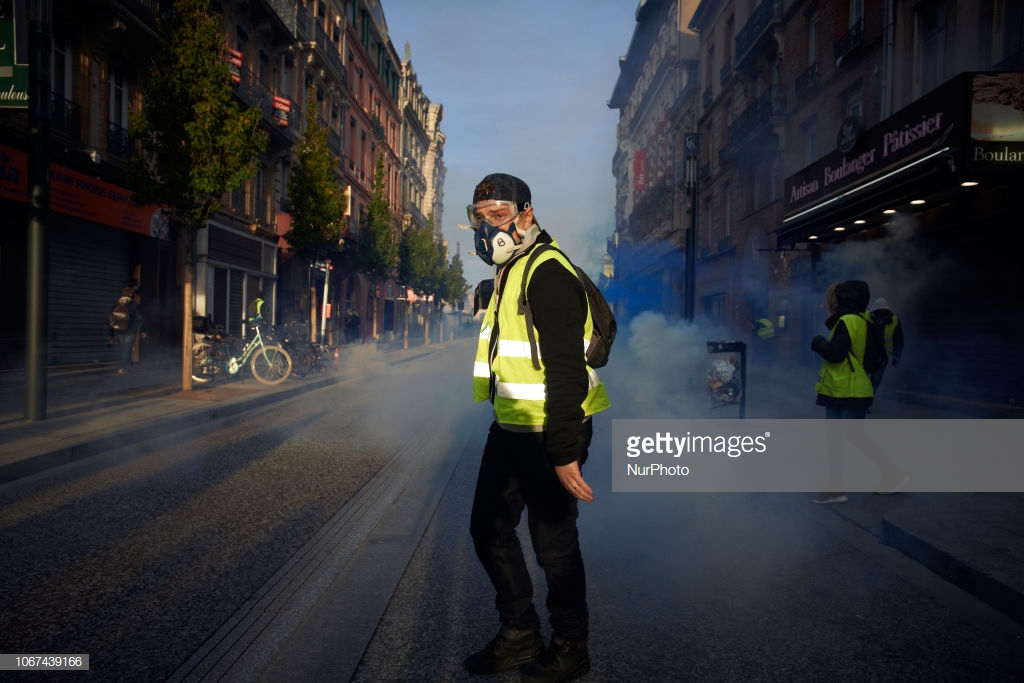
So the idea of wearing your yellow vest to demonstrate against unpopular government measures caught on quickly. The costume was at hand and didn’t have to be provided by Soros for some more or less manufactured “color revolution”. The symbolism was fitting: in case of socio-economic emergency, show that you don’t want to be run over.
As everybody knows, what set off the protest movement was yet another rise in gasoline taxes. But it was immediately clear that much more was involved. The gasoline tax was the last straw in a long series of measures favoring the rich at the expense of the majority of the population. That is why the movement achieved almost instant popularity and support.
The Voices of the People
The Yellow Vests held their first demonstrations on Saturday, November 17, on the Champs-Elysées in Paris. It was totally unlike the usual trade union demonstrations, well organized to march down the boulevard between the Place de la République and the Place de la Bastille, or the other way around, carrying banners and listening to speeches from leaders at the end. The Gilets Jaunes just came, with no organization, no leaders to tell them where to go or to harangue the crowd. They were just there, in the yellow vests, angry and ready to explain their anger to any sympathetic listener.
Briefly, the message was this: we can’t make ends meet. The cost of living keeps going up, and our incomes keep going down. We just can’t take it any more. The government must stop, think and change course.
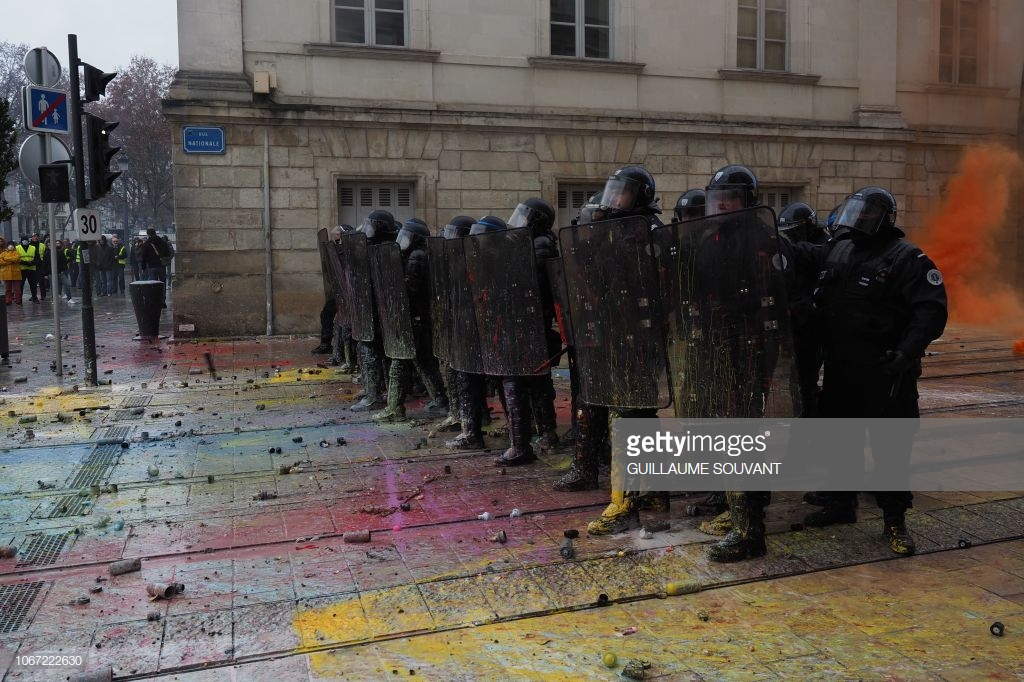
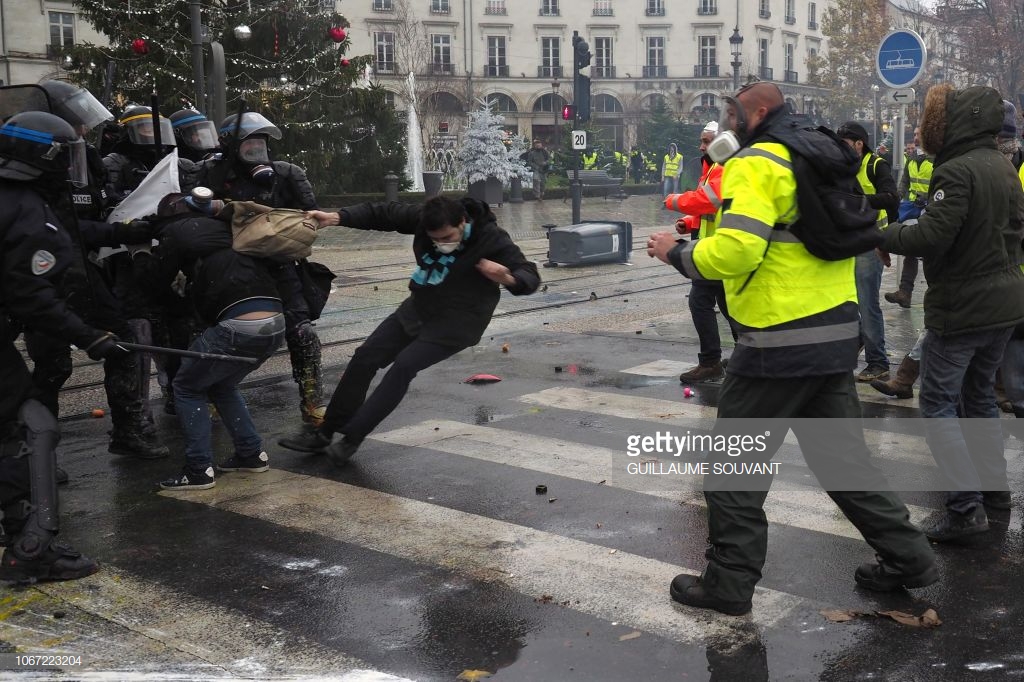
But so far, the reaction of the government was to send police to spray torrents of tear gas on the crowd, apparently to keep the people at a distance from the nearby Presidential residence, the Elysee Palace. President Macron was somewhere else, apparently considering himself above and beyond it all.
But those who were listening could learn a lot about the state of France today. Especially in the small towns and rural areas, where many protesters came from. Things are much worse than officials and media in Paris have let on.
There were young women who were working seven days a week and despaired of having enough money to feed and clothe their children.
People were angry but ready to explain very clearly the economic issues.
Colette, age 83, doesn’t own a car, but explained to whoever would listen that the steep raise of gasoline prices would also hurt people who don’t drive, by affecting prices of food and other necessities. She had done the calculations and figured it would cost a retired person 80 euros per month.
“Macron didn’t run on the promise to freeze pensions”, recalled a Yellow Vest, but that is what he has done, along with increasing solidarity taxes on pensioners.
A significant and recurring complaint concerned the matter of health care. France has long had the best public health program in the world, but this is being steadily undermined to meet the primary need of capital: profit. In the past few years, there has been a growing government campaign to encourage, and finally to oblige people to subscribe to a “mutuelle”, that is, a private health insurance, ostensibly to fill “the gaps” not covered by France’s universal health coverage. The “gaps” can be the 15% that is not covered for ordinary illnesses (grave illnesses are covered 100%), or for medicines taken off the “covered” list, or for dental work, among other things. The “gaps” to fill keep expanding, along with the cost of subscribing to the mutuelle. In reality, this program, sold to the public as modernizing improvement, is a gradual move toward privatization of health care. It is a sneaky method of opening the whole field of public health to international financial capital investment. This gambit has not fooled ordinary people and is high on the list of complaints by the Gilets Jaunes.
The degradation of care in the public hospitals is another complaint. There are fewer and fewer hospitals in rural areas, and one must “wait long enough to die” emergency rooms. Those who can afford it are turning to private hospitals. But most can’t. Nurses are overworked and underpaid. When one hears what nurses have to endure, one is reminded that this is indeed a noble profession.
In all this I was reminded of a young woman we met at a public picnic in southwestern France last summer. She cares for elderly people who live at home alone in rural areas, driving from one to another, to feed them, bathe them, offer a moment of cheerful company and understanding. She loves her vocation, loves helping old people, although it barely allows her to make a living. She will be among those who will have to pay more to get from one patient to the next.
People pay taxes willingly when they are getting something for it. But not when the things they are used to are being taken away. The tax evaders are the super-rich and the big corporations with their batteries of lawyers and safe havens, or intruders like Amazon and Google, but ordinary French people have been relatively disciplined in paying taxes in return for excellent public services: optimum health care, first class public transport, rapid and efficient postal service, free university education. But all that is under assault from the reign of financial capital called “neo-liberalism” here. In rural areas, more and more post offices, schools and hospitals are shut down, unprofitable train service is discontinued as “free competition” is introduced following European Union directives – measures which oblige people to drive their cars more than ever. Especially when huge shopping centers drain small towns of their traditional shops.
Incoherent Energy Policies
And the tax announced by the government – an additional 6.6 cents per liter for diesel and an additional 2.9 centers per liter of gasoline – are only the first steps in a series of planned increases over the next years. The measures are supposed to incite people to drive less or even better, to scrap their old vehicles and buy nice new electric cars.
More and more “governance” is an exercise in social engineering by technocrats who know what is best. This particular exercise goes directly opposite to an earlier government measure of social engineering which used economic incitements to get people to buy cars running on diesel. Now the government has changed its mind. Over half of personal vehicles still run on diesel, although the percentage has been dropping. Now their owners are told to go buy an electric car instead. But people living on the edge simply can’t afford the switch.
Besides, the energy policy is incoherent. In theory, the “green” economy includes shutting down France’s many nuclear power plants. Without them, where would the electricity come from to run the electric cars? And nuclear power is “clean”, no CO2. So what is going on? People wonder.
The most promising alternative sources of energy in France are the strong tides along northern coasts. But last July, the Tidal Energies project on the Normandy coast was suddenly dropped because it wasn’t profitable – not enough customers. This is symptomatic of what is wrong with the current government. Major new industrial projects are almost never profitable at first, which is why they need government support and subsidies to get going, with a view to the future. Such projects were supported under de Gaulle, raising France to the status of major industrial power, and providing unprecedented prosperity for the population as a whole. But the Macron government is not investing in the future nor doing anything to preserve industries that remain. The key French energy corporation Alstom was sold to General Electric under his watch.
Indeed, it is perfectly hypocritical to call the French gas tax an “ecotax” since the returns from a genuine ecotax would be invested to develop clean energies – such as tidal power plants. Rather, the benefits are earmarked to balance the budget, that is, to serve the government debt. The Macronian gas tax is just another austerity measure – along with cutting back public services and “selling the family jewels”, that is, selling potential money-makers like Alstom, port facilities and the Paris airports.
The Government Misses the Point
Initial government responses showed that they weren’t listening. They dipped into their pool of clichés to denigrate something they didn’t want to bother to understand.
President Macron’s first reaction was to guilt-trip the protesters by invoking the globalists’ most powerful argument for imposing unpopular measures: global warming. Whatever small complaints people may have, he indicated, that is nothing compared to the future of the planet.
This did not impress people who, yes, have heard all about climate change and care as much as anyone for the environment, but who are obliged to retort: “I’m more worried about the end of the month than about the end of the world.”
After the second Yellow Vest Saturday, November 25, which saw more demonstrators and more tear gas, the Minister in charge of the budget, Gérard Darmanin, declared that what had demonstrated on the Champs-Elysée was “la peste brune”, the brown plague, meaning fascists. (For those who enjoy excoriating the French as racist, it should be noted that Darmanin is of Algerian working class origins). This remark caused an uproar of indignation that revealed just how great is public sympathy for the movement – over 70% approval by latest polls, even after uncontrolled vandalism. Macron’s Minister of the Interior, Christophe Castaner, was obliged to declare that government communication had been badly managed. Of course, that is the familiar technocratic excuse: we are always right, but it is all a matter of our “communication”, not of the facts on the ground.
Maybe I have missed something, but of the many interviews I have listened to, I have not heard one word that would fall into the categories of “far right”, much less “fascism” – or even that indicated any particular preference in regard to political parties. These people are wholly concerned with concrete practical issues. Not a whiff of ideology – remarkable in Paris!
Some people ignorant of French history and eager to exhibit their leftist purism have suggested that the Yellow Vests are dangerously nationalistic because they occasionally wave French flags and sing La Marseillaise. That simply means that they are French. Historically, the French left is patriotic, especially when it is revolting against the aristocrats and the rich or during the Nazi Occupation. ( The exception was the student uprising of May 1968, which was not a revolt of the poor but a revolt in a time of prosperity in favor of greater personal freedom: “it is forbidden to forbid”. The May ’68 generation has turned out to be the most anti-French generation in history, for reasons that can’t be dealt with here. To some extent, the Yellow Vests mark a return of the people after half a century of scorn from the liberal intelligentsia.) It is just a way of saying, We are the people, we do the work, and you must listen to our grievances. To be bad, “nationalism” must be aggressive toward other nations. This movement is not attacking anybody, it is strictly staying home.
The Weakness of Macron
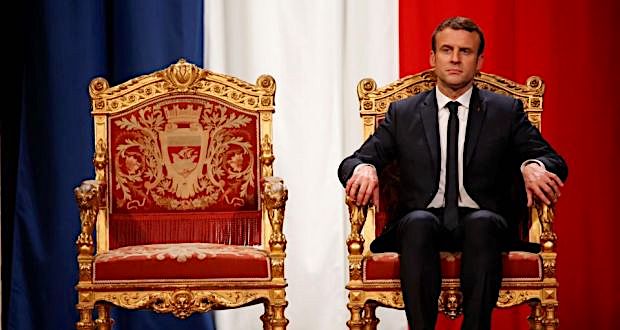
The Yellow Vests have made clear to the whole world that Emmanuel Macron was an artificial product sold to the electorate by an extraordinary media campaign.
Macron was the rabbit magically pulled out of a top hat, sponsored by what must be called the French oligarchy. After catching the eye of established king-maker Jacques Attali, the young Macron was given a stint at the Rothschild bank where he could quickly gain a small fortune, ensuring his class loyalty to his sponsors. Media saturation and the scare campaign against “fascist” Marine LePen (who moreover flubbed her major debate) put Macron in office. He had met his wife when she was teaching his theater class, and now he gets to play President.
The mission assigned to him by his sponsors was clear. He must carry through more vigorously the “reforms” (austerity measures) already undertaken by previous governments, which had often dawdled at hastening the decline of the social State.
And beyond that, Macron was supposed to “save Europe”. Saving Europe means saving the European Union from the quagmire in which it finds itself.
This is why cutting expenses and balancing the budget is his obsession. Because that’s what he was chosen to do by the oligarchy that sponsored his candidacy. He was chosen by the financial oligarchy above all to save the European Union from threatening disintegration caused by the euro. The treaties establishing the EU and above all the common currency, the euro, have created an imbalance between member states that is unsustainable. The irony is that previous French governments, starting with Mitterrand, are largely responsible for this state of affairs. In a desperate and technically ill-examined effort to keep newly unified Germany from becoming the dominant power in Europe, the French insisted on binding Germany to France by a common currency. Reluctantly, the Germans agreed to the euro – but only on German terms. The result is that Germany has become the unwilling creditor of equally unwilling EU member states, Italy, Spain, Portugal and of course, ruined Greece. The financial gap between Germany and its southern neighbors keeps expanding, which causes ill will on all sides.
Germany doesn’t want to share economic power with states it considers irresponsible spendthrifts. So Macron’s mission is to show Germany that France, despite its flagging economy, is “responsible”, by squeezing the population in order to pay interest on the debt. Macron’s idea is that the politicians in Berlin and the bankers in Frankfurt will be so impressed that they will turn around and say, well done Emmanuel, we are ready to throw our wealth into a common pot for the benefit of all 27 Member States. And that is why Macron will stop at nothing to balance the budget, to make the Germans love him.
So far, the Macron magic is not working on the Germans, and it’s driving his own people into the streets.
Or are they his own people? Does Macron really care about his run of the mill compatriots who just work for a living? The consensus is that he does not.
Macron is losing the support both of the people in the streets and the oligarchs who sponsored him. He is not getting the job done.
Macron’s rabbit-out-of-the hat political ascension leaves him with little legitimacy, once the glow of glossy magazine covers wears off. With help from his friends, Macron invented his own party, La République en Marche, which doesn’t mean much of anything but suggested action. He peopled his party with individuals from “civil society”, often medium entrepreneurs with no political experience, plus a few defectors from either the Socialist or the Republican Parties, to occupy the most important government posts.
The only well-known recruit from “civil society” was the popular environmental activist, Nicolas Hulot, who was given the post of Minister of Environment, but who abruptly resigned in a radio announcement last August, citing frustration.
Macron’s strongest supporter from the political class was Gérard Collomb, Socialist Mayor of Lyons, who was given the top cabinet post of Minister of Interior, in charge of national police. But shortly after Hulot left, Collomb said he was leaving too, to go back to Lyons. Macron entreated him to stay on, but on October 3, Collomb went ahead and resigned, with a stunning statement referring to “immense problems” facing his successor. In the “difficult neighborhoods” in the suburbs of major cities, he said, the situation is “very much degraded : it’s the law of the jungle that rules, drug dealers and radical Islamists have taken the place of the Republic.” Such suburbs need to be “reconquered”.
After such a job description, Macron was at a loss to recruit a new Interior Minister. He groped around and came up with a crony he had chosen to head his party, ex-Socialist Christophe Castaner. With a degree in criminology, Castaner’s main experience qualifying him to head the national police is his close connection, back in his youth in the 1970s, with a Marseilles Mafioso, apparently due to his penchant for playing poker and drinking whiskey in illegal dens.
Saturday, November 17, demonstrators were peaceful, but resented the heavy teargas attacks. Saturday November 25, things got a big rougher, and on Saturday December 1st, all hell broke loose. With no leaders and no service d’ordre (militants assigned to protect the demonstrators from attacks, provocations and infiltration), it was inevitable that casseurs (smashers) got into the act and started smashing things, looting shops and setting fires to trash cans, cars and even buildings. Not only in Paris, but all over France: from Marseilles to Brest, from Toulouse to Strasbourg. In the remote town of Puy en Velay, known for its chapel perched on a rock and its traditional lace-making, the Prefecture (national government authority) was set on fire. Tourist arrivals are cancelled and fancy restaurants are empty and department stores fear for their Christmas windows. The economic damages are enormous.
And yet, support for the Yellow Vests remains high, probably because people are able to distinguish between those grieved citizens and the vandals who love to wreak destruction for its own sake.
On Monday, there were suddenly fresh riots in the troubled suburbs that Collomb warned about as he retreated to Lyons. This was a new front for the national police, whose representatives let it be known that all this was getting to be much too much for them to cope with. Announcing a state of emergency is not likely to solve anything.
Macron is a bubble that has burst. The legitimacy of his authority is very much in question. Yet he was elected in 2017 for a five year term, and his party holds a large majority in parliament that makes his destitution almost impossible.
So what next? Despite having been sidelined by Macron’s electoral victory in 2017, politicians of all hews are trying to recuperate the movement – but discreetly, because the Gilets Jaunes have made clear their distrust of all politicians. This is not a movement that seeks to take power. It simply seeks redress of its grievances. The government should have listened in the first place, accepted discussions and compromise. This gets more difficult as time goes on, but nothing is impossible.
For some two or three hundred years, people one could call “left” hoped that popular movements would lead to changes for the better. Today, many leftists seem terrified of popular movements for change, convinced “populism” must lead to “fascism”. This attitude is one of many factors indicating that the changes ahead will not be led by the left as it exists today. Those who fear change will not be there to help make it happen. But change is inevitable and it need not be for the worse.
Diana Johnstone is the author of Fools’ Crusade: Yugoslavia, NATO, and Western Delusions. Her new book is Queen of Chaos: the Misadventures of Hillary Clinton. The memoirs of Diana Johnstone’s father Paul H. Johnstone, From MAD to Madness, was published by Clarity Press, with her commentary. She can be reached at diana.johnstone@wanadoo.fr .
If you enjoyed this original article please consider making a donation to Consortium News so we can bring you more stories like this one.
Monday, December 3, 2018
Scott Bennet/Alex Christoforu
http://theduran.com/g20-summit-is-missed-opportunity-for-trump-and-putin-video/
LATEST
LATESTVIDEO
G20 summit is missed opportunity for Trump and Putihttp://theduran.com/g20-summit-is-missed-opportunity-for-trump-and-putin-video/n (Video)
http://theduran.com/g20-summit-is-missed-opportunity-for-trump-and-putin-video/http://theduran.com/g20-summit-is-missed-opportunity-for-trump-and-putin-video/Lavrov’s interview and answers to questions for the programme “Moscow. Kremlin. Putin”
Foreign Minister Sergey Lavrov’s interview and answers to questions for the programme “Moscow. Kremlin. Putin” on the sidelines of the G20 summit in Buenos Aires, December 2, 2018
Question: It was a highly unusual G20 summit, with very many factors. I don’t remember Chancellor of Germany Angela Merkel having to overcome so many obstacles just to get to a meeting. The death of President George H.W. Bush cast a pall over the event. And then there is this strange situation with presidents Vladimir Putin and Donald Trump and the US president’s reaction to the incident in the Black Sea.
What are your feelings over this? Have these events spoiled the G20 meeting or prevented the participants from implementing the agenda?
Sergey Lavrov: I believe that all these circumstances have had their effect on the events that are taking place in Buenos Aires. However, they have hardly had any serious effect on the agenda.
Just as it happened in 2008, when the G20 convened at the top level to discuss the root causes of a crisis that had spread to nearly all the countries, we are now amid a period of transformation in the global economy. There is, first of all, the digital transformation, an unprecedented rise in protectionist policies, up to trade wars, the sovereign debts of many countries and a shadow over the future of free multilateral trade, as well as many other factors. There is also the problem with the reliability of reserve currencies and the obligations of the countries that have them. It is these factors that influenced the preparations for the summit and discussions at it.
I have not mentioned the sanctions, the restrictive, prohibitive or punishing duties and tariffs, all of which created a serious and contradictory background for and influenced the essence of the discussions. It is good that a final declaration has been adopted. This is better than nothing. However, all the sharp angles which I mentioned have been smoothed over. But I don’t think this is connected to the circumstances we were talking about.
Anyway, the G20 has made rather useful decisions. We have outlined our position on the digital economy and the need to start adjusting the labour and education markets to it. We have also put forth our views on the situation when it comes to food security. Russia as a major grain producer is playing an increasing role in these matters.
There was also a thorough discussion on migration, refugees and approaches to this new problem. I would like to say in this connection that we have rejected the attempts to force the “concept of equal responsibility” on the G20 and the international community as a whole for the refugees who fled their homes, for various reasons, in the hope of finding a better future in foreign countries. We clearly pointed out to our colleagues that the root cause of this unprecedented wave of migration in Europe and other countries is the irresponsible policy of flagrant military interference in the internal affairs of sovereign states, primarily in the Middle East and North Africa. The most serious factor is, of course, the aggression against Libya, which has destroyed the country and has turned it into a black hole for the transfer of illegal weapons, drugs and organised crime to southern Africa. The northbound transit, above all via Libya, has brought migrants to Europe where they have become a major problem, including for the EU.
Another subject on which Russian delegates spoke actively here is the fight against terrorism. We drew the international attention to a new phenomenon of the so-called foreign terrorist fighters who return back to their home or other countries after completing criminal jobs in Libya, Syria, Iraq or some other places. It is vitally important to trace the movement of these dangerous people. Several years ago, Russia’s Federal Security Service (FSB) created a database of foreign terrorist fighters. This database involves 42 security services from 35 countries, including G20 members, such as the BRICS countries, Turkey and South Korea. The UN Security Council Counter-Terrorism Committee (CTC), Interpol, the CIS Anti-Terrorism Centre, the SCO Regional Anti-Terrorism Structure (RATS) and other international organisations have joined this database. We actively promoted this experience at the G20 summit where it aroused keen interest.
Question: Have you managed to bring across to our European partners the truth on what really happened in the Black Sea (and not in the Sea of Azov, as they usually write)? Have they finally heard our position?
Sergey Lavrov: I think they could not but hear it because President Vladimir Putin, while meeting with President of France Emmanuel Macron and German Chancellor Angela Merkel, personally explained “in lay terms” how all this happened, how the provocation had been planned and how its execution was attempted, as well as how responsibly the Russian border guards performed their functions trying to prevent any undesirable incidents. Regrettably, the [Ukrainian] agents provocateurs (and the provocation, carried out by two craft and a tug, was controlled by two Ukrainian Security Service officers) did their best to fulfill the order, which was found after the Russian border guards stepped on board these fire-support craft. It said in no uncertain terms that they should secretly penetrate the neutral waters, perform a breakthrough under the Crimean Bridge without giving any previous notice or hiring a pilot, and sail through the Kerch Strait to the Sea of Azov. President Putin personally told his interlocutors about this. I did not hear from them a response that would be based on different facts.
Question: It is important to note a totally different level of cooperation between Russia, India and China. One gets the impression that this time a unique mutual understanding took shape within the G20 between the three countries that together account for one-third of the world population. They have a totally different point of view than, for example, America and its partners, whom it is easier to call “satellites.”
Sergey Lavrov: It was the first Russia-India-China summit (RIC Group, as we call it) since 2006. The leaders of our three countries have agreed that this format should be maintained, including by holding regular summits in addition to ministerial and expert contacts that, basically, have not been discontinued during these years. What unites our countries was emphasised at the RIC meeting. This is primarily the striving not to allow the disintegration of multilateral universal organisations that are based on the UN Charter and the principles enshrined in it, such as equality, respect for sovereignty, and non-interference in internal affairs. Generally, an intention was voiced to defend the foundations of the multilateral, open economic and trade system. Prime Minister of India Narendra Modi clearly spoke out against the sanctions that were increasingly often used in this sphere by the United States in the hope of enhancing its competitiveness and getting unfair competitive advantages.
As I said, the [three] leaders have agreed to continue holding summits, while instructing their foreign ministers to prepare for the RIC leaders proposals on how to make this cooperation more effective and promote it in new spheres.
Question: Is there any hope that these three countries – Russia, India and China – will have a common understanding and will vote unanimously in the UN Security Council?
Sergey Lavrov: India is not yet a full member of the UN Security Council, but it was elected several times as a non-permanent member for two years. We have identical views on the overwhelming majority of subjects. It is notable that our countries’ positions often overlap not only in the UN Security Council but also during voting on matters of fundamental importance at the UN.
Another example has to do with the Organisation for the Prohibition of Chemical Weapons (OPCW) and concerns a scandalous process which the West has launched in gross violation of the Chemical Weapons Convention (CWC). When the Western countries proposed giving the OPCW’s Technical Secretariat the prerogatives that actually belong to the UN Security Council, India, Russia and other like-minded countries unanimously voted against this. The BRICS countries co-authored a statement in which they sharply criticised such inappropriate actions and demanded that all states respect the CWC and their obligations under it. I have mentioned BRICS for a reason, because President of Russia Vladimir Putin, President of China Xi Jinping and Prime Minister of India Narendra Modi have said that these three countries are the driving force behind such organisations as BRICS and the SCO, which India has recently joined. We are connected geographically and politically, share common views on the key aspects of the world order, want all disputes to be settled peacefully and would like to have a free, open and fair trade and economic system, which, taken together, makes us allies in these matters.
Question: Presidents Putin and Trump have held a short meeting after all. As for US Secretary of State Mike Pompeo, was he evading you, or did he have to meet with you?
Sergey Lavrov: Of course, I did not pursue him, and he did not try to meet with me. To be quite frank, I do not even know if he is here, because I have not seen the full US delegation. US National Security Adviser John Bolton said in a conversation with Presidential Aide Yury Ushakov, who deals with political matters, that they [the US administration] would like to resume and normalise our dialogue. We are ready to do this as soon as our colleagues are.
Question: As far as I know, there have been very interesting discussions on Syria. Has Russia managed to move the Western countries towards the realistic Russian view on the Syrian problem?
Sergey Lavrov: I don’t know how close we have managed to move them towards our position, but it is becoming increasingly clear that they don’t have any alternative strategy or tactic on this matter. Likewise, it is becoming clear that unacceptable things are taking place on the eastern bank of the Euphrates. The United States is trying to create quasi-public structures there, investing hundreds of millions of dollars so that the people could resume a normal peaceful way of life in these regions. At the same time, they refuse to rebuild the infrastructure in the regions that are controlled by the Syrian government. It is becoming obvious to everyone that the developments on the eastern bank of the Euphrates run contrary to the general commitment to Syria’s territorial integrity as sealed in a relevant UN Security Council resolution, although the United States has been trying to present its activities there as a temporary solution.
The US activities on the eastern bank of the Euphrates and in other Syrian regions where it has special forces and advisers include playing the Kurdish card. It is a very dangerous game, considering that the Kurdish question is very acute in several countries apart from Syria, such as Iraq, Iran and, obviously, Turkey. President Putin discussed this matter at a meeting with President of Turkey Recep Tayyip Erdogan on the last day of the G20 session. They have confirmed their commitments regarding the Idlib de-escalation zone. We pointed out that not all extremists have heeded the demand to leave the 20-mile demilitarised zone, despite the active and consistent operations of our Turkish colleagues. We have coordinated further moves to ensure compliance with the agreement on the demilitarised zone and also to prevent the extremists from sabotaging this crucial agreement, which all sides welcomed.
The third aspect of the Syrian subject is the political process. The overwhelming majority of countries agree that the Constitution Committee, which is being created at the initiative of the three guarantor countries of the Astana process as per the decisions of the Syrian National Dialogue Congress held in Sochi, is the only viable method to start implementing UN Security Council Resolution 2254, under which all Syrian sides must hold negotiations to coordinate common and mutually acceptable views on life in their country and on its future development. This is exactly what is stipulated in the above-mentioned UN Security Council resolution. After they reach this understanding, they should adopt a new constitution and hold elections based on its provisions. However, as I have said before, no reasonable alternatives have been proposed over the past years to the initiatives advanced by the three Astana countries on combating terrorism, creating conditions for the return of the refugees and internally displaced persons back home, providing humanitarian aid and launching a political process.
Question: When the death of President George H.W. Bush was announced, President Putin expressed his condolences in a very emotional message. George Bush Sr. believed that one of the worst mistakes of his presidency was failure to prevent the Soviet Union’s dissolution. Did you meet with him? What are your impressions of him?
Sergey Lavrov: I did not meet with him often, but we did meet. I believe that George Bush Sr greatly contributed to the development of the United States and ensured that his country responsibly played its role in the world, considering its weight in international affairs.
I remember very well how President George H.W. Bush visited Moscow, I believe it was in 1991, and then he went to Ukraine where he encouraged the Soviet republics’ political forces to act responsibly and do their duty by preserving the country rather than create huge, tragic problems for millions of people who became citizens of different states the next morning after the Soviet Union collapsed.
Mr Bush was a great politician. I believe that every word that will be said about his achievements reflect the people’s true attitude to this man. However, one comment among the great number of condolence messages can be connected to your question about the link between President Bush and the demise of the Soviet Union. I watched CNN and Fox News on the day he died, and I heard a commentator say that George Bush Sr made history by helping Mikhail Gorbachev soft-land the Soviet Union. In fact, George Bush Sr never did that; he simply wanted to protect the millions of people who had lived in one country for decades or even centuries from political games. This is what we can say confidently about him.
***
Question: Do you think there is a connection between the provocation in the Kerch Strait and the US cancellation of the planned meeting between our presidents?
Sergey Lavrov: I don’t believe in the conspiracy theories. However, there have been too many coincidences, when a provocation that takes place ahead of a major event is used for fanning hysteria over sanctions. British Prime Minister Theresa May has demanded that Brussels further worsen its Russia policy, even though Britain has almost exited the EU.
We know our partners very well, and we have masses of questions about the adequacy of their approach to serious problems. There are very serious and very real threats. The fight against these challenges cannot be improved by making sacrifices to immediate geopolitical considerations.
Question: When will President Putin and President Trump hold a full-scale meeting after all?
Sergey Lavrov: I won’t even try to guess.
The Essential Saker II: Civilizational Choices and Geopolitics / The Russian challenge to the hegemony of the AngloZionist Empire
Subscribe to:
Posts (Atom)