Tuesday, November 20, 2018

UN-Migrationspakt


Wirtschaft oder Politik – Wer wirklich hinter dem UN-Migrationspakt steht 

Wirtschaft oder Politik – Wer wirklich hinter dem UN-Migrationspakt steht
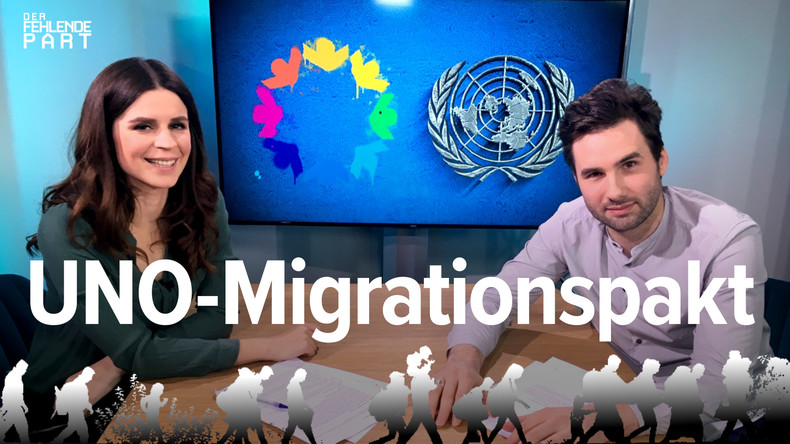
Der Globale Pakt für sichere, geordnete und reguläre Migration wirft viele Fragen auf, welche der Fehlende Part in dieser Woche behandelt. Mit einem Studio-Gespräch zwischen Jasmin Kosubek und Alexander Pałucki. Außerdem: ein Bericht über den Filmemacher Grigorij Richters.
Ein umstrittenes UN-Dokument sucht die deutsche Medienlandschaft nun offiziell heim: der Globale Pakt für sichere, geordnete und reguläre Migration.
Nach nahezu konstantem Verschweigen und ein paar Bundestagserwähnungen in diesem Jahr ist die "rechtlich nicht bindende" internationale Absichtserklärung, der "Globale Pakt für sichere, geordnete und reguläre Migration" nun in aller Munde. Manche deutschen Medienvertreter planten sogar, erst am Tag der Unterzeichnung am 11. Dezember 2018 darüber zu berichten.
"Souveränitätsverlust" ja oder nein? Die juristischen Experten und politischen Lager sind sich uneinig. Offenbar werden sich aber einige Länder genau dieser Argumentation bedienen, um den Pakt von sich zu weisen.
Wer außer Zivilgesellschaft und Regierungsspitzen war aber noch an der Entstehung des UNO-Papiers beteiligt? Dazu erfahrt ihr mehr in unserem Studio-Gespräch zwischen Jasmin Kosubek und Alexander Pałucki.
Trotz der wachsenden Skepsis gegenüber internationaler Migrationspolitik in manchen Bereichen der Gesellschaft gibt es Menschen, die die Angelegenheit auf ihre eigene Weise in eigene Hände nehmen: Grigorij Richters ist Filmemacher und seit dem 27. Oktober zu Fuß unterwegs. Unter dem Motto "I March for You" läuft der Hamburger von Paris nach Berlin, um auf die vergessenen Kinder in den Flüchtlingslagern in Griechenland aufmerksam zu machen. Mittlerweile haben sich nicht nur Privatfamilien bereit erklärt, 250 Kinder aufzunehmen. Auch die Städte Bonn und Köln sind bereit, mehr zu tun. Das Problem ist zum einen die EU, zum anderen die Bundesregierung, die in Sachen Migration nicht ohne Abstimmung entscheiden kann. Ein Bericht von Jasmin Kosubek.
Obwohl die Mitgliedsstaaten bereits seit Januar 2016 gezielt am Pakt arbeiten, waren sowohl die Berichterstattung als auch die Kommunikation der Bundesregierung selbst die meiste Zeit absolut unbefriedigend. Doch mit zunehmenden Zweifeln seitens der Länder, die aus dem Pakt aussteigen, häufen sich auch die Fragen und Ängste der Menschen, die vermehrt auf die Straße gehen und Petitionen unterschreiben. Obgleich es am 8. November so weit war, eine öffentliche Debatte über den Migrationspakt im Bundestag zu veranstalten, lehnt der Petitionsausschuss des Bundestags Petitionen gegen den Pakt nach wie vor mit der Begründung ab, sie "könnten den interkulturellen Dialog belasten".
UNO-Migrationspakt auf Deutsch: 
„Business Case for Migration“, das Papier des Weltwirtschaftsforums (WEF) auf Englisch:
Internationale Arbeitgeberorganisation (IOE) über „Arbeitsmigration“:
CDU.de: Fragen und Antworten zum UN-Migrationspakt
DFP-Kommentar: Das Weltwirtschaftsforum in Davos: Wer bestimmt die globale Agenda?
DFP-Interview: „Kritik der Migration“ – Österreichischer Historiker Hannes Hofbauer im Gespräch

Wednesday, November 14, 2018

NATO Manöver Kritik "Trident Juncture" aus der "Friedensbewegung"?

TRAINING FÜR DEN ERNSTFALLBeteiligung an Nato-Großmanöver kostet Deutschland 90 Millionen Euro

Tausende Bundeswehrsoldaten trainieren in den kommenden Wochen bei einem Nato-Manöver. Die Kosten erreichen fast einen dreistelligen Millionenbetrag.
 Kommentieren 


Leopard-2-Panzer der Bundeswehr fahren nach der Verschiffung für das Großmanöver der Nato „Trident Juncture“ vor dem RoRo-Schiff. Mit dem Manöver will die Nato vom 25. Oktober an für den sogenannten Bündnisfall trainieren. Quelle: dpa
Nato-Großmanöver
Leopard-2-Panzer der Bundeswehr fahren nach der Verschiffung für das Großmanöver der Nato „Trident Juncture“ vor dem RoRo-Schiff. Mit dem Manöver will die Nato vom 25. Oktober an für den sogenannten Bündnisfall trainieren.
(Foto: dpa)
BrüsselDie Beteiligung der Bundeswehr am Nato-Großmanöver „Trident Juncture“ wird die deutschen Steuerzahler rund 90 Millionen Euro kosten. Gut die Hälfte der Summe fließt ins Gastgeberland Norwegen, wo unter anderem für die Verpflegung und Bereitstellung von Feldlagern bezahlt werden muss. Der Rest ist für den Hin- und Rücktransport von Personal und Material eingeplant, wie die Deutsche Presse-Agentur aus dem Verteidigungsministerium erfuhr.
Mit dem Großmanöver in Norwegen will die Nato vom kommenden Donnerstag an ein Signal der Abschreckung an Russlandsenden und für den sogenannten Bündnisfall trainieren. Dieser könnte ausgerufen werden, wenn einer oder mehrere der 29 Mitgliedstaaten von einem Gegner angegriffen würden. In der Folge müssten dann die anderen Alliierten Beistand leisten.
Die Übung wird mit rund 50.000 Soldaten die größte seit Ende des Kalten Krieges. Deutschland beteiligt sich mit rund 10.000 Soldaten, 8.000 davon werden in Norwegen vor Ort sein. Die Bundeswehr ist damit nach Gastgeber Norwegen zweitgrößter Truppensteller.
Dass die Bundeswehr so stark beteiligt ist, liegt vor allem daran, dass sie ab Anfang 2019 die Führung der schnellen Eingreiftruppe der Nato übernehmen soll. Die sogenannte VJTF (Very High Readiness Joint Task Force) wurde im Zuge der Ukraine-Krise aufgestellt und ist ebenfalls ein Element der Abschreckungsstrategie gegen Russland, der seit 2014 wieder starke Aufmerksamkeit gewidmet wird.
https://www.handelsblatt.com/politik/deutschland/training-fuer-den-ernstfall-beteiligung-an-nato-grossmanoever-kostet-deutschland-90-millionen-euro/23213944.html?ticket=ST-750512-gSZ29XfZIXiiBxEF5JRv-ap2

Emergency demonstrations throughout Israel: Stop the war! Movetowards peace! Today at 20:00 - Haifa, Tel Aviv, Jerusalem


Israeli peace movement.  Not large, but courageous.  

 
Hebrew original was forwarded by Standing Together <media@standing-together.org> ,   translation  Adam Keller
 
Press Release Nov. 13, 2018 
Emergency demonstrations throughout Israel: Stop the war! Move towards peace!
Today at 20:00 - Haifa, Tel Aviv, Jerusalem
 
The Standing Together movement, along with various peace groups, will demonstrate today (Tuesday, Nov. 13) throughout the country, demanding a complete change of  direction. Instead of war and fear and bloodshed we should  lift the siege of Gaza, end the occupation, and actively pursue of a comprehensive Israeli-Palestinian peace.
 
The pain of suffering casualties, the fear of another night without sleep and the question “why?" are now the lot of very many people. We want - we must -  change this reality. This conflict has gone on far too long. Again and again it flares up. Again we hear arrogant statements about “It is time to teach them a lesson” which do not and should not give anyone a feeling of confidence. 
 
We must take a new path. Residents of Southern Israel and residents of Gaza, Israelis and Palestinians – only peace can guarantee security to all of us. Only peace will ensure quiet nights -  this is the only way. Let's end for spreading hatred and sowing fear, let's end this pain. Today, especially today, let us demand what should have taken place long ago, the only thing that can ensure life: lifting of the siege, ending the occupation and achieving Israeli-Palestinian peace. We deserve a happy ending to this sad and difficult story. "
 
The demonstrations will take place at:
Haifa - UNESCO Square in the German Colony, at the foot of the Baha'i Gardens
Jerusalem - Paris Square
Tel Aviv – The corner of Rothschild Boulevard and Allenby Street
 
***
 
For further details and coordination of interviews:
Hila +972-(0)54-2457680 or Doron +972-

Tuesday, November 13, 2018

Pat Buchanan: Macron Trash Talks “America First”


Charles de Gaulle was perhaps the greatest French patriot of the 20th century.
 He spoke of a Europe of nation-states and ordered NATO out of France in 1966.
Patrick J. Buchanan
Published
 
on
 
459 Views


In a rebuke that bordered on a national insult Sunday, Emmanuel Macron sniped at Donald Trump’s calling himself a nationalist.
“Patriotism is the exact opposite of nationalism; nationalism is a betrayal of patriotism,” Macron said.
As for Trump’s policy of “America first,” Macron trashed such atavistic thinking in this new age: “By saying we put ourselves first and the others don’t matter, we erase what a nation holds dearest, what gives it life, what makes it great and what is essential: its moral values.”
Though he is being hailed as Europe’s new anti-Trump leader who will stand up for transnationalism and globalism, Macron revealed his ignorance of America.
Trump’s ideas are not ideological but rooted in our country’s history.
America was born between the end of the French and Indian War, the Declaration of Independence in 1776, and the ratification of the Constitution in 1788. Both the general who led us in the Revolution and the author of that declaration became president. Both put America first. And both counseled their countrymen to avoid “entangling” or “permanent” alliances with any other nation, as we did for 160 years.
Were George Washington and Thomas Jefferson lacking in patriotism?
When Woodrow Wilson, after being re-elected in 1916 on the slogan “He Kept Us Out of War,” took us into World War I, he did so as an “associate,” not as an Allied power. American troops fought under American command.
After that war, the U.S. Senate rejected an alliance with France. Under Franklin Roosevelt, Congress formally voted for neutrality in any future European war.
The U.S. emerged from World War II as the least bloodied and least damaged nation because we stayed out for more than two years after it had begun.
We did not invade France until four years after it was occupied, the British had been thrown off the Continent, and Josef Stalin’s Soviet Union had been fighting and dying for three years.
The leaders who kept us out of the two world wars as long as they did—did they not serve our nation well, given that America’s total losses were just over 500,000 dead, compared with the millions that other nations lost?
At the Armistice Day ceremony, Macron declared, “By saying we put ourselves first and the others don’t matter, we erase what a nation holds dearest…its moral values.”
But Trump did not say that other countries don’t matter. He only said we should put our own country first.
What country does Emmanuel Macron put first?
Does the president of France see himself as a citizen of the world with responsibility for all of Europe and all of mankind?
Charles de Gaulle was perhaps the greatest French patriot of the 20th century. Yet he spoke of a Europe of nation-states, built a national nuclear arsenal, ordered NATO out of France in 1966, and, in Montreal in 1967, declared, “Long live a free Quebec”—inciting French Canadians to rise up against “les Anglo-Saxons” and create their own nation.
Was de Gaulle lacking in patriotism?
By declaring American nationalists anti-patriotic, Macron has asserted a claim to the soon-to-be-vacant chair of Angela Merkel.
But is Macron really addressing the realities of the new Europe and world in which we now live? Or is he simply assuming a heroic liberal posture to win the applause of Western corporate and media elites?
The realities: in Britain, Scots are seeking secession, and the English have voted to get out of the European Union. Many Basques and Catalans wish to secede from Spain. Czechs and Slovaks have split the blanket and parted ways.
Anti-EU sentiment is rampant in populist-dominated Italy.
A nationalism their peoples regard as deeply patriotic has triumphed in Poland and Hungary and is making gains even in Germany.
The leaders of the world’s three greatest military powers—Trump in the U.S., Vladimir Putin in Russia, and Xi Jinping in China—are all nationalists.
Turkish nationalist Recep Tayyip Erdogan rules in Ankara; Hindu nationalist Narendra Modi is head of India. Jair Bolsonaro, a Trumpian nationalist, is the incoming president of Brazil. Is not Benjamin Netanyahu an Israeli nationalist?
In France, a poll of voters last week showed that Marine Le Pen’s renamed party, Rassemblement National, has moved ahead of Macron’s party for the May 2019 European Parliament elections.
If there is a valid criticism of Trump’s foreign policy, it is not that he has failed to recognize the new realities of the 21st century. It’s that he has not moved expeditiously to dissolve old alliances that put America at risk of war in faraway lands where no vital U.S. interests exist.
Why are we still committed to fight for a South Korea far richer and more populous than the nuclear-armed North? Why are U.S. planes and ships still bumping into Russian planes and ships in the Baltic and Black seas?
Why are we still involved in the half-dozen wars into which Bush II and Barack Obama got us in the Middle East?
Why do we not have the “America first” foreign policy we voted for?

Patrick J. Buchanan is the author of Nixon’s White House Wars: The Battles That Made and Broke a President and Divided America Forever. To find out more about Patrick Buchanan and read features by other Creators writers and cartoonists, visit the Creators website at www.creators.com.http://theduran.com/pat-buchanan-macron-trash-talks-america-first/
Liked it? Take a second to support The Duran
 on Patreon!

Monday, November 12, 2018

Finian Cunningham World War I Homage – A Triumph of Lies and Platitudes


The unilateral, lawless imperialism that engendered World War I and 20 years later
World War II is still alive and dangerously vigorous.
Published
 
on
 
159 Views


World leaders gathered in Paris on Sunday under the Arc de Triomphe to mark the centennial anniversary ending World War I. In an absurd way, the Napoleon-era arc was a fitting venue – because the ceremony and the rhetoric from President Emmanuel Macron was a “triumph” of lies and platitudes.
Among the estimated 70 international leaders were US President Trump and Russian counterpart Vladimir Putin, each sitting on either side of Macron and his wife. German Chancellor Angela Merkel was also given pride of place beside the French president.
Macron’s address to the dignitaries was supposed to be a call for international multilateralism. He urged a “brotherhood” for the cause of world peace. He also made a pointed rebuke of “nationalism” as posing a danger to peace – a remark which seemed aimed at Donald Trump who recently boasted of his politics with that very word.
But, ironically, everything about the ceremony and Macron’s speech resonated with jingoistic French nationalism, not his avowed multinationalism. As the politicians sat under the Arc de Triomphe, Macron walked around its circular esplanade in a salute to assembled French military forces bearing assault rifles and bayonets. The French anthem – The Marseillaise – was played twice, once by an army brass band, the second time sung by an army choir. There was also a military plane flyover displaying the blue, red and white tricolor of the French national flag.
In his speech, Macron talked about soldiers coming from all over the world to “die for France” during the 1914-18 Great War. He even said at one point that the war was fought for “the vision of France” and its “universal values”.
This was fluent drivel, French-style. No wonder Russia’s Putin momentarily gave a look of boredom as Macron waxed lyrical.
The speechifying and commemoration was completely detached from current realities of conflict and international tensions.
Among the “brotherhood” whom Macron was appealing to were Israeli Prime Minister Benjamin Netanyahu whose military forces continue to bomb and slaughter Palestinian civilians in illegally occupied territory. Also present was Ukrainian President Petro Poroshenko whose armed militias continue to terrorize the people of eastern Ukraine with the blatant objective of instigating a war between the US-led NATO alliance and Russia.
Listening to Macron one would think that World War I erupted mysteriously from no specific cause and that an estimated 10 million soldiers were all killed in heroic battles for noble principles.
There was, of course, no mention by Macron of imperialist warmongering and the barbaric sacrifice of humans as slaves in the service of national capitalist power interests.
Grotesquely, as the world leaders donned solemn faces and mouthed pious platitudes for peace, the whole occasion was a triumph in burying reality and the ongoing causes of wars, as well as whitewashing the very culprits responsible for wars. Among the war criminals wearing a mournful black suit was former French President Nicolas Sarkozy who launched the NATO blitzkrieg on Libya in 2011.
While the empty, self-indulgent rhetoric was ringing out, one couldn’t help but recall some of the most glaring contemporary contradictions that were blocked out with awesome Orwellian efficiency.
Just this week, reports emerged of the horrific civilian death toll from the American air force bombing the Syrian city of Raqqa. The city was razed to the ground by US air strikes last year – supposedly to defeat the ISIS terror group. Some 8,000 bodies of civilians, mainly women and children, have now been recovered by Syrian government forces. And that’s only from clearing away a tiny area of rubble for the whole city.
What the Americans did in Raqqa was a monumental war crime, all the more criminal because US forces, along with their NATO partners Britain and France, are illegally present in and assaulting sovereign Syrian territory.
As Macron was telling world leaders about “the vision of France”, hundreds were being killed in Yemen in a battle to strangle the entire population by taking the port city of Hodeida. The genocidal war on that country – which is putting up to 16 million people at risk from starvation – has been fully backed by France, the US and Britain, from their supply of warplanes and bombs to the Saudi and Emirati aggressive forces.
We could mention other specific conflicts where the culprits are clearly identified. For example, the multi-million-dollar support from Washington for the Azov Battalion and other Neo-Nazi militias in Ukraine, which openly emulate the genocidal conduct of Hitler’s Third Reich to exterminate ethnic Russians.
We could mention how US-led NATO forces continue to expand towards Russian territory with outrageous provocation. The mounting earlier this month of the biggest-ever NATO war drills since the Cold War in the Arctic region adjacent to Russia’s northern border was a brazen threat of rehearsing invasion. The announced tearing up of yet another nuclear arms control treaty unilaterally by Washington is a reckless undermining of global security.
Washington threatens China with naval forces marauding near Beijing’s maritime territory in the South China Sea. Washington blockades Iran with illegal economic warfare and openly agitates for regime change. Washington declares Venezuela, Nicaragua and Cuba a “troika of tyranny” and reserves the right to threaten each of these countries with military invasion at any time.
Meanwhile, this weekend, Russia hosted peace talks in Moscow between the warring parties of Afghanistan. It was seen as a major breakthrough in trying to bring peace to the Central Asia country which has been wracked by 17 years of violence since US forces began their ongoing military occupation – allegedly to defeat terrorism.
Elsewhere, Russia has engaged with Turkey, Germany and France to convene a summit for peaceful reconstruction of Syria. The latest summit held in Ankara at the end of last month follows several other such meetings in Astana and Sochi, largely at the behest of Russian leader Vladimir Putin, to find a political settlement to the nearly eight-year war in Syria – a war that was fomented covertly by Washington and its allies for regime change.
France’s Macron talks about “multilateralism” for world peace, yet the two countries which have arguably supported and implemented multilateralism in practice are Russia and China in their calls and policies for global partnership and economic development.
And yet it is Russia and China that are being harassed with American and European sanctions, and US military provocations.
The unilateral, lawless imperialism that engendered World War I and 20 years later World War II is still alive and dangerously vigorous. We only have to look around the present world to realize that. But when the culprits indulge in a triumph of bullshit then we also know that the world is once again in very grave danger.

Sunday, November 11, 2018

The ‘War Party’ Wins the Midterm Elections, Accelerating the Transition to a Multipolar World Order


The outcome of the American midterm elections gives us an even more divided country,
confirming that the United States is in the midst of a deep crisis within its establishment.
Published
 
on
 
2,139 Views


The midterm elections represented a substantial draw for Democrats and Republicans, a defeat for the Trump administration and a clear victory for the “war party” in Washington. The House of Representatives ended up in the hands of the Democrats, who managed to overturn the results of 2016 by winning 26 seats and bringing their majority to 219, with the Republicans with 193 seats. The Republicans, despite the feared “blue wave”, have increased their representation in the Senate, with 51 senators against the 45 of the Democrats. In terms of governors, Republicans remain ahead, with 25 red states against 21 blue. After two years of fake investigations on Russiagate, continuous attacks by the US media (except for the few pro-Trump channels like Fox News), the blue Democratic wave seemed inevitable. Instead, we witnessed a minor repetition of the 2016 elections, with Trump managing to perform above expectations.
The House of Representatives performs functions mainly related to domestic politics, while the Senate is responsible for confirming important appointments such as those to the Supreme Court. The Democrats holding the majority in the House makes Trump’s 2020 presidential campaign an uphill battle. Trump will need to be able to present to his constituents from 2019 with a series of 2016 promises fulfilled. Getting one’s legislative agenda passed with the House in the hands of one’s opponents is difficult at the best of times. For Trump the task becomes almost impossible.
For this reason, we are faced with a scenario that delivers the country to the war party, that faction composed of Republicans and Democrats who respond to the interests of specific conglomerates of power and not to the citizens who elected them. The real winners of the midterms appear to be the intelligence agencies, Wall Street and the banks, the ratings agencies, the Fed, the mainstream media, think-tanks, policy-makers, and the military-industrial complex. Donald Trump has come to discover, in his first two years as president, how little autonomy he has in foreign policy, thanks to the warmongering of the US establishment.
The realist view of foreign policy on which Trump based his election campaign was swept away just a few days after his victory. Hoping to bribe the hawks in Washington, Trump surrounded himself with neoconservatives, who only ended up trying to box him into something that resembles the Washington Consensus, where every attempt at dialogue with opponents is seen as a surrender or sign of weakness.
Washington and its elites live trapped in a unipolar bubble, still convinced that the United States is the only world power left on the geopolitical chessboard. Even the Pentagon’s military planners have confirmed in two official documents (the Nuclear Posture Review and National Defence Review) how international relations have shifted into a multipolar reality where the United States will have to deal with peer competitors like Russia and China.
Washington’s neoliberal inner circle views international relations in a very unrealistic and ideologically spoiled manner. This was masterfully explained by Mearsheimer in his latest book, suitably entitled The Great Delusion, where he compares the three most important “isms” of nationalism, liberalism and realism. Those who make up the overwhelming majority of the foreign-policy establishment are convinced that the United States is a benign hegemon that has a moral duty to remake the world in its own image and likeness.
In the process, bombing a country, destroying its social fabric and killing hundreds of thousands of innocents is justified by this supposedly noble end. This is end-justifies-means mentality is behind the overwhelming majority of Washington’s foreign-policy actions. Of course only people who are victims of their own propaganda can really believe that they are acting in the greater good by bringing about so much chaos and destruction. On the contrary, the rest of the world has for decades observed with disgust and dismay the imperialism of a warmongering country committed to consuming the resources of others, vainly hoping, especially since 1990s, that the unipolar moment would be cut short through the counterbalancing effect of other powers. Ultimately, it is not only Russia and China that awaits a multipolar world, but all those countries that do not intend to submit to American diktats over how they conduct their own foreign or domestic policies.
The outcome of the midterm elections could speed up this process. With the House of Representatives in the hands of the Democrats, Trump will have to abandon his realist foreign policy even more so than he has done over the last two years. The accumulation of foreign-policy concessions is starting to become disturbing. Just think of the enmity towards Iran, fomented by Israel and Saudi Arabia, the main partners of the Trump administration. The same goes for China, with the antagonism fomented by Trump himself to justify the impoverishment of the US middle class who voted in force for him to change this situation. And of course there remains the endemic hatred of Russia, a sworn enemy of the Washington establishment.
Trump still seems to possess a bit of Mearsheimerian realism in foreign policy. But following his defeat in the House, if he wants to get anything passed, he will need to grant much more of a free hand in foreign policy to the neoliberals, who are chomping at the bit to revive the Bush and Obama foreign policy. Without any concessions from the House, all of Trump’s domestic promises to his constituents will be hobbled.
The permanent political civil war in the United States seems destined to intensify over the next two years, and the prospect of an even less independent administration in foreign policy will impel the rest of the world to rely less and less on Washington and begin to look elsewhere. Even European countries like France, Germany and Italy seem to have understood that an exclusive alliance with Washington is not beneficial and is in fact destined to fail as a result of of the chaos in US politics. In this context, the events of the past few days are particularly important and certainly worthy of elaboration in a future article. While many Eurasian countries like India, Japan, Turkey, Iran, Russia, China, Afghanistan and Pakistan try to overcome their differences by creating international cooperation frameworks, Washington pushes unnecessarily on the accelerator of disorder. A shining example of what Washington’s decline means can be clearly seen in Korea. Without the direct involvement of the United States, Seoul and Pyongyang seem to be heading towards peaceful reconciliation. Moon Jae-in and Kim Jong-un interact every day, and the progress made on the DMZ speaks for itself, such as with renewed railway connections. Such an example, reflecting the global model that tends towards resolving problems, represents the basis on which to build bilateral, direct and negotiated solutions between relevant parties.
Such examples are numerous and concern, for example, the disagreements between India and China, as well as the territorial disputes between Japan and China and Japan and Russia. The goal is always the same: to overcome obstacles that stand in the way of mutual gain. It is a way of approaching international relations that differs from the bipolar past, but above all from the unipolar one where the attention of all international actors has been focused on the interests of Washington above even one’s own.
The continuing division within the American political class will only accelerate the loss of America’s pre-eminence in the existing the world order. The United States finds itself in the middle of an evident decline, without even a united and compact political front as was the case during the days of Bush and Obama. But with Trump in office, the House in the hands of the Democrats, and the Senate in the hands of Republicans, we are facing a situation that is set to downsize Washington’s role in international affairs.
There is still an even crazier and more devastating scenario for America’s role in the world. Trump’s impeachment, which can be initiated by the House of Representatives, would significantly add to the chaos in the United States and risk bringing the country to the brink of socio-political collapse. While this scenario is very unlikely, it cannot be totally excluded, especially given the ideological folly of the Washington establishment.
A Pence presidency would best represent the interests of evangelical conservatives, who are closely linked to Israeli Zionism. For this reason, the impeachment of Trump could find allies in the Republican minority, not to mention the fact that such a move by the Democrats would open the way for the Republicans to win in 2020, stamping the Democrats as spoilers only able to oppose and unable to build anything. Such a possibility cannot be excluded, and with the victory of the war party in the midterms, a President Pence would represent the greatest effort of the American establishment to impose its will on the rest of the world on the basis of “American exceptionalism”.
Prolonging the unipolar dream seems to be the new goal of the war party, and the reconquest of the House is the first step in this endeavour. Trump can adapt or give battle, but observing how he immediately came to terms after his victory in 2016, it is no surprise that if he stays in charge and tries to win the 2020 election, he will cede foreign policy to the neocons, neoliberals, Zionists and Wahhabis.
Allies and enemies alike must prepare to withstand the shock waves emanating from the struggle between the elites in Washington, understanding that it is not possible to rely on Trump, let alone the war party, especially when the damage produced by both has negative effects on even allies. Europe, for example, suffers from the blowback of a Middle East and Africa sunk into chaos by the war party, and also suffers economically from the sanctions placed on Russia and Iran.
What is more, Trump’s economic warfare, using tariffs and sanctions, has only worsened the international financial economic arrangement, accelerating the complete de-dollarization of world economies.
The midterms were what Washington’s allies and enemies had been waiting for in order to understand the direction of US foreign policy in the next few years. The election results present allies and enemies with an even more divided and chaotic United States, suggesting that it is time for them to stop waiting for Washington. Given that Trump does not control his foreign policy, any attempt to engage in dialogue with him is pointless. The sooner allies and enemies realize this, and act accordingly, the better off they will be.
Washington and her elite seem too caught up in domestic dynamics to notice that their behaviour is only accelerating the transition to a multipolar world order
The next two years will settle the question over whether our present reality is already multipolar, or whether the unipolar order remains, with Washington the indispensable nation for friends and enemies alike. http://theduran.com/the-war-party-wins-the-midterm-elections-accelerating-the-transition-to-a-multipolar-world-order/