Wednesday, March 28, 2018

The Western-Eurasian Seismic Shift; the March 2018 Factors

by Ghassan Kadi for the Saker blog
March 2018 seems to continue to be full of surprises, and when we speak about the imminent and inevitable collapse of the Empire, and the consequential demise of global Western influence, we often forget who is the biggest loser, or rather victim, of this forthcoming event.
Without a speck of doubt, the biggest loser will be the Western civilian.
The time has come for citizens of the West to wake up and realize that the Western Civilization is under threat, a huge threat. The threat is not from Russia as their politicians have managed to convince them in order to deflect their attention, but from their failed leaders.
When Westerners watch TV news, they hear lies. When they go to their ballot boxes, they hear false promises. When they are told that their sons and daughters are sent to fight a war in a distant country in order to protect the homeland, they are hearing fabricated stories of lies and deception.
Their politicians lie, and their media dance to the tunes of the lies of their politicians.
After their governments lied to them about Korea, Vietnam, Iraq, Afghanistan and Libya, and they know they lied, they continue to believe their lies about Syria and Russia today.
A few decades ago, the perception of those lies by the populace did not make much of a difference, because the West was “flying high” on many fronts. But this is now changing, and changing fast.
At this juncture, we owe the Western Civilization a good review, and this is a task that requires extensive research, something which is far beyond the content and capabilities of this article. Not even a single PhD thesis can cover this topic satisfactorily. And incidentally, almost every time I wrote an article about the West in the past, and America in particular, some feedback comments insinuated that I should only write about Syria and that I don’t know enough about America to be writing about it. Whilst such statements do not really represent my knowledge of the West, the main objective of this article is for the Western reader, particularly American readers, to have a look at what an “outsider” has to say from a distant vintage point.
After all, a bird’s eye view from a distance sees the overall picture, but a close eye can easily get bogged down in the details.
When we talk about the Empire, we must keep in mind that the citizens of the West and Western politics are two different things.
And when Western politicians chant such mantras as democracy and human rights, and use them to bolster their own positions for personal, or at best, party gain, they would indeed be capitalizing on the achievements of Western people, the Western mind; not Western governments.
The achievements of the contemporary Western Civilization have been a subject of claim and ownership by many now minor Western and other non-Western nations. It is not a secret that the gates for the Western mind to fly and soar were opened up during the Renaissance, but the Renaissance is seen by Arab/Muslim scholars, and for good and substantiated reasons, as a byproduct of Muslim Civilization and the Andalusia factor, which in turn can be attributed to earlier Byzantine, Roman, Greek, Phoenician, Egyptian, Sumerian civilizations.
This is all true, and historically documented. The success of the Ford factory did capitalize on the Babylonian invention of the wheel, it didn’t have to pay the inventor any royalties, but such is the path of civilization.
The Western Civilization therefore did not start from scratch and Stone Age or even beyond. It did take on board the achievements of earlier civilizations; not only from the Near East and closer, but even from as distant nations as India and China.
So let us not underestimate the Western Civilization.
The countless number of the achievements of Western Civilization encompasses virtually all aspects of human endeavor and excellence. Even Chinese medical universities now teach Western Medicine alongside ancient traditional Chinese Medicine.
But it was Galileo, Copernicus and Magellan who proved that earth was a round ball; not Western Governments.
It was Da Vinci and Dali, and many artists in between, who inspired their minds and vision.
It was Pythagoras and Kant, and many other philosophers in between who evoked their souls and sense of awakening.
It was the brilliant minds of scientists like Newton and the recently departed Hawkins who set the Western mind on the path of technological achievements; not Hillary Clinton.
And when the people of France rose against the exploits of the French Monarchy, they were motivated by Voltaire, Rousseaux and Moliere, not by the nobility.
And when other monarchies either tumbled or gave “power to the people”, it was in every instant, a fateful event in which Western governments had to grant their citizens the right to vote, first men then women, and were forced to adopt democracy; by the power and will of the people who had become educated and free-thinking.
The monarchies of Western Europe today are a testimony of royal dynasties that managed to survive by accepting the compromise of hanging on to their thrones as titular figures, and giving power to the democratic process; or at least, this is how it is understood to be.
After having parliaments with elected members who appoint governments, Western citizens believed that they have reached the pinnacle of the rights of citizenship.
And why wouldn’t they feel this way when events were rosy all around?
To top it off, Western citizens were given what appeared to be unconditional freedom of speech, political freedom and the premise of defending and upholding human rights. In view of all of this, Western civilians felt there was no need to ask for much more. They had it made, they thought, and humanity had reached a zenith never expected in the past, a status in which they can live peacefully, with superb medical help, good education for their children, the right to speak and worship, and an economy of abundance. Who could ask for more?
For a while, and this “while” varies a bit from one western country to another, Western citizens did not need to question those milestone achievements.
It was those strong achievements that built wealth and prosperity; not the stock market. That wealth was produced when the West had real productivity, but this is all now dwindling away, and very fast.
Westerners have learned to take their past earned privileges for granted. They seem to totally turn a blind eye to the highly competitive and rising Eurasia. The once strong economies the West had has enabled its citizens to earn more for working less than citizens of developing countries. Furthermore, by inflating their currencies and suppressing currencies of developing nations, the West has given its citizens an unfair advantage over citizens of other nations who manufacture their consumables. But this luxury is coming to a head.
The month of March 2018 has served Western global hegemony with two serious blows; the first was Putin’s 1st of March speech, and the second was the launch of the Petroyuan on the 26th of March.
The Putin speech told the West, and America in particular, that it no longer has the military edge over Russia. And even though STRATCOM Commander General Hyten was initially dismissive and reiterated that American submarines have the capacity to “decimate” Russia and China https://sputniknews.com/military/201803091062379869-submarines-can-decimate-russia-china/ , almost overnight, he made a very contradictory, yet more realistic statement, and said that America does not have the means to defend itself against Russia’s new hypersonic weapons http://www.dailymail.co.uk/news/article-5525257/US-defend-against-Russias-hypersonic-weapon-commander-says.html
Later on, the introduction of the Petroyuan heralded the beginning of the end of the Petrodollar and American financial hegemony.
Two almost fatal blows that the West has received this month, and citizens of the West seem none the wiser. They are concerned with the Skripal case and the “shameful” behaviour of Russia and all the ensuing sanctions, not seemingly knowing that this month their military and financial superiorities have been taken away from them.
How bizarre.
We are now on the cusp of a major civilizational shift. The Western hegemony is finished. Eurasia is taking over. This is a major and unprecedented civilizational seismic shift, but few in the West seem to be concerned; let alone aware.
How bizarre, how bizarre, how bizarre.
The tragedy here is that citizens of the West, many of them, most of them in fact, continue to believe that the slogans of human rights and freedom that their politicians dish out to them on a daily basis are indeed the law of the land and that which underpins their governments.
Even after they have been subjected to the falsehood of their governments and politicians many a time, and even after they have seen how corrupt and deceitful their governments have been in the past and recent past, many, in fact most Westerners continue to believe that their system of government is perfect, and that they only need to find a way to eradicate corruption.
And even though talk of the so-called “deep state” has been brought to the surface more than ever after the election of President Trump, many Westerners, most of them, continue to believe that proper reform can rectify this anomaly that is in total contradiction with their respective constitution(s).
When dirt finally hits the fan and the lies and deceptions can no longer be hidden, citizens of the West will wake up and realize that not only have they been lied to, not only have they lost their world stature, lifestyle and wealth, but the whole civilization is now under threat.
Citizens of the West will have all the right to feel let down at seeing that their wealth and achievements have been squandered by their politicians and the business elites.
Citizens of the West will have all the right to be angry because their two-party system took away from them the right to actually choose their own leaders.
Citizens of the West will have all the right to feel undermined and cheated at seeing that their sons and daughters went to fight illegal wars that did not have any justification.
Citizens of America in particular have all the right to be devastated at seeing that 50 million of them are on food stamps and millions others homeless.
Citizens of the West need to ask their leaders and media outlets how they can in recent times throw accusations on other nations without providing a shred of evidence. What happened to the Western principle of “innocent until proven guilty”? they should ask.
Citizens of the West must wake up and realize that all that is left of their lofty principles are hollow slogans, but the core is rotten, corrupt, and has totally lost its morality and integrity.
The Western Civilization is on the cusp of total and utter collapse unless citizens of the West wake up to the ill-deeds of their political apparatus.
This is far more serious than France’s Louis the XVIth days just prior to the French Revolution. Back then, the issue at hand was economic inequality. Now, the whole civilization, at every level, is under threat of dwindling into oblivion.
The West now needs a new intellectual revolution; not a military revolution, because the Western mind has reached a level of civility that should allow its citizens to implement political changes within the democratic process; provided that they manage to find a way to allow them to do so.
Western citizens should be asking for the fruits of their achievements to be restored.
Once again, Western Civilization and the Western Empire are two distinct things. It is hoped that the civilization will survive the huge challenges it is facing, but Western governments seem hell-bent on the path of destruction, and it is time for Western citizens to rise and realize that the clock is ticking, and that it is time for Bastille Day Take II.
The Essential Saker II
The Essential Saker II: Civilizational Choices and Geopolitics / The Russian challenge to the hegemony of the AngloZionist Empire
Order NowFree Downloadhttps://thesaker.is/the-western-eurasian-seismic-shift-the-march-2018-factors/

Tuesday, March 20, 2018

In Syria, the Real Siege Is by Western Criminal Powers


In Syria, the Real Siege Is by Western Criminal Powers
EDITORIAL | 02.03.2018 | WORLD / MIDDLE EAST

In more than seven years of war in Syria, we have seen many times how Western governments and news media shamelessly invert reality.
The same was seen this week over the grim fighting around Eastern Ghouta, the suburb near the capital, Damascus, where 400,000 people are said to be trapped.
But who is trapping who?
US and European media breathlessly claim that Eastern Ghouta is under siege from Syrian “regime forces” allied with Russia. This description is posing things upside down.
The district was taken over nearly six years ago by foreign-backed extremists, like Jaysh al Islam, Ahrar al Sham, and Al Nusra Front. The latter is an internationally outlawed terror group, but they all share the same murderous ideology, as well as the same Western covert sponsors in the American CIA, British MI6, French DGSE, and lavish Gulf Arab funding. It is these illegally armed insurgents who are holding the civilian population under siege in a reign of terror.
The same situation, and Western inversion of reality, has been seen before, most notably regarding Syria’s second city of Aleppo. The Syrian and Russian forces liberated that city at the end of 2016, and since then life for the residents there has fortunately returned to the normal peaceful, pluralist coexistence which prevailed before the foreign-backed terror goons took over.
Yet, Western media and officials continually fabulate about “rebels” and civilians being besieged by Syrian state forces. This inversion of reality is of course necessary in order to push the Western false narrative that has underpinned the covert Western war for regime change in Syria, including the clandestine support for terror groups as proxies.
Further twisting the situation in Eastern Ghouta this week, the Western media blamed the Syrian “regime” and Russia for not implementing a ceasefire plan to enable evacuation of civilians.
Russia proposed a daily five-hour truce, and the Syrian government established humanitarian corridors exiting from the conflict zone. The proposal from Moscow was a reasonable counter to what the US, Britain and France had wanted, which involved a 30-day cessation of all military operations.
The Western powers had tried the same proposal during the liberation of Aleppo. Syria and its legally mandated Russian ally are within their sovereign right to take back remaining territory that has been illegally occupied by foreign-backed militants.
What the Western powers would like to impose is a No-Fly Zone over parts of Syria to enable their residual proxies time and space to regroup. Why should the Syrian government forfeit its sovereign rights by accommodating foreign enemies?
The reason why the Russian humanitarian relief plan proposed this week for Eastern Ghouta did not gain traction was simply because the militants continually shelled the designated corridors for escaping civilians. Video footage clearly showed buses and aid workers organized by the Syrian government waiting to receive the civilians. But none were permitted from the area because of sniper and mortar fire from the militants.
Evidently, the militants are holding the civilian population as hostages and human shields. The same criminal tactics were deployed in Aleppo and other towns and cities where the terrorist gangs ruled with their death-cult barbarity.
Russian Foreign Minister Sergei Lavrov, addressing the UN Human Rights Council in Geneva this week, rightly pointed out that the humanitarian relief plan for Eastern Ghouta can only be made to work if the militants commit to upholding a ceasefire. But these foreign-backed mercenaries have done nothing of the sort. They have not only cut off evacuation corridors under fire; they continue to launch rockets and mortars at nearby government-controlled Damascus inflicting dozens of civilian deaths in recent weeks.
Reliable figures cited by the Syrian Free Press network, indicate that some 85 per cent of the Syrian population live in areas under the control of President Bashar Assad’s state forces. Only a small minority – 15 per cent – live in areas controlled by insurgents. And many of those people are being held in these dwindling areas against their will in a state of fear imposed by the so-called jihadists.
The brazen Western media propaganda war – misnamed as “news” – reports totally from the minority areas, which are exalted as “rebel bastions”.
In all the so-called “reporting” by France 24, BBC, CNN, and others, the information is either sourced from the CIA-sponsored and terrorist-affiliated White Helmets media operation; or anonymous “residents” and “activists”; or it is sourced from “a UK-based monitor” who is an exiled Syrian furniture salesman who has not been in Syria for 15 years.
This pathetic Western mainstream media “journalism” has been going on for the past seven years in relation to Syria.
Significantly, when do you ever hear a Syrian government official or diplomat being aired directly and at length in these media? Or Russian officials? Never. It’s all a one-way street of lies and fabrication.
The preposterous inversion of reality that the Western governments and media have perpetrated over Syria can only be sustained through systematic distortion.
Russia’s humanitarian relief plan for Eastern Ghouta has so far been sabotaged by terror groups firing on civilians. But Western officials and media have the brass neck to claim that the long-suffering population is under siege from the very forces who are trying to liberate them from terror.
When Eastern Ghouta is eventually liberated one thing is sure. The Western media will never follow-up to ask residents what their lives were really like. Just as these same vile propaganda outlets did not follow-up on liberated Aleppo.
As if the distortion couldn’t get any worse, this week the New York Times and other Western media reported claims that North Korea had secretly supplied materials for chemical weapons to Syria. The reported claims seemed unconvincing, as usual, and the Syrian government denied the latest allegations.
Alongside that the British government asserted this week that it would order air strikes on the Syrian “regime” if it found proof that chemical weapons were used.
Adding up the Western distortion it is obvious what the objective is: to find a pretext for overt military aggression on Syria. The covert proxy war using terrorist mercenaries has failed. Now the Western terror sponsors need to take the distortion to an even more demonic level.
In truth, there is indeed a siege in Syria. The entire Syrian nation is under siege – by criminal Western regimes and their equally criminal propaganda media, justifying war and aggression.
Photo: Theirworld


Saturday, March 17, 2018


Acceptable Bigotry and Scapegoating of Russia


Merken
Exclusive: The scapegoating of Russia has taken on an air of bigotry and ugliness, based largely on Cold War-era stereotypes. In this article, Natylie Baldwin counters this intolerance with some of her positive impressions having traveled the country extensively.
By Natylie Baldwin
Over the last year and a half, Americans have been bombarded with the Gish Gallop claims of Russiagate. In that time, the most reckless comments have been made against the Russians in service of using that country as a scapegoat for problems in the United States that were coming to a head, which were the real reasons for Donald Trump’s upset victory in 2016.  It has even gotten to the point where irrational hatred against Russia is becoming normalized, with the usual organizations that like to warn of the pernicious consequences of bigotry silent.
The first time I realized how low things would likely get was when Ruth Marcus, deputy editor of the Washington Post, sent out the following tweet in March of 2017, squealing with delight at the thought of a new Cold War with the world’s other nuclear superpower: “So excited to be watching The Americans, throwback to a simpler time when everyone considered Russia the enemy. Even the president.”
Not only did Marcus’s comment imply that it was great for the U.S. to have an enemy, but it specifically implied that there was something particularly great about that enemy being Russia.
Since then, the public discourse has only gotten nastier. Former Director of National Intelligence James Clapper – who notoriously perjured himself before Congress about warrantless spying on Americans – stated on Meet the Press last May that Russians were uniquely and “genetically” predisposed toward manipulative political activities.  If Clapper or anyone else in the public eye had made such a statement about Muslims, Arabs, Iranians, Jews, Israelis, Chinese or just about any other group, there would have been some push-back about the prejudice that it reflected and how it didn’t correspond with enlightened liberal values. But Clapper’s comment passed with hardly a peep of protest.
More recently, John Sipher, a retired CIA station chief who reportedly spent years in Russia – although at what point in time is unclear – was interviewed in Jane Mayer’s recent New Yorker piece trying to spin the Steele Dossier as somehow legitimate. On March 6, Sipher took to Twitter with the following comment: “How can one not be a Russophobe? Russia soft power is political warfare. Hard power is invading neighbors, hiding the death of civilians with chemical weapons and threatening with doomsday nuclear weapons. And they kill the opposition at home. Name something positive.”
In fairness to Sipher, he did backpedal somewhat after being challenged; however, the fact that his unfiltered blabbering reveals such a deep antipathy toward Russians (“How can one not be a Russophobe?”) and an initial assumption that he could get away with saying it publicly is troubling.
Glenn Greenwald re-tweeted with a comment asking if Russians would soon acceptably be referred to as “rats and roaches.”  Another person replied with: “Because they are rats and roaches. What’s the problem?”
This is just a small sampling of the anti-Russian comments and attitudes that pass, largely unremarked upon, in our media landscape.
There are, of course, the larger institutional influencers of culture doing their part to push anti-Russian bigotry in this already contentious atmosphere. Red Sparrow, both the book and the movie, detail the escapades of a female Russian spy. The story propagates the continued fetishization of Russian women based on the stereotype that they’re all hot and frisky. Furthermore, all those who work in Russian intelligence are evil and backwards rather than possibly being motivated by some kind of patriotism, while all the American intel agents are paragons of virtue and seem like they just stepped out of an ad for Nick at Nite’s How to be Swell.
The recent Academy Awards continued their politically motivated trend of awarding Oscars for best documentary to films on topics that just happen to coalesce nicely with Washington’s latest adversarial policy. Last year it was the White Helmets film to support the regime change meme in Syria. This year it’s Icarus about the doping scandal in Russia.
Similarly, Loveless, the new film by Russian director Andrey Zvyagintsev (director of Leviathan) is being reviewed – as Catherine Brown points out – by writers from the mainstream American media in a predictably biased fashion. The film focuses on the disintegration of a married Moscow couple’s relationship and the complicated web of factors involved which have tragic ramifications for the couple’s 12-year old son.
American reviewers manage to paint the factors detailed in the film that are prevalent in most modern capitalist cities (e.g. being self-centered, materialistic and preoccupied with technological gadgets) as somehow uniquely Russian sins. They also ignore a prominent character in the film that defies their negativity about modern Russia – a character that represents altruism and the growth of civil society in the country.
A common theme in all this is that Russia is a bad country and Russians can’t help but be a bunch of good-for-nothings at best and dangerous deviants at worst. Indeed, according to media depictions, sometimes they manage to be both at the same time. But what they don’t manage to be is positive, constructive or even complicated. Sipher knows that the average American has been deluged with this anti-Russian prejudice, as reflected in his challenge at the end of his initial tweet about the largest country, geographically at least, in the world: Name something positive.
Countering the Negative
Most people know, at least in the abstract, that few individuals or groups are purely good or bad. Most are a complex combination of both. But many – including those who normally consider themselves to be open-minded liberals – have allowed their lizard brains to be triggered by the constant demonization of Russia in the hopes of taking down Trump whom they deem to be a disproportionate threat to everything they hold dear. So as a counterweight to all the negative constantly pumped out about Russia and to take Sipher up on his challenge, I will list some positive things about Russia and the contribution of the country and its people to the world.
Contemporary Russia’s Domestic Policy
Russia has one of the most educated populations in the world, universal health care for its people, a home ownership rate of 84%, strong gun control laws, no death penalty, 140 days of guaranteed maternity leave for women at 100% salary, and Moscow was just voted the 4th safest megacity in the world for women.

(Old) Arbat Street, Moscow; photo by Natylie Baldwin
And, despite claims that are often repeated in corporate media and even by many in the alternative press, Russia has independent and critical voices in the print media. Even on television, which is heavily influenced by the Kremlin, the Western position is often given airtime by either pro-Western Russian critics or Westerners themselves. During both of my visits to Russia (in 2015 and 2017) I interviewed a cross-section of Russians who all confirmed that they had access to Western media through both satellite and the internet. Furthermore, while violence against journalists is a concern, according to the Committee to Protect Journalists, journalist murders have decreased significantly under Putin compared to the era of Boris Yeltsin in the 1990s.
Am I saying that Russia is a utopia without any problems? No. Like most countries, it has plenty. Most Russians, including Putin, admit this. These problems include still significant poverty rates, comparatively low productivity and life expectancy, and corruption. But it is important to note the direction of trends, which are mostly positive since Putin took over. Under his leadership, poverty rates have been cut in half, life expectancy has increased by several years – especially among men who had suffered the worst mortality crisis since WWII, crime has dropped, pensions have increased and are paid regularly, the unemployment rate has been around 5% for years, great investments in infrastructure and agriculture have been seen along with development throughout the country.
And that development has not just been seen in Moscow and St. Petersburg – the latter city which, by the way, culturally and architecturally rivals those in France and Italy.

Church on Spilled Blood, St. Petersburg; photo by Natylie Baldwin
There are plenty of medium-sized cities throughout Russia that are becoming well-developed and culturally engaging. As one example, during my 2015 trip, I visited Krasnodar, located in the Black Sea region. The rate of civic construction in the city during 2014 surpassed even Moscow. As a consequence of the challenges of this rapid development, the public felt that decisions were not being made with sufficient feedback from residents, several of whom got together and created a group called the Public Council which eventually found ways to get city authorities to listen to their concerns.
The group had received significant media attention, networked with youth groups and infrastructure specialists, and received foreign experts in urban planning, public arts, transportation and city marketing. They have also organized periodic clean-up and renovation days, which are sponsored by local businesses that donate use of equipment. Currently, they are working on the creation of protected green zones, including one that connects all of the city’s hiking paths and another to connect its 16 lakes. They have received no opposition from the Russian government and have elicited the interest of other cities who want to model their approach to local issues.
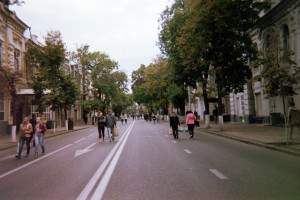
While in Krasnodar I met a dozen or more professionals, from lawyers to engineers and doctors, who lived in the city and were part of another civic group engaged in charitable, conservation and youth programs. At one point, I took a walking tour of the city. In terms of architecture, I saw the old and the new side by side, including a large shopping center that was built around a large tower that had been there for generations that local residents saved from destruction by the mall planners, a square with controversial fountains, and a main thoroughfare that was closed to auto traffic, allowing pedestrians free reign. Couples – including some of mixed race, parents pushing baby strollers, and bicyclists – all wound their way through the streets as both Russian and American music was piped in and building walls on one side of the street for a stretch displayed delicate illustrations of Russian history.

Pedestrian Thoroughfare, Downtown Krasnodar; photo by Natylie Baldwin
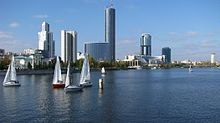
Fifteen hundred miles away in the Ural mountain region, the city of Yekaterinburg – named after Catherine I – has the infamous distinction of being the place where Czar Nicholas II and his family were massacred by the Bolsheviks in 1918. On the site where the family’s bodies were exhumed, a magnificent Russian Orthodox Church has been erected and dedicated to the last royal family. Nearby is the Yeltsin Library, denoting the Russian Federation’s first President, although his legacy is not popular in Russia today.
The city is also home to a wide variety of precious metals and gems, along with a thriving economy. According to Sharon Tennison, an independent program coordinator who has traveled there numerous times over the past 15 years, hundreds of new apartment blocks can be seen on the outskirts of the city to accommodate the recent economic and population growth.
Yekaterinburg has a bustling cultural life that includes an opera house, a ballet, numerous theaters and museums, as well as dozens of libraries. In this respect, the city has continued its preoccupation with the classical arts as in Catherine’s period.  At the same time, many modern Russian rock bands with a distinctive sound have formed there (known as Ural rock).
The city also has a low rate of violence and crime.

Yekaterinburg
As the New York Times and NPR like to point out and generalize out from, there are some rural and industrial areas in Russia that still need attention and investment. However, there are other towns in the countryside that are doing well.
Russia’s Contributions to the World
Russia has made many cultural and humanitarian contributions to the world.  In the 18th and 19th centuries, imperial Russia produced some of the most renowned figures in the world of arts. These include writers, such as Tolstoy and Dostoevsky, whose works are often cited by American readers as among the greatest of all time; great composers include Tchaikovsky, Stravinsky and Rachmaninoff.
The country also has a rich history of pre-Soviet philosophers who debated questions of politics, history, spirituality and meaning. One of the most famous is Vladimir Solovyev, classified as belonging to the Slavophile school but distinguished from his fellow Slavophiles by his openness to and integration of several lines of thought.
He acknowledged the intuitive as well as the rational. He was friends with Dostoyevsky but had disagreements over Orthodoxy since Solovyev was an advocate of ecumenism and healing the schism between Orthodoxy and Catholicism. Furthermore, he is credited with influencing Nicolai Berdyaev, Rudolf Steiner and the Russian Symbolists, among others. He admired the Greek goddess Sophia who he characterized as the “merciful unifying feminine wisdom of God.” Solovyev was adept at integrating several spiritual strands, such as Greek philosophy, Buddhism, Kabbalah, and Christian Gnosticism.
Solovyev was famous for his debates with Slavophile contemporary, Nicolai Fedorov. In these and other writings, questions about morality and technological progress, how much humans should control nature, and prioritizing which problems to invest man’s resources in solving were all given great consideration by Solovyev and are still relevant today, in both Russian society and the larger world.
It is interesting to note that, of all the early Slavophile philosophers, Putin chose Solovyev, the one who was the least strident and most open to the synthesis of differing values and viewpoints, as part of his assignment of books for Russia’s regional governors to read a few years back. Of course, that didn’t stop several western pundits – who showed they knew virtually nothing of Solovyev but perhaps some cherry-picked and out-of-context tidbits they’d found online – from distorting his writings, which naturally had to be horrible because Putin recommended them.
Moving on to the 20th century, it should not be forgotten that the Soviet Union bore the brunt of defeating the Nazis during WWII, losing 27 million people, and saw a third of their country destroyed in the process.

Front left of Monument to Siege of Leningrad, St. Petersburg; photo by Natylie Baldwin
In the 21st century, Russia provided significant aid to Americans in the aftermath of Hurricane Katrina and Hurricane Sandy. They also provided safe transport to Yemeni-Americans out of that devastated country after the U.S. State Department effectively abandoned them in 2015.  Russia provided medical aid to 60,000 people affected by the Ebola epidemic in West Africa in 2014.  Last September, Russia provided 35 tons of aid to earthquake victims in Mexico.
For someone who spent years in Russia as a professional expert working for the U.S. intelligence community, John Sipher is either not well-informed on his subject or is intentionally being disingenuous when it comes to the suggestion that Russia has done nothing positive, whether under Putin’s governance or before.
The Purpose of Scapegoating Russia
In early 2017, journalists Jonathan Allen and Amie Parnes published a book called Shattered: Inside Hillary Clinton’s Doomed Campaign. Largely based on interviews with insiders from Hillary Clinton’s failed 2016 presidential campaign, the book was an attempt to analyze why she lost. The insiders agreed that Clinton had trouble providing a plausible explanation to voters as to why she was running other than that she simply wanted to be president. They also noted her trouble connecting with average Americans and her failure to campaign in certain rust belt areas that Trump ultimately got support in. The book also states that within 24 hours of Clinton’s loss, members of her campaign had decided to home in on the excuse of “Russian interference” to explain away her humiliating defeat.
In addition to a bloc of Clinton’s supporters continuing to push this excuse for her loss and the ratings motive that channels like CNN and MSNBC have in continuing to milk the scandal, there is also Robert Mueller’s investigation which has dragged on for over a year.
The most notable thing about the Mueller investigation to anyone who takes a sober look at it is its constantly evolving purpose. First, the purpose of the investigation was to find any evidence to support the allegation that Russia had hacked into the DNC’s emails. When no substantial evidence could be found to support that allegation, the purpose evolved into collusion between Trump and Russia to steal the election on behalf of Trump.
When no substantial evidence could be found to support that allegation, the purpose evolved yet again into Russia influencing the election on behalf of Trump, possibly without his knowledge or participation. When no substantial evidence could be found to support that allegation and all that could be found was a paltry number of social media ad buys – many of which were purchased after the election or advocated conflicting positions or didn’t even have anything to do with the election, the purpose became “sowing discord.”
After all of this, we have an indictment against 13 private individuals who worked for a “troll farm” that had been exposed several years ago and is run by a caterer with no proven orchestration by Putin or the Kremlin. Mueller also knows that this indictment will never be legally tested because the 13 individuals will never be extradited and stand trial.
After all the shrieking and howling 24/7 for close to a year and a half that Trump was an illegitimate president installed by the Kremlin, this is the best Mueller and the mainstream Democrats can come up with. It’s pretty obvious by now that this investigation has simply been feeding into the media and Democratic Party circus mentioned above rather than uncovering anything substantive with which to impeach Trump.
The 2016 election showed that the Democrats faced a sleeping giant that had been awakened – one that the Democratic Party had helped to create for decades by enabling lower living standards, outsourcing of good-paying jobs, the proliferation of low-wage jobs, unaffordable education, lack of health care coverage, public health problems, and decrepit infrastructure.
Consequently, there was a demand for meaningful policies that would help average Americans, policies that polls show they want.  But mainstream Democrats will not deliver on such policies, like $15/hour minimum wage, Medicare for All, and pulling out of our wars and investing the money saved in jobs and infrastructure. They won’t deliver on these things for the same reason that Republicans won’t deliver on them: because their donors don’t want them to. But they are not going to admit that to the American people who were going to keep demanding, so they needed a scapegoat and a diversion.
It’s a cheap trick that the political elite is using to appeal to the basest instincts of their fellow Americans while shoring up support for their most reckless tendencies in the area of foreign policy.
Natylie Baldwin is co-author of Ukraine: Zbig’s Grand Chessboard & How the West Was Checkmated, available from Tayen Lane Publishing. Since October of 2015, she has traveled to six cities in the Russian Federation and has written several articles based on her conversations and interviews with a cross-section of Russians.  Her fiction and nonfiction have appeared in various publications including Consortium News, The New York Journal of Books, The Common Line, and the Lakeshore.  She is currently submitting her first novel to agents and finishing a second.  She blogs at natyliesbaldwin.com. source:https://consortiumnews.com/2018/03/15/acceptable-bigotry-and-scapegoating-of-russia/