Monday, March 20, 2017

Letting Russia Be Russia by Alastair CROOKE


Letting Russia Be Russia
EDITOR'S CHOICE | 20.03.2017

Many in the West have purported to find Candidate, and now President, Trump’s insistence that détente with Russia is a “good thing” to be troubling. Some suggest that the President’s insistence on this is somehow sinister – worse even than troubling. But perhaps Trump and his chief strategist Steve Bannon’s sense that détente may be possible is not so much “sinister,” but has more to do paradoxically with a particular coincidence – a confluence of intellectual thinking, a confluence that has been taking shape, almost unnoticed over recent years, but which nonetheless is becoming more significant, and which posits a profound foreign policy potential.
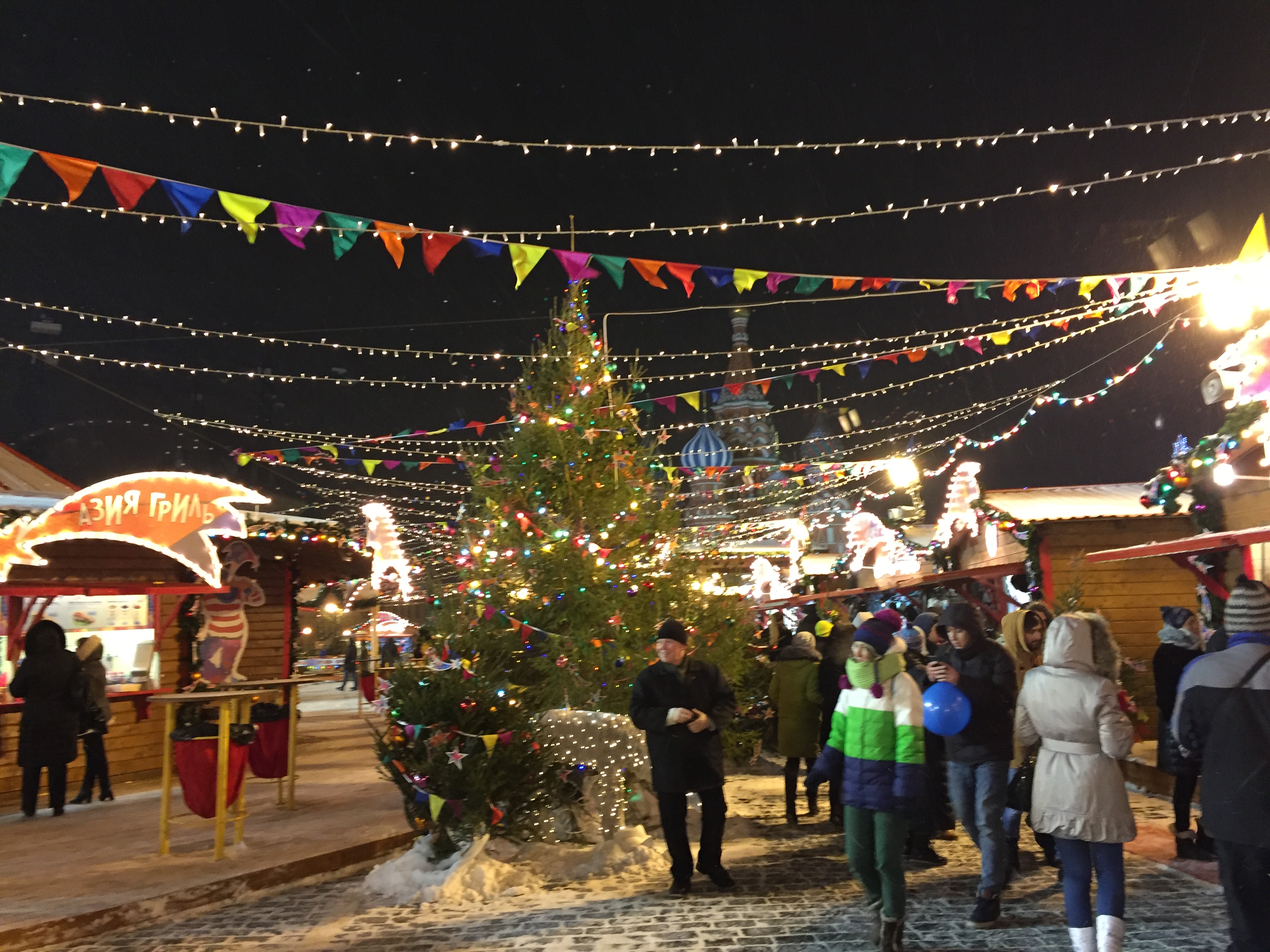

Wintery scene at Red Square in Moscow, Dec. 6, 2016. (Photo by Robert Parry)
Much has been read (most of it hostile) into Steve Bannon’s comment, via the internet, at a 2014 Vatican conference, during which he said that many of Vladimir Putin’s views were underpinned by eurasianism: “He’s got an adviser who harkens back to Julius Evola and different writers of the early 20th century, who are really the supporters of what’s called the Traditionalist Movement … We, the Judeo-Christian West,” continued Bannon, “really have to look at what [Putin]’s talking about as far as Traditionalism goes — particularly the sense of where it supports the underpinnings of nationalism.”
Here lies one immediate problem. It is presumed in the Western media, that the unnamed Putin adviser who harkens back to Julius Evola is Professor Alexander Dugin. And here, precisely is the first difficulty: both philosophers have a rare quality of intellectual brilliance, a command of the literature that is encyclopedic, but they are radical – radical way beyond, and at odds with, today’s secular, and uniform tastes. Indeed, even today in Italy, it is best to read Julius Evola, a prolific Italian philosopher and writer, with some discretion, or at least to hold such a book within nondescript, concealing covers, if one is to avoid hostile glares, or even physical abuse.
And the second difficulty? Alexander Dugin has been described as Putin’s “Rasputin” – a “mad mystic.” And Julius Evola was charged in 1951, with others, with the crime of promoting the Fascist Party, and of promoting ideas proper to fascism. Both philosophers, in short, are controversial and have proved hugely vulnerable to sometimes quite wild misrepresentations. Evola was acquitted on both charges of promoting fascism (though he is popularly still viewed as linked to post-war Italian neo-fascism), and Dugin, from 1998 to 2003, was a geopolitics counselor of the Duma’s Chairman (Gennadiy Selezyov) – but was not adviser to Vladimir Putin.
In fact, as Professor Bertonneau has written: “Evola condemns with equal fervour Muscovite communism and American money-democracy, as representing, the both of them, the mechanization and dehumanization of life. Unlike the Marxists – and unlike the Fascists and National Socialists – Evola saw the only hope for Western Civilization as lying in a revival of what he liked to capitalize, on the one hand, as Tradition and, on the other, as transcendence [personal transformation]; he thus rejected all materialism and instrumentalism as crude reductions of reality for coarse minds and, so too, as symptoms of a prevailing and altogether repugnant decadence.”
Delicate Ground
So why raise these controversial figures? Particularly, as in raising them we tread delicate ground. Well, it is because of that interesting coincidence to which we earlier alluded. Here is one aspect, as Professor Dugin himself notes:
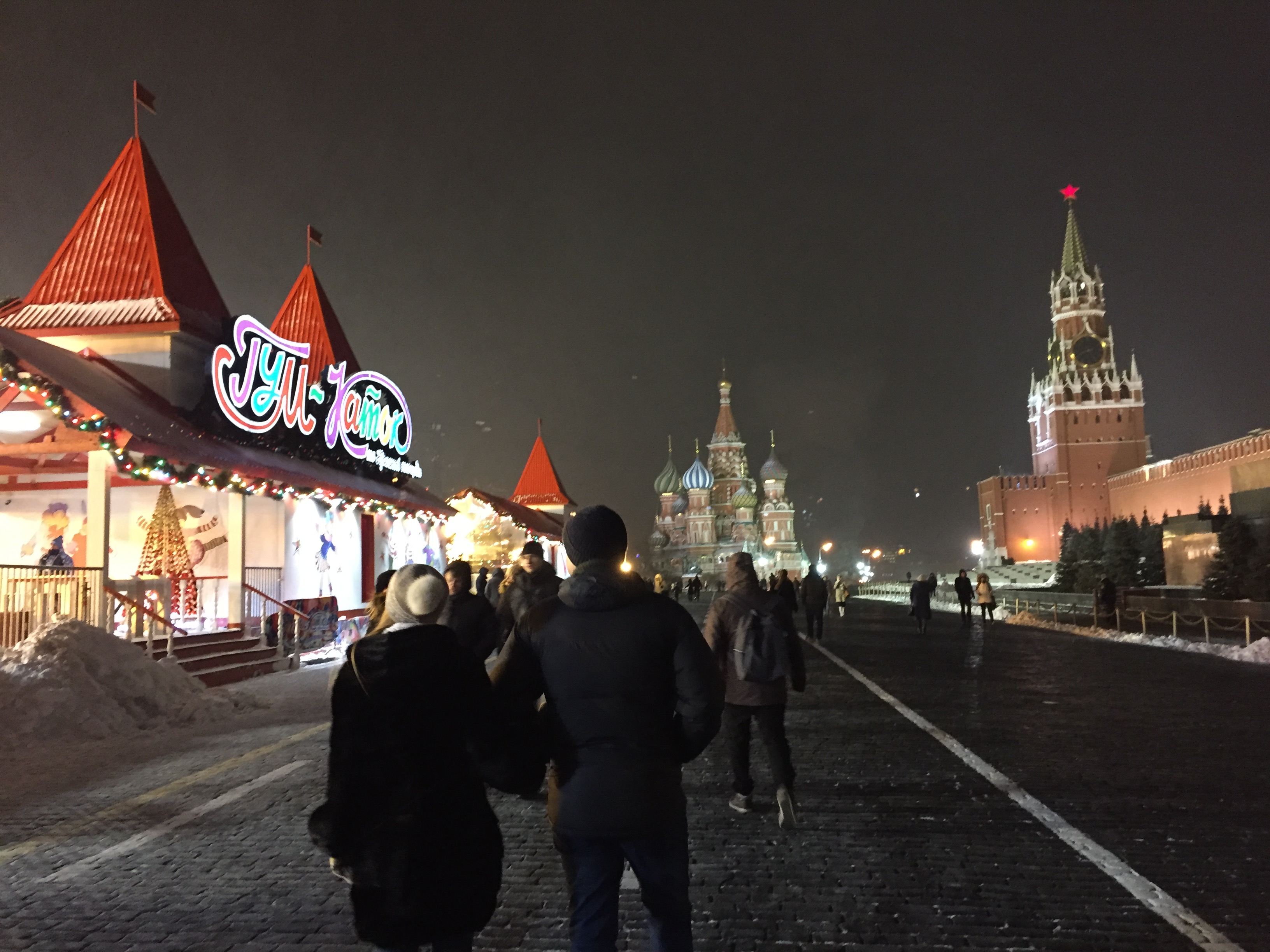
Red Square in Moscow with a winter festival to the left and the Kremlin to the right. (Photo by Robert Parry)
“Julius Evola’s works were discovered in the 1960s [in Russia] by the very esoteric group of anti-communist intellectual thinkers known as ‘the Dissidents of the Right’. They were a small circle of people who had conscientiously refused to participate in the ‘cultural life’ of the USSR, and who had instead chosen an underground existence for themselves. The disparity between the presented Soviet culture and the actual Soviet reality was almost entirely what made them seek out the fundamental principles that could explain the origins of that evil, absolutist idea. It was through their refusal of communism that they discovered certain works by anti-modernist and traditionalist authors: above all, the books by René Guénon, and by Julius Evola.”
And, in America: “Sometime around the year 2000, the work of Julius Evola reached [the American] public consciousness, and thanks to writers like Bill White, Radical Traditionalism entered the [American] right-wing lexicon. This is a philosophy more than a political view, but fits neatly into the New Right idea that culture must be the generative actor for change which will manifest in politics and other areas … It is concerned with two fronts: first, arresting the decline of the West by crushing the Left by any means necessary; and second, a zeal for restoring the greatness of Western Civilization at its height, and [even] surpassing it.”
And here lies the third “difficulty” (or perhaps not a difficulty, but its particular merit, in the eyes of many): in a secular, liberal age, Evola’s philosophy is anti-modernist, anti-secularist and anti-Liberal. It harks back to philosophia perennis, and in American terms, to Aldous Huxley’s definitions of Perennial Philosophy. (In France, the Nouvelle Droite has a different, but parallel, ontological basis, i.e. with such as Alain de Benoist). More confusingly, though it is called Traditionalism, it is really a traditionalism that has no defined tradition.
Of course, this is not to suggest that Julius Evola was the only writer in this radical traditionalist vein. There was René Guenon, Frithjof Schuon, and many others. But, as the New York Times acknowledges (in a typically hostile piece): “More important for the current American administration, Evola also caught on in the United States with leaders of the alt-right movement, which Mr. Bannon nurtured as the head of Breitbart News, and then helped harness for Mr. Trump. ‘Julius Evola is one of the most fascinating men of the 20th century’, said Richard Spencer, the white nationalist leader, who is a top figure in the alt-right movement.”
Just to be clear, that the widely-read Steve Bannon made mention of Evola does not, of course, make him an Evolista. And nor does Putin’s embrace of Eurasianism, make him a Duginista. “But,” as the Times quotes one specialist, “the fact that Bannon even knows Evola is significant.”
Radical Traditionalists
In fact, what we seem to be witnessing is that just as the Russian philosopher, Dugin, draws on Radical Traditionalist thinking and then tries to apply it to the Russian situation, so too, the Alt-Right in the U.S. seems to be doing something similar: drawing on Evola and other Traditionalist sources, while distilling their ideas into an American cultural perspective (linking back to Huxley and Edmund Burke).
A wintery scene in Moscow, near Red Square. (Photo by Robert Parry)
In this respect, Trump and Bannon may indeed find much in common with Mr. Putin (though it would be a mistake, I believe, to read the Russian President through the prism of Professor Dugin). Where there is common ground between the latter (Putin and Dugin) is the sense that the West has never made a satisfactory attempt to try to understand Russia as distinct, and of worth, in its own right.
So the West has always tried to change Russia into something that it isn’t – has always tried to make it more like the West: more liberal, more democratic, more “diversity”- orientated – always assuming that that’s how it somehow has to be, and is the best way for it to “be.” But Russia is a thousand-year civilization; it has its own religious sites and its own particular civilizational code. Russia’s leaders do not want to let the West dictate to it how to interpret Russia’s history, or its present – and, certainly not its future.
Dugin unquestionably does share Evola’s unyielding disdain for liberalism, liberal modernity and liberal democracy. And moreover, he also intensely dislikes how the West tries to force this liberalism upon others – in ugly ways – as an “universal value.” This attitude has led him to be cast as fiercely anti-American and a Russian imperialist to boot, who yearns to re-establish the Soviet Empire.
It is possibly Dugin’s polemical video In Trump We Trust  that contributed to the (unwarranted) U.S. inference that President Putin too, favored Trump in the U.S. Presidential election. To read Putin in this way, would be wrong. He likely does have empathy for the Traditionalist leaning toward differentiation (national as well as personal, in the Evola sense of becoming: of becoming oneself, of a return to origins). President Putin frequently makes this very point about Russia having its own essential essence and having, too, every right to that differentiation and cultural particular (as do other nation-states).
Evola does refer to Empire, but this has to be understood in a very different way from our contemporary understanding. And Dugin reflects this explicitly:
“One particular layer of Evola’s thoughts is felt by the Russians to be of imminent and extreme importance: his praise for the Imperial Ideal. Rome represents the focal point of Evola’s worldview. This sacred living power which had manifested itself all across the Empire was to Evola the very essence of the West’s traditional heritage… But a similar line of thought is seemingly naturally felt by the Russians, whose historical destiny has always been profoundly tied to that of Imperium… [that is to say], Moscow as the ‘Third Rome’: It should be noted that the ‘First Rome’ in this cyclic orthodox interpretation, was not Christian Rome, but rather Imperial Rome, because the Second Rome (or the ‘New Rome’) was Constantinople, the capital of the Christian Empire.
“Thus the idea of ‘Rome’ held by the Orthodox Russians corresponds to the understanding of … the inseparable ‘symphony’ between the spiritual authority and the temporal realm. For traditional orthodoxy, the catholic separation between the King and the Pope is simply unimaginable and close to blasphemy; and this very concept is actually called the ‘Latin heresy.’ Again, one can see the perfect convergence between Evola’s dogma and the commonplace mindset of Russian conservative thought.”
In his book on Evola, Paul Furlong describes it thus: “Evola sees nationalism as, in essence, the offspring of liberalism, modernity and bourgeois subversion, which announced the arrival of the fourth state that destroyed the traditional order of empire. Within the empire, nations find a just hierarchical order; [whereas] outside of it, they are mere tools of chauvinistic nationalisms, and of regimes interested only in material conquest in the name of contingent realities such as fatherlands.”
Misreading Philosophy
It is not hard to see how Dugin might be misread (and therefore perhaps project a false reading on to President Putin of Imperial revanchism rather than, as Dugin intends, of the hoped-for co-joining of the spiritual with the secular). This, despite President Putin having been at some pains to distance his own notion of eurasianism (communal psychology and a single geo-geographic and civilizational unity as a firm basis for state solidarity) from the more (literal) nationalist currents in Russia today.
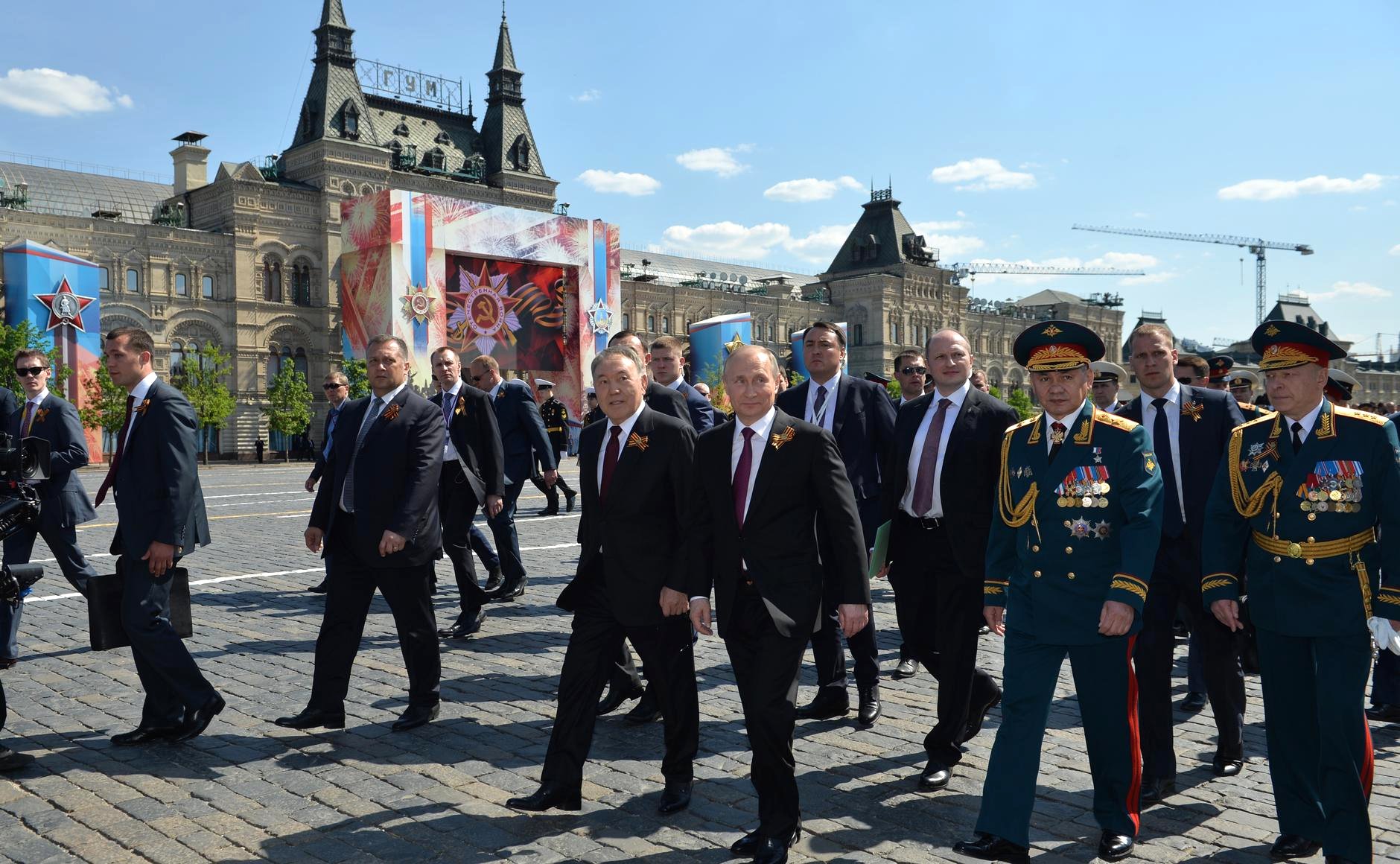
Russian President Vladimir Putin after the military parade on Red Square, May 9, 2016 Moscow. (Photo from kremlin.ru)
The point here is that Dugin’s (and Evola’s) thinking is novel, and can give rise to wrong assumptions about what some Russian philosophers mean when they talk about “Empire” — a terminology which is translated in the West to imply Russia as being a potential “aggressor.”
But, if we turn to Steve Bannon and his 2010 film Generation Zero, which narrates America’s decline into crisis, it is not hard to detect some Evola resonances – albeit ones tailored to the distinct American cultural code:
Firstly, there is the idea of virile America (as it used to be) as the traditional, just, order of American society – a sort of “New Imperial Rome” perhaps, rather than a “New Jerusalem.”
Secondly, Bannon – like Evola – traces the beginning of the American slide towards decadence to the narcissistic, self-indulgent 1960s (to the Woodstock era, in Bannon’s narrative). Ditto for Europe, in Evola’s view.
Thirdly, Bannon – like Evola – disdains the undifferentiated, materialist and uniform bureaucratic modernity, to which this decadence has given rise. Evola admires ancient and historical societies for the virility of their structures – and not as tools of power (or of chauvinistic nationalism).
Fourthly, Bannon – like Evola – extols the symphony between the spiritual (Judeo Christian) and temporal authority.
Fifth, both see history as cyclical: the fourth turning in Bannon’s narrative versus the fourth stage in Evola’s.
Sixth, both believe that if you are a traditionalist, you must challenge “decadence” by all means.
I do not know whether Bannon or Trump have read Evola, but his sprit, and that of other Radical Traditionalists, has certainly permeated the thinking of the Alt-Right circles in which both men have been moving.
The important point here, is not to draw out all the parallels in order to assert a literary lineage. That does not matter. But rather, to point to something far more substantive: their foreign policy implications. The concinnity of thinking – albeit one refined through different cultural optics – is there.
Trump and Putin do indeed have something in common. If both parties – as it seems they do – concur that differentiated, individuated (but not individualist) states, are legitimate and appropriate to their separate and particular, cultural codes – what then, is there to fight about?

If America and the West now can disavow the need to remake Russia in the Western, diversity-centric, individualist, liberal-democratic image, and agree to accept Russia simply for what it, and its culture, “is,” then this would amount to a shift in Western policy of tectonic import. It would indeed be paradoxical if a figure, such as Evola, somehow might have contributed to such an event.

Nach Trump Besuch wird Merkel zu Putin reisen

Seehofer kündigt Merkel-Reise nach Russland für Mai an

https://www.welt.de/newsticker/dpa_nt/infoline_nt/brennpunkte_nt/article162894285/Seehofer-appelliert-an-Kreml-Putin-freut-sich-auf-Merkel.html

Brauchen Europa und Russland einander wirklich? Rede von Matthias Platzeck in Dresden

sz-online.de | Sachsen im Netz

Saturday, March 18, 2017

Ankara Believes Europe Is Carrying Out a Planned Operation Against Turkey by PYOTR ISKENDEROV


Ankara Believes Europe Is Carrying Out a Planned Operation Against Turkey


The troubled relations between Turkey and the European Union clearly demonstrate the futility of Brussels’ attempts to build a working model of multiculturalism in Europe. The main thing here is the objective impossibility of combining two mutually exclusive aims: getting the refugee crisis under control, including by working with Muslims, chiefly the many Turkish communities in EU countries, while at the same time opposing the policies of the current Turkish government headed by President Recep Tayyip Erdoğan.
The forthcoming Turkish constitutional referendum set to take place in April, which will increase the president’s powers even more, is currently being regarded by European leaders as a challenge almost comparable in importance to Brexit and Donald Trump’s victory in the US presidential election. According to the information available, EU leaders, having consulted with the leading European countries, primarily Germany, have already taken the fundamental decision not to recognise the results of the Turkish referendum, which, in turn, will make it possible to reject President Erdoğan’s legitimacy. 
Europe’s hostility towards Erdoğan can be attributed to a number of factors: 
1. The need to demonstrate toughness on the refugee issue during the pre-election campaigns in France, Germany and other countries, where the ruling classes are trying to re-take the initiative and mobilise support from the right-wing and extreme right-wing segments of the domestic political spectrum.
2. The impossibility of departing from the canons of democracy and the pro-democracy rhetoric. With regard to Turkey, this means continuing to provide support to the anti-government forces that first asserted themselves during the 2013 protests in Istanbul.
3. The desire to prevent Turkey from strengthening relations with Russia both in the economic sphere (the Turkish Stream gas pipeline project, the Akkuyu Nuclear Power Plant) and in the military and political ones (Syria, Iraq). 
4. An attempt to offer Ankara a game with raised stakes as part of a solution to the refugee problem (new negotiations on which are inevitable anyway). During further bargaining with Erdoğan, it will allow the EU to withdraw previously-agreed commitments to give Turkey a visa-free regime and multi-billion-dollar financial aid. 
Ankara does not believe that the current crisis in relations with the European Union is situational or has arisen spontaneously. «Europe is carrying out a planned political operation initiated by Germany», writes the Turkish newspaper Vatan. According to the newspaper, European leaders are trying to obtain a negative outcome in the referendum on 16 April and so deliver a blow to Erdoğan’s administration. There is an error in the EU’s thinking, however: the crisis «has fuelled and will inevitably continue to fuel nationalist sentiment, prompting people to vote ‘yes’ in the Turkish referendum», Vatan concludes.
The outcome of the Turkish referendum looks uncertain at present, but this is where the vote of Turkish communities in EU member countries could unexpectedly play a decisive role. The latest polls indicate that the numbers for and against changing the Turkish constitution to create a presidential system are roughly the same. The polls do not shed any light on the balance of power, either. At the beginning of March, for example, Turkey’s two main polling agencies announced conflicting results. According to AKAM, 42.4% of voters who have already made their choice intend to vote in favour of constitutional reform and 57.6% intend to vote against. Yet the ORC polling company paints a completely different picture: 57.2% are in favour of Erdoğan’s bill and 42.8% are against. 
According to the most conservative estimates, more than 5.5 million Turks currently live outside of Turkey, with 1.4 million of these living in Germany and eligible to vote in the forthcoming referendum. There is now a struggle going on between Berlin and Ankara for their votes. 
At the same time, however, the EU can only go so far in aggravating tensions with Turkey, since there is an objective need to reach new refugee and migrant agreements with Ankara that is forcing compromises. 
Turkey is also still one of the EU’s main trade and economic partners. The Netherlands, for example, is the largest investor in Turkey, surpassing even the US. 
There is not complete solidarity among EU members on the ‘Turkish issue’ and the row is not dying down. While Germany, the Netherlands, Austria and Denmark put up a united front against Turks in their countries organising protests in support of the Turkish referendum, France and Sweden took a more reserved, even a neutral, stance, imposing additional security measures at such meetings and rallies. Having read the situation well, Ankara intends to use it to its advantage. The Turkish Ministry of Foreign Affairs has already referred to the European Union’s calls for restraint as «pointless». And this should be taken to mean that Erdoğan is ready for confrontation.http://www.strategic-culture.org/news/2017/03/18/ankara-believes-europe-carrying-out-planned-operation-against-turkey.html

Friday, March 17, 2017

Battle over Healthcare: Just Another Theater in the War to Remove Trump


Battle over Healthcare: Just Another Theater in the War to Remove Trump
JAMES GEORGE JATRAS | 17.03.2017 | OPINION

Ever since the November 2016 election and the defeat of the horrible warmonger Hillary Clinton, I have been flooded with inquiries from Serbia, Russia, and other countries asking how and when American foreign policy will change for the better. Will NATO back off from provocations in the Baltic and Black seas? Will Trump accept a compromise over Crimea? Will Washington cease its 100 percent bias in favor of Zagreb, Sarajevo, and Priština against the Serbs? Why has nothing changed yet? Will America go to war with Iran? North Korea? China?
Keep in mind that Donald Trump’s appointments within his own administration are proceeding with glacial sluggishness, in part though not entirely due to Senate Democrats’ slowing down the confirmation process. It also doesn’t help that Trump seems to have a penchant for appointing people to foreign policy and national security posts who in no way reflect what appear to be his sincerely held views. Sometimes it seems that the only ideological Trump-ist in his administration is Trump himself.
But most importantly, keep in mind that Trump mainly ran on what he would do for the American people at home: police our borders («Build the Wall!»), deport criminal aliens, end the glut of cheap illegal labor that drives down wages (and drives up medical costs with illegals’ uninsured visits to the emergency room); reverse one-sided trade deals and restore manufacturing; and rebuild our infrastructure, which was once the envy of the world and is now its laughingstock.
These promises, which impact the everyday life of Americans at home, will determine if his presidency is a success or if he gets tossed out on his ear in 2020, with the warmongering Deep State majestically reassuming its rightful patrimony. That’s if the ongoing «soft coup» being waged against him by the Deep State and MSM hasn’t succeeded in removing him before then. With that in mind, Trump’s only essential foreign task is not to stumble into another catastrophic war somewhere.
Among his domestic promises that are make-or-break for him, and for the Republican Party in which he is locked in an uncomfortable symbiosis, Trump’s promise to repeal and replace «Obamacare» (formally, the «Affordable Care Act») is front and center. Keep in mind that for historical reasons too complicated to describe here, the United States doesn’t have a healthcare system like most other countries. While the federal government has a large role in regulating the system, the major players are private companies providing insurance to pay for medical services, much as we have life insurance or car insurance.
But medical insurance is much more heavily regulated, and as one might expect the companies themselves have a lot of influence about how they are regulated. The result is something like a system of state capitalism which satisfies nobody, neither those who advocate the kind of universal «single payer» socialist model practiced by other developed countries (but which often results in waiting lists, shortages, and lower quality of care) versus those who claim that a purer free market model of the sort we have for other essential services, like food, would work better. American prices for prescription drugs, many of them developed in the U.S., are among the world’s highest, because other countries’ governments insist on buying them in bloc at set prices, leading the companies to make up the difference in America where they can charge whatever they like. Among Trump’s heresies with many Republicans is that he’d like the U.S. federal government also to purchase in bulk and drive prices down.
American health services are prohibitively expensive for anyone who doesn’t have insurance, and not everyone does. Most Americans who have insurance get it through their employers (where the worker also must pay into the system), itself a problem as more and more companies hire people as «contract workers,» not as employees who must be offered such benefits. Millions of working people are uninsured, either because their employers don’t offer insurance or they can’t afford the premiums. Some young and healthy people – they call them «young immortals» – have access and can afford insurance but would rather spend their money on something else. The Medicaid program provides basic services for the poor. As it stands, American healthcare generally is considered as having a high quality of care and quick availability – if you have insurance, you won’t die waiting for your heart bypass, you’ll get it right away.
Obamacare adjusted this system, largely by trying to force young immortals to buy insurance by fining them if they don’t. In the end, American healthcare became even more complex and expensive, though several million people who were uninsured now have it on a subsidized basis.
For a number of reasons, the Republican Congress has decided that keeping their promise to repeal and replace Obamacare is first on their legislative agenda. This in effect means that almost nothing else can get done until Congress takes care of that. (As the American expression has it, they aren’t coordinated enough to walk and chew gum at the same time.) Similarly, the forces eager to bring down Trump – for other reasons, especially to prevent him from changing American foreign and security policy – are doing their very best to ensure that the first item on the Republicans’ domestic agenda turns into a disastrous failure.
Certainly, there is disagreement in the Republican ranks on how to proceed. There are procedural problems on how to get legislation through the Senate, where the Democrat minority can block it. A powerful Democratic ally is the supposedly non-partisan Congressional Budget Office, which just released a skewed estimate on costs of the Republican replacement plan and how many people might not be forced to buy insurance and will therefore be presumed uninsured. In the media, that becomes a depiction of cruel Republicans kicking sick grandmothers out to the curb to die for the sheer evil fun of it.
In short, the healthcare debate will proceed with the same scorched-earth ferocity we’ve seen on «Russian hacking» and the political assassination of Mike Flynn, except the theater of civil war has shifted to a domestic issue. But the real issue isn’t health care at all, it’s how to cripple Trump and then remove him before he can do real damage to the Deep State.
And now, just as I write this, someone at the Internal Revenue Service has criminally leaked part of Trump’s 2005 tax return. The hunt is on!
http://www.strategic-culture.org/news/2017/03/17/battle-over-healthcare-just-another-theater-war-remove-trump.html

Analysis, Latest, News, Report Russia A Russian-German thaw? Merkel heads for Moscow


A Russian-German thaw? Merkel heads for Moscow

As crises build up around her, Angela Merkel sends Putin "particularly warm greetings" and prepares trip to Moscow.

German Chancellor Angela Merkel, facing a possibly difficult election in Germany later this year, is travelling to Moscow on 2nd May 2017.


Suffice to say that the last occasion when Merkel visited Moscow was in the fraught run-up to the Minsk Agreement in February 2015.  When German SPD leader and Vice-Chancellor Sigmar Gabriel and Bavarian Minister-President and CSU leader Horst Seehofer, visited Moscow in October 2015 and February 2016, she made little attempt to hide her disapproval.
This time the mood is completely different.  Not only is Merkel herself going to Moscow, but her journey there has been well prepared in advance by the same duo of Gabriel and Seehofer who earned her displeasure by going to Moscow in October 2015 and February 2016.
Both Gabriel (now Germany’s Foreign Minister) and Seehofer have just visited Moscow over the course of the last week, and this time both have made it clear that they have done so with Merkel’s full backing.
Gabriel was there first, meeting with Putin in the Kremlin on 9th March 2017.
During this meeting Gabriel not only confirmed Merkel’s intention to travel to Moscow, but informed Putin that Germany’s new President and previous Foreign Minister, Frank-Walter Steinmeier, is also intending to go to Moscow soon.  The Kremlin’s summary of his comments to Putin shows they were both extremely relaxed and remarkably warm
It is wonderful that you found the time for this exchange and dialogue. I already had a substantial discussion on various subjects with Sergei Lavrov today.
I also think, and you are quite right, that despite the various difficulties before us, we do have the task of ensuring peace and stability in Europe. This is not easy, but it is something that is worth the effort.
It is with pleasure that I will pass on your best wishes to the Federal Chancellor, and I too hope that the opportunity will come up for her visit. I think that the Federal President [President-elect Frank-Walter Steinmeier] also plans to visit. We therefore have every reason to be confident in our bilateral relations’ stability.
A few days after Gabriel’s visit Horst Seehofer also turned up, leading a strong delegation from Bavaria, which first met with Lavrov and various Russian business leaders.
Seehofer eventually met with Putin in the Kremlin on 16th March 2017.  To grasp the change in the atmosphere between this visit and his previous visit of a year ago, it is sufficient to compare what Seehofer said to Putin on this occasion with what he said a year ago.
Here is what Seehofer said a year ago
We have come here from the free state of Bavaria, which traditionally has very intensive ties with Russia, and we want to maintain these ties.
Bavaria is part of the federal government. We are part of the government coalition, and we think it our duty, the duty of our hearts and souls, to put a bit more trust back into our relations. We think this is essential in today’s situation, looking at what is happening in the world.
I am very pleased that you said today that we are not coming here as plotters. Never in the run-up to any of my previous visits to other countries, have I heard as much untruthful and inaccurate information as I have this time.
Compare that with the words Seehofer said to Putin during their latest meeting
I am very pleased to see that trade relations between Bavaria and Russia are developing so well. Let me thank you too for the fact that during our last meeting, you allowed us to hold talks and work at the federal level, which we are doing. Of course, we are continuing our cooperation with our partner city, Moscow.
Allow me to convey particularly warm greetings from our Federal Chancellor [Angela Merkel]. She reminded me several times that I was not to forget to do this, and said that she would visit you in early May.
We therefore have an excellent opportunity to continue the good relations that have become a tradition between Bavaria and Russia. Some of my predecessors even piloted the plane themselves on the way here and landed safely. My direct predecessor, Edmund Stoiber, as we counted today, visited Moscow around ten times.
(bold italics added)
In February 2016 Seehofer went to Moscow under a cloud, complaining to Putin that he was being called a plotter.  In March 2017 he came bearing warm greetings for Putin from Merkel herself.
Seehofer’s comments confirm that the initiative for Merkel’s forthcoming trip to Moscow came from her.  Moreover Merkel’s repeated requests to Seehofer to make sure that he remembered to pass on her “particularly warm greetings” to Putin is a clear sign that she wants to carry out at least some repairs both to Germany’s relationship with Russia and her own broken relationship with Putin.
What explains this reversal?
Firstly it should be said that Merkel’s policy positions have little to do with ideology and everything to do with her wish to secure her position in Germany and to remain Chancellor.  Thus where before 2014 she followed the policy of engaging with Russia, which Germany had followed since the Ostpolitik era of the 1970s, and which has much support in Germany especially within its business community, in 2014, when it suited her politically, she reversed course and took a hard line against Russia of a sort that would have been countenanced by no previous German leader since Adenauer.
If Merkel is now softening that line, it is because she thinks her position as Chancellor would benefit from her doing so, not because she has any strong convictions about the matter.
As to why Merkel might think that, at its simplest, with crises (eg. Brexit, Le Pen, the refugee crisis, relations with Turkey, Poland, Grexit etc) rapidly building up all around her, Merkel – rather like Erdogan in June 2016 – probably has come to realise that with a difficult election coming she needs to start solving problems more quickly than she is causing them.  With her other problems both intractable and largely beyond her control it is understandable why she might be looking to improve relations with Russia where at least some progress is possible.
Having said this, there are three pressing issues that must be causing Merkel concern, and which may explain why she is looking to mend at least some fences with Moscow now.
The first is the rapidly deteriorating situation in Ukraine.  Some time ago one of Merkel’s aides let slip that Merkel regards the crisis in Ukraine as by far the biggest crisis she faces, and that it is the one that keeps her awake at night.
With the situation in Ukraine going rapidly from bad to worse, it is understandable if Merkel wants to talk about it with Putin to see how the crisis might be contained.  The fact that she was on the receiving end of a furious lecture from Putin a short while ago during the military crisis in Avdeevka will have spelled out to her how important it is as the situation in Ukraine deteriorates that she keeps her lines of communication to Putin open.
Significantly criticism of Putin and Russia over Ukraine from Merkel and other Western leaders has been surprisingly muted over recent weeks, even as Russia recognises the validity of the documents issued by the Donetsk and Lugansk People’s Republics, and even as the Donetsk and Lugansk People’s Republics have nationalised Ukrainian businesses located on their territories in retaliation for the Ukrainian transport blockade.
Another fact that is probably causing Merkel to reconsider her hardline policy towards Russia is the coming of Donald Trump.
It is becoming increasingly clear that Donald Trump is not going to be driven from the White House because of the ‘Russiagate’ scandal, and Merkel must calculate that once he has put this essentially fake scandal behind him he will be able to press ahead with his stalled plan for detente with Russia.
Certainly Merkel will have noticed – even if most Western commentators have not – that since Trump arrived in the White House the US and Russian militaries have been quietly talking to each other, and have even been quietly cooperating with each other in Syria.
If the drive for detente between the US and Russia is renewed, perhaps in the summer, then Merkel does not want to be left high and dry, clinging on to an anti-Russian policy the US is no longer intent on.
To understand the importance of relations with the US to Merkel’s actions, it is only necessary to recall what happened to Seehofer after he returned to Germany following his trip to Moscow in February 2016.  Shortly after his return the US delivered him a brutal public snub when the US delegation to the Munich security conference led by the neocon hardliner Victoria Nuland, Obama’s Assistant Secretary of State for European Affairs, boycotted a public dinner Seehofer hosted on behalf of the Bavarian government.
Merkel will want to avoid any such snub, and as the self-proclaimed ‘Queen of Europe’ she will not want to be left out in the cold if the US and Russia start edging closer to each other.  Her trip to Moscow is therefore in a sense her taking out insurance in case (as remains likely) US-Russian relations start to improve in the summer.
Lastly Merkel must be concerned that the issue of sanctions – to which her reputation and her authority are now tied – has now become an issue in the French elections, and probably before long be an issue in the Italian elections whenever they happen.  If she is to continue to hold the line on sanctions, as is essential for her prestige, she has to give at least the appearance of negotiating with Moscow so as to hold out the hope to her increasingly restive European partners and to the German business community that they will one day be lifted.
Merkel therefore has multiple good reasons to reach out to Putin and go to Moscow now.  Whatever else she is, she is above all an extremely skilled politician, and the fact she is going to Moscow is a clear sense that she senses a turn in the wind.
The Russians for their part will be willing to receive her.  From their point of view a rapprochement with Germany, the single most important country in Europe and a major trading parter, is worth the price her visit.
The Russians will receive Merkel with all their customary courtesy.   They will listen to (and record) attentively what she says.  They may even conclude some agreements with her.
They will not however trust her.  The experience of what happened in 2014, when the Russians thought they had an understanding with Merkel over how to handle the Ukrainian crisis only for Merkel to back a Ukrainian army offensive in the Donbass and then slap sanctions on Russia when it began to go wrong, is not one the Russians are going to forget.  Nor is Putin likely to forget the terrible things Merkel has said about him.
Behind the smiles and the smooth words there will be continued mistrust and the Russians will be very much on their guard.
By now the Russians have learnt that if it is wise to hold your enemies close and your friends even closer, in the case of Merkel it is wisest to hold her closer still. http://theduran.com/germanys-merkel-heads-moscow/