Saturday, November 26, 2016

"Left - Liberal - Progressive" Hysteria Over Trump’s Victory - Paul Craig Roberts


Trump the Great
“Those who control the levers of power in Washington and the global special interests they partner with, don’t have your good in mind. It’s a global power structure that is responsible for the economic decisions that have robbed our working class, stripped our country of its wealth and put that money into the pockets of a handful of large corporations and political entities. The only thing that can stop this corrupt machine is you.” Trump

EDITOR'S CHOICE | 26.11.2016

Trump the Great by Paul Craig Roberts 

Liberals, progressives, and the left-wing (to the extent that one still exists) are aligning with the corrupt oligarchy against president-elect Trump and the American people.


They are busy at work trying to generate hysteria over Trump’s “authoritarian personality and followers.” In other words, the message is: here come the fascists.
Liberals and progressives wailed and whined about “an all white male cabinet,” only to be made fools by Trump’s appointment of a black male and two women, one a minority and one a Trump critic.
The oligarchs are organizing their liberal progressive front groups to disrupt Trump’s inauguration in an effort to continue the attempt to delegitimize Trump the way the paid Maidan protesters were used in Kiev to delegitimize the elected Ukrainian government.
To the extent any of the Trump protesters are sincere and not merely paid tools of oligarchs, such as George Soros, military and financial interests, and global capitalists, they should consider that false claims and unjustified criticism can cause Trump and his supporters to close their ears to all criticism and make it easier for neoconservatives to influence Trump by offering support.
At this point we don’t know what a Trump government is going to do. If he sells out the people, he won’t be reelected. If he is defeated by the oligarchy, the people will become more radical.
We do not know how Washington insiders appointed to the government will behave inside a Trump presidency. Unless they are ideologues like the neoconservatives or agents of powerful interests, insiders survive by going along with the current. If the current changes under Trump, so will the insiders.
Trump got elected because flyover America has had all it can take from the self-dealing oligarchy. The vast bullk of America has seen its economic prospects and that of children and grandchildren decline for a quarter century. The states Hillary carried are limited to the liberal enclaves and oligarchy’s stomping grounds on the NE and West coasts and in Colorado and New Mexico, where effete (verweichlichte*) wealthy liberals have located because of the scenary. If you look at the red/blue electoral map, geographically speaking Hillary’s support is very limited.
We know that Hillary is an agent for the One Percent. The Clintons $120 million personal wealth and $1.6 billion personal foundation are proof that the Clintons are bought-and-paid-for. We know that Hillary is responsible for the destruction of Libya and of much of Syria and for the overthrow of the democratically elected government in Ukraine. We know that the Clinton regime’s sanctions on Iraq resulted in the deaths of 500,000 children. These are war crimes and crimes against humanity. We know Hillary used government office for private gain. We know she violated national security laws without being held accountable. What we don’t know is why groups that allegedly are liberal-progressive-leftwing are such fervent supporters of Hillary.
One possible answer is that these groups are mere fronts for vested interests and are devoid of any sincere motives.
Another possible answer is that these groups believe that the important issues are not jobs for Americans and avoiding war with nuclear powers, but transgender, homosexual and illegal alien rights.
Another possible answer is that these groups are uninformed and stupid.
What these protesters see as a threat in Trump’s strong and willful personality is actually a virtue. A cipher (eine Chiffre/ eine Null) like Obama has no more ability to stand up to the oligarchy than a disengaged George W. Bush so easily stage-managed by Dick Cheney. Nothing less than an authoritarian style and personality is a match for the well-entrenched ruling oligarchy and willful neoconservatives. If Trump were a shrinking violet, the electorate would have ignored him.
Trump did not purchase his presidency with the offer of handouts to blacks, the poor generally, teachers unions, farmers, abortion rights for women, etc. Trump was elected because he said: “Those who control the levers of power in Washington and the global special interests they partner with, don’t have your good in mind. It’s a global power structure that is responsible for the economic decisions that have robbed our working class, stripped our country of its wealth and put that money into the pockets of a handful of large corporations and political entities. The only thing that can stop this corrupt machine is you.”**
It has been a long time since the electorate heard this kind of talk from someone seeking public office. Trump’s words are what Americans were waiting to hear.
As willful as Trump is, he is only one person. The oligarchy are many.
As impressive as Trump’s billion dollars is, the oligarchs have trillions.
Congress being in Republican hands will spare Trump partisan obstruction, but Congress remains in the hands of interest groups.
As powerful as the office of the president can be, without unity in government changes from the top don’t occur, especially if the president is at odds with the military with regard to the alleged threat posed by Russia and China. Trump says he wants peace with the nuclear powers. The military/security complex needs an enemy for its budget.
It is absolutely necessary that a lid be put on tensions between nuclear powers and that economic opportunity reappears for the American people. Trump is not positioned to benefit from war and jobs offshoring. The only sensible strategy is to support him on these issues and to hold his feet to the fire.
As for the immigration issue, the Obama Justice (sic) Department has just worsened the picture with its ruling that American police departments cannot discriminate against non-citizens by only hiring citizens as officers. Now that US citizens face arrest in their own country by non-citizens, the resentment of immigrants will increase. Clearly it is nonsensical to devalue American citizenship in this way. Clearly it is sensible to put a lid on immigration until the US economy is again able to create jobs capable of sustaining an independent existence.
If Trump can defeat the oligarchy and save America, he can go down in history as Trump the Great. I think that this prospect appeals to Trump more than more wealth. Instead of trying to tear him down in advance, he should be supported. With Trump’s determination and the people’s support, change from the top down is possible. Otherwise, change has to come from the bottom up, and that means an awful lot of blood in the streets.

paulcraigroberts.org http://www.strategic-culture.org/news/2016/11/26/trump-the-great.html

* Bloger's German translation ** Blogger's emphasis

Jill Stein for Hillary - What's up?


Jill Stein for Hillary
BY Stephen Lendman EDITOR'S CHOICE | 26.11.2016

Jill Stein for Hillary


Shameful! What’s going on? Why did her campaign announce its“intent to file for a recount of votes in the battleground states of Wisconsin, Michigan and Pennsylvania, leading a multi-partisan effort to check the accuracy of the machine-counted vote tallies in these states in order to ensure the integrity of our election?”
Did she forget Hillary criticizing Trump’s possible refusal to accept electoral results when asked, calling it “a direct threat to our democracy?”
Does she support what war goddess, racketeer, perjurer Hillary stands for? Does she oppose Trump wanting normalized relations with Russia - crucial to prevent the threat of possible nuclear war with Hillary empowered as US military commander-in-chief.
I supported Stein, believed in her, wrote glowing articles about her campaign, her advocacy for world peace, equity and justice. Was I wrong? Did I misjudge her? Is she against what she claims to stand for?
Many times in articles I called Hillary the most ruthlessly dangerous presidential aspirant in US history. Does Stein support her? Want the election reversed in her favor? Why else would she want recounts in Michigan, Pennsylvania and Wisconsin? Outrageous!
Interviewed by Sputnik News, she said she raised over $3.7 million dollars so far, aiming for up to $7 million to cover all costs, and complete the task by filing deadlines - Nov. 25 in Wisconsin, Nov. 28 in Pennsylvania, and Nov. 30 in Michigan.
A pre-Thanksgiving Day article asked if Hillary intended to challenge the electoral results. In my judgment, Trump won because deep state power brokers jettisoned her as damaged good, too scandal-ridden to serve effectively, choosing Trump instead.
Neither snow nor rain nor gloom of night nor Stein’s misguided effort will change the electoral results - just stir the pot disruptively for some days, accomplishing nothing but shaming herself.
Claiming “we deserve some confidence in the outcome of this election” misses the crucial point. Hillary as president risks possible cataclysmic nuclear war with Russia.
Trump want normalized ties, both countries cooperating in combating terrorism. That’s the core issue aside from all others - including the nonexistent integrity of America’s electoral system. 
Failure to understand it shows poor judgment on Stein’s part at the least - recklessness at worst. And why did Sputnik News publicize her effort? Surely it knows Putin prefers Trump over Hillary. So do I.
Will recounts be held in the three states in question? Doubtful but we’ll see. Either way won’t matter. On January 20, Trump’s inauguration will proceed as scheduled.

Fidel Castro, Cuba’s longtime leader, dies at 90

Fidel Castro © Desmond Boylan
Fidel Castro, Cuba’s longtime leader, dies at 90
Nov 26, 2016 05:29    After years of dealing with failing health, Fidel Castro, leader of the Cuban revolution who steered the country through decades of a US economic blockade, has died, state media report.
News line

Resolution Targeting Russian Media as Discriminatory

Diplomats wait for the start of a meeting of the permanent council of the OSCE, the Organization for Security and Cooperation in Europe in Vienna, Austria © Leonhard Foeger
Envoy blasts OSCE resolution targeting Russian media as discriminatory 
Russia’s envoy to the Organization for Security and Cooperation in Europe (OSCE) has branded the group’s resolution on countering the Russian mass media a discriminatory document that contradicts basic international agreements on human rights.

Thursday, November 24, 2016

greens-question-trumps-victory

Consortiumnews.com

A sudden flood of cash has enabled the Green Party to demand recounts of votes in Wisconsin, Pennsylvania and Michigan, three formerly Democratic states that largely decided the 2016 election for Donald Trump, reports Joe Lauria.
https://consortiumnews.com/2016/11/24/greens-question-trumps-victory/

Trump’s Possible Path Out of Ukraine Crisis By Jonathan Marshall


  • "Fortunately, President-elect Trump has created an opening for such a settlement by reaching out to Putin during the election campaign and explicitly declining to bash Russia for its annexation of Crimea (which followed a hastily arranged referendum in which the official results showed that 96 percent of the voters favored leaving Ukraine and rejoining Russia)."
  • "The best hope for Ukraine — and renewed East-West cooperation — is the Minsk Protocol, signed by Ukrainian, Russian, and European parties in the capital of Belarus on Sept. 5, 2014. The agreement provided for a ceasefire, an exchange of prisoners, and a framework for a political settlement based on giving the Donetsk and Luhansk regions a “special status.”


November 24, 2016 https://consortiumnews.com/2016/11/24/trumps-possible-path-out-of-ukraine-crisis/


Exclusive: The U.S.-backed coup in Ukraine in 2014 sparked a New Cold War with Russia, but a President Trump could roll back tensions with a creative strategy for resolving the Ukraine standoff, writes Jonathan Marshall.
By Jonathan Marshall
If Donald Trump wants to make a decisive and constructive mark on U.S. foreign policy early in his presidency, there’s no better place to start than by helping to end the brutal war in Ukraine that has claimed some 10,000 lives.
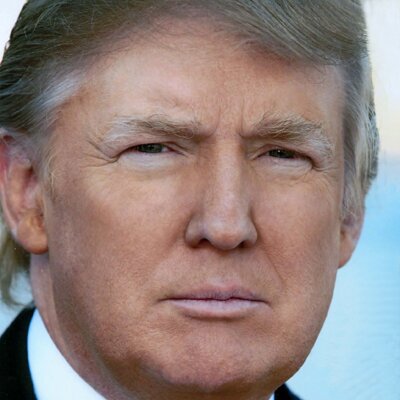
President-elect Donald Trump
The Obama administration helped ignite that war by attempting to yank Ukraine out of Russia’s orbit and into the Western security and economic sphere. Working alongside the European Union, Washington fanned mass street protests that led to a violent putsch against Kiev’s elected government in February 2014. Moscow responded by annexing (or, depending on your point of view, reunifying with) Russian-speaking Crimea, which is also headquarters of Moscow’s Black Sea Fleet, and backing pro-Russia separatists in the eastern regions of Donetsk and Luhansk.
Since then, the two sides have fought to a bloody stalemate. Besides killing thousands of civilians, the war has sunk Ukraine’s economy and fostered rampant corruption. U.S. and E.U. sanctions have dragged down Russia’s economy and derailed cooperation between Washington and Moscow in other theaters. Rising tensions between NATO and Russia have greatly raised the odds of an accidental military confrontation between the world’s two largest nuclear powers.
The best hope for Ukraine — and renewed East-West cooperation — is the Minsk Protocol, signed by Ukrainian, Russian, and European parties in the capital of Belarus on Sept. 5, 2014. The agreement provided for a ceasefire, an exchange of prisoners, and a framework for a political settlement based on giving the Donetsk and Luhansk regions a “special status.”
That agreement broke down amid renewed fighting until the parties signed the Minsk-2 Agreement on Feb. 12, 2015. It provided for constitutional reforms, elections in the two republics, and restoration of Ukrainian sovereignty over its borders. But Kiev has made no serious move to recognize the special status of its breakaway regions, and the two sides have engaged in sporadic hostilities ever since.
Final Words
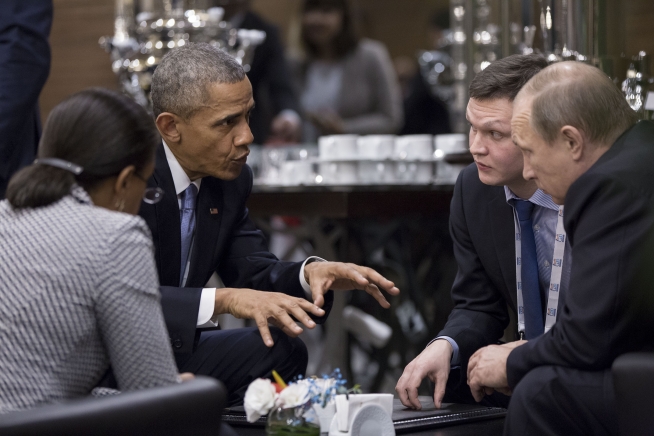
Presidents Obama and Putin exchanged what may have been their final, desultory words on the subject at the Asia-Pacific Economic Cooperation summit in Peru this month. Obama “urged President Putin to uphold Russia’s commitments under the Minsk agreements,” while a Russian spokesman said the two men “expressed regret that it was not possible to make progress in Ukraine.”
President Barack Obama meets with President Vladimir Putin of Russia on the sidelines of the G20 Summit at Regnum Carya Resort in Antalya, Turkey, Sunday, Nov. 15, 2015. National Security Advisor Susan E. Rice listens at left. (Official White House Photo by Pete Souza)
As current foreign policy messes go, however, the Ukrainian imbroglio may offer the greatest opportunities for a rewarding cleanup. Doing so will require both sides to acknowledge some fault and find creative ways to save face.
Fortunately, President-elect Trump has created an opening for such a settlement by reaching out to Putin during the election campaign and explicitly declining to bash Russia for its annexation of Crimea (which followed a hastily arranged referendum in which the official results showed that 96 percent of the voters favored leaving Ukraine and rejoining Russia).
There are also small signs of progress that give hope. A limited demilitarization accord signed in September led to a mutual retreat by the Ukrainian army and pro-Russia separatists from a small city in eastern Ukraine. The withdrawal was verified by observers from the Organization for Security and Cooperation in Europe (OSCE), a party to the Minsk accords. Meanwhile, Ukraine, Germany, France and Russia are working on a new roadmap to strengthen the ceasefire.
Conditions for Peace
In a June 2015 interview with Charlie Rose, Putin laid out clear and reasonable conditions for making the Minsk accord stick:
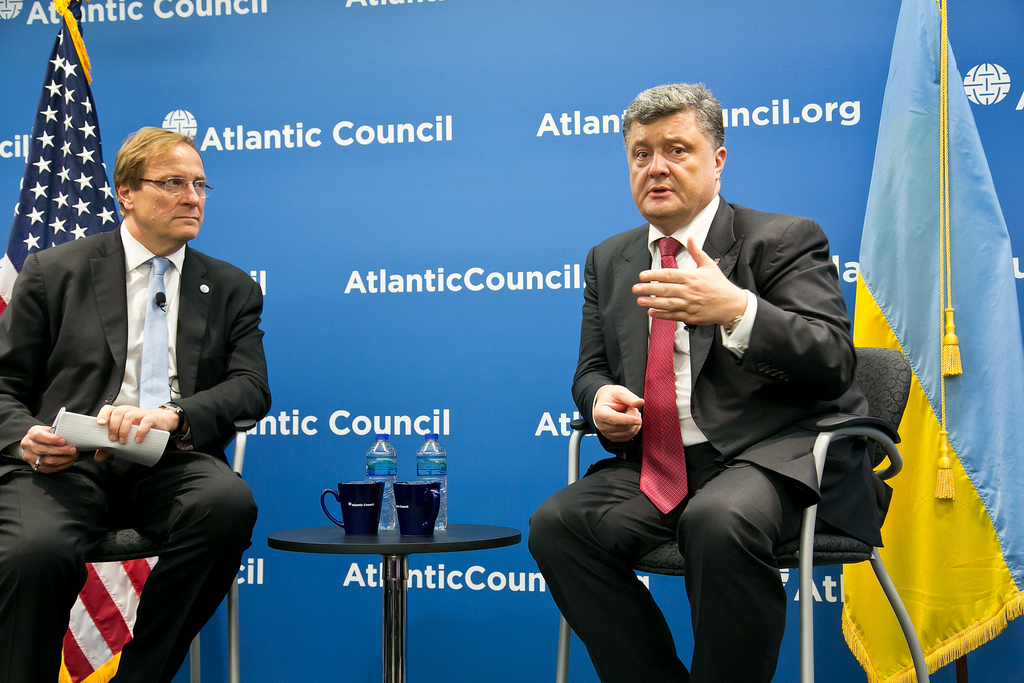
Ukraine's anti-Russian President Petro Poroshenko speaking to the Atlantic Council in 2014. (Photo credit: Atlantic Council)
Ukraine’s anti-Russian President Petro Poroshenko speaking to the Atlantic Council in 2014. (Photo credit: Atlantic Council)
“Today we primarily need to comply with all the agreements reached in Minsk … At the same time, I would like to draw . . . the attention of all our partners to the fact that we cannot do it unilaterally. We keep hearing the same thing, repeated like a mantra – that Russia should influence the southeast of Ukraine. We are. However, it is impossible to resolve the problem through our influence on the southeast alone.
“There has to be influence on the current official authorities in Kiev, which is something we cannot do. This is a road our Western partners have to take – those in Europe and America. Let us work together. … We believe that to resolve the situation we need to implement the Minsk agreements, as I said. The elements of a political settlement are key here. There are several. . . .
“The first one is constitutional reform, and the Minsk agreements say clearly: to provide autonomy or, as they say, decentralization of power. . .
“The second thing that has to be done – the law passed earlier on the special status of . . . Luhansk and Donetsk, the unrecognized republics, should be enacted. It was passed, but still not acted upon. This requires a resolution of the Supreme Rada – the Ukrainian Parliament – which is also covered in the Minsk agreements. . . .
“The third thing is a law on amnesty. It is impossible to have a political dialogue with people who are threatened with criminal persecution. And finally, they need to pass a law on municipal elections on these territories and to have the elections themselves. All this is spelled out in the Minsk agreements. . . .
“I repeat, it is important now to have a direct dialogue between Luhansk, Donetsk and Kiev – this is missing.”
Future of Crimea
Any lasting settlement will also require some compromise over Crimea, which Putin has vowed never to relinquish.
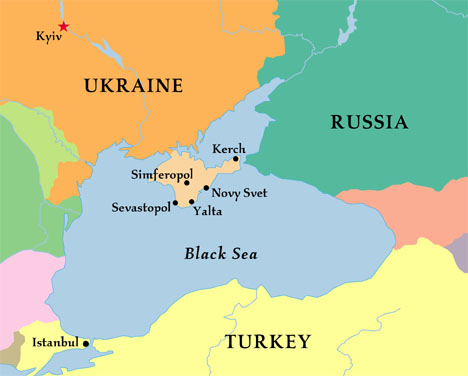
A map showing Crimea (in beige) and its proximity to both the Ukrainian mainland and Russia.
As Ray McGovern, the CIA’s former chief Russia analyst, has noted, the annexation of Crimea did violate a pledge that Russia made in 1994 — along with Great Britain and the United States — “to respect the independence and sovereignty and existing borders of Ukraine,” as a precondition to Ukraine giving up its nuclear weapons. Of course, the United States and the E.U. had already violated the same pledge by supporting a coup d’état against the country’s elected government.
McGovern cited other “extenuating circumstances, including alarm among Crimeans over what the unconstitutional ouster of Ukraine’s president might mean for them, as well as Moscow’s not unfounded nightmare of NATO taking over Russia’s major, and only warm-water, naval base at Sevastopol in Crimea.”
In support of annexation, Russian and Crimean authorities also pointed to the hasty referendum that was held in Crimea in March 2014, which resulted in 96 percent support for reunification with Russia, a relationship dating back to the Eighteenth Century. Subsequent polls of Crimean opinion, conducted by Western firms, have largely confirmed support for the 2014 referendum on rejoining Russia. But the referendum did not have international observers and was not accepted by the United States and other Western nations.
Condemning the annexation in a soaring speech about the “rule of law” and America’s dedication to universal principles, President Obama contrasted Crimea with Kosovo, which NATO forcibly broke away from Serbia in 1999.
Obama said, “Kosovo only left Serbia after a referendum was organized not outside the boundaries of international law, but in careful cooperation with the United Nations and with Kosovo’s neighbors. None of that even came close to happening in Crimea.”
Actually, none of that came close to happening in Kosovo, either. Obama’s story was a myth, but it confirmed the powerful legitimacy offered by popular referenda, like those in Great Britain over Scottish independence or Brexit.
Yet, as part of a permanent settlement of the larger Ukraine crisis, the Minsk signatories could agree to hold another, binding referendum in Crimea under international supervision to decide whether it stays under Russian rule or returns to Ukraine.
To get Russia’s buy-in, the United States and its European allies should agree to lift sanctions if Moscow abides by the referendum and other terms of the Minsk accord. They should also agree to rule out the incorporation of Ukraine into NATO, the original sin that sowed the seeds of crisis between Russia and the West. Russia, in turn, could agree to demilitarize its border with Ukraine.
Obstacles to Settlement
President Putin has signaled his willingness to compromise in several ways, including firing his hardline chief of staff, Sergei Ivanov, and welcoming the presence of armed observers from OSCE to monitor the Minsk agreement.
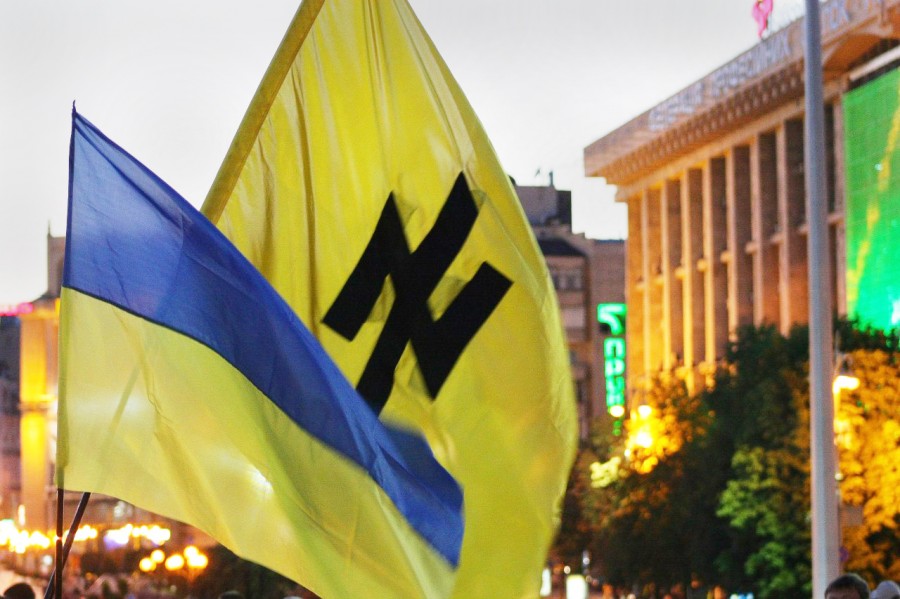
The neo-Nazi Wolfsangel symbol on a banner in Ukraine.
But major obstacles still impede progress. One is President Petro Poroshenko’s stalling in the face of opposition to the Minsk accord by Ukrainian nationalists. Kiev needs to be given a firm choice: go it alone, or compromise if it wants continued economic support from the United States and Western Europe. The Obama administration has quietly urged the Poroshenko government to honor the Minsk agreement, but has never put teeth behind its entreaties.
The other major obstacle is hostility from militarist hardliners in the West who propose arming Ukraine to ratchet up conflict with Russia. Prime examples include the State Department’s chief policy maker on Ukraine, Victoria Nuland; former NATO Commander Gen. Philip Breedlove, who became infamous for issuing inflated warnings about Russian military operations; Senate Armed Services Committee Chairman John McCain; and Stephen Hadley, Raytheon board member and former national security adviser to President George W. Bush, who chairs the Orwellian-named United States Institute for Peace.
But Trump will have great leeway as commander-in-chief to reject their advice and set a new direction for NATO’s policy on Ukraine and Russia more generally. He has everything to gain by breaking the cycle of political conflict with Moscow.
An ally in the Kremlin will immeasurably improve his chances of making deals in the Middle East, finding a way out of Afghanistan, and managing China.
The next few months should tell us whether Trump has the independence, imagination, and gumption to do the right thing.
Jonathan Marshall is author or co-author of five books on international affairs, including The Lebanese Connection: Corruption, Civil War and the International Drug Traffic . Some of his previous articles for Consortiumnews include “Nazi Roots of Ukraine’s Conflict,” “Escalations in a New Cold War,” “European Union’s Imperial Overreach,” and “Kosovo Chaos Undercuts Clinton ‘Success.’”

Wednesday, November 23, 2016

BerlinerCompagnie DAS BILD VOM FEIND Theaterstück

Die Ukraine, Putin, US-Geopolitik und der geheimnisvolle Gleichklang unserer Medien
DAS BILD VOM FEIND
Wie Kriege entstehen. Ein Theaterstück

Die Zahl der Besucher und ihr minutenlanger Applaus zeigen: Mit seinem Theater trifft das Ensemble den Nerv der Zeit.  GOSLARSCHE ZEITUNG

Fr.,  2. Dezember    19:30   
Sa., 3. Dezember    19:30   
So., 4. Dezember    17:00   
Di.,  6. Dezember    19:30   
Mit., 7. Dezember    19:30   

Werkraum der Berliner Compagnie
Fabrikgebäude / Hinterhof
Muskauer Straße 20 A
Berlin-Kreuzberg, U-Bhf Görlitzer Bhf

Eintritt: 14 €, ermäßigt 10 €
Kartenvorbestellung:

Die kleine linke Zeitung „Der Fortschritt“ ist vom Milliardär Doppelhaus aufgekauft worden. Der von ihm eingesetzte Chefredakteur soll bei den Redakteuren einen neuen Kurs des Blattes durchsetzen. Erste Aufgabe: eine Sonderbeilage über die Krise in der Ukraine...

Weitere Informationen unter: www.BerlinerCompagnie.de