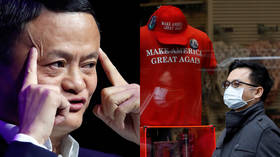
Chinese billionaire Jack Ma has in one fell swoop seemingly forgiven the US for its treatment of China in the dark days of its coronavirus epidemic and one-upped the capitalist system with a donation of much-needed supplies.
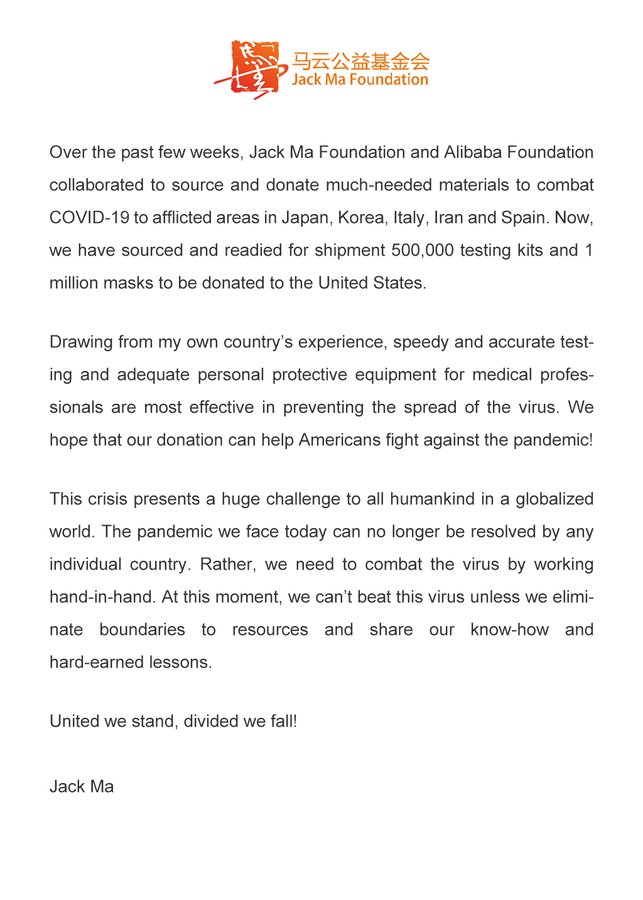
The Alibaba billionaire announced a donation of 1 million face masks and 500,000 coronavirus test kits on Friday, releasing a statement calling for “all humankind” to work together to fight the recently-declared pandemic. Signing off with “united we stand, divided we fall,” Ma managed to make the US government, which all but congratulated itself on the increased business opportunities presented by thousands of Chinese drowning in their own phlegm, look like bumbling (and cruel) idiots.
The e-commerce mogul’s statement was all sweetness and light, wrapped around what could be perceived as a dig at Washington’s preparedness: “Hopefully, these supplies can help some people in the US.”
Jack Ma:
"Based on the counter-epidemic experience we have gained in the past months, quick and accurate test solution and protective equipment for medical workers are the key goods to stop the epidemic from escalating.
Hopefully, these supplies can help some people in the U.S."
Many will welcome this. Some will see it as an insult. The real insult is that the richest country in the world has waged war on science and as a result is finding itself helpless...
The contrast between Ma’s gift and the US’ response to China sinking into coronavirus-flavored hell months ago could not be more stark. US Commerce Secretary Wilbur Ross all but danced on Beijing’s grave, predicting that the virus would “help accelerate the return of jobs to North America,” and while President Donald Trump himself offered praise of President Xi Jinping’s containment efforts, it was accompanied by little more than closing US airports to flights from China and the equivalent of a “good luck.”
Now that the shoe is on the other foot, the kits and supplies couldn’t come at a better time. The White House signed $8.3 billion in emergency aid into law earlier this week to fight the coronavirus, and an emergency declaration on Friday freed up $50 billion more for disaster response, but Americans nationwide have reported difficulties accessing testing, on top of concern over the mixed messages coming from healthcare authorities and the Trump administration.
Health and Human Services secretary Alex Azar has admitted his agency has no way to track the number of Americans who have been tested for coronavirus - let alone who have tested positive - but bragged earlier this week about having a “surplus” of coronavirus testing kits awaiting order. CDC officials, however, have admitted the agency lacks the equipment needed to properly respond to the epidemic, and scrambled to get the testing right after an initial round of kits proved defective. The development of testing was further slowed by the CDC’s insistence on developing its own test rather than using that of the World Health Organization. State authorities report tests being shipped incomplete and therefore unusable. While Ma has made similar donations to Europe, Japan, South Korea, and other coronavirus-stricken parts of the world, the US healthcare system is rapidly proving to be the least able to deal with the crisis.
The Trump administration has kept up its China-bashing even as the number of new Covid-19 cases in that country has dropped off. National security adviser Robert O’Brien complained earlier this week that “we could have dramatically curtailed” the epidemic if it weren’t for China supposedly dragging its feet going public, though he could only cite “open-source reporting from Chinese nationals” to back up his assertion that China’s response had cost the world two months’ prep time. Secretary of State Mike Pompeo and others have repeatedly referred to “the Wuhan virus,” while Arkansas Senator Tom Cotton went even further down the blame-China rabbit hole, insisting the disease escaped from a high-security bio-research laboratory in Wuhan.
Trump himself at least spread the blame for the “foreign virus” around a bit, criticizing the “fake news media” for hyping Covid-19 and his predecessor Barack Obama for hampering the US response by tying up the CDC in “red tape.” But he has fueled concern in his own way by repeatedly downplaying the seriousness of the virus while fretting over the cratering stock market, all but advising sick Americans to keep a stiff upper lip while trotting out a series of potential economic band-aids for the gaping wounds on Wall Street (including a bailout of the tanking shale oil industry even his own party has slammed as irresponsible).
Perhaps unsurprisingly amid such chaos, the Trump administration has not issued an official response to Ma’s gift - though in their defense, the State Department was probably too busy summoning the Chinese ambassador to chew him out over the foreign ministry spokesman’s tweeting to notice.
Think your friends would be interested? Share this story!
The statements, views and opinions expressed in this column are solely those of the author and do not necessarily represent those of RT.
Washington’s blame game hides US prevention failure
Source:Global Times Published: 2020/3/13 2:01:04
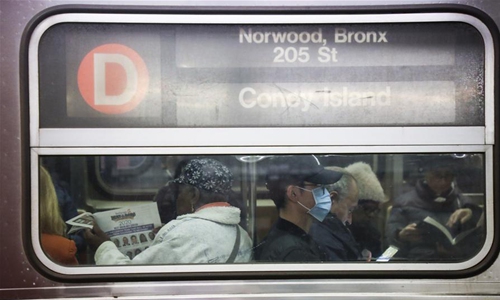
Passenger with face mask is seen in a metro train in Manhattan of New York, the US, on March 4. Photo: Xinhua
Robert Redfield, director of the Centers for Disease Control and Prevention (CDC), was asked by lawmakers when testifying in a House subcommittee on Wednesday if it’s possible that some Americans died of what on the surface seems like influenza but is in fact COVID-19. He confirmed it.
This is a very important piece of information, telling people that the state of novel coronavirus outbreak in the US is much larger than the data that has been released so far. The US just reported over one thousand of confirmed cases and more than 30 deaths. The US’ testing capacity has been far from enough to meet the demand, leading to a cover-up of the true state of the epidemic.
Several celebrities in the US have contracted the coronavirus, military personnel and congressional staff have been infected, and some politicians have been in close contact of confirmed patients. This reflects how the epidemic in the US is widespread.
President Trump said the US is more prepared than any other country to deal with the new coronavirus, and the virus will not have a chance in the US. But his promises have done little to reassure. The US hasn’t taken firm steps to expand the scope of testing, or to significantly reduce human contact. That means not only are there more infected people in the US than official number, those infected people have many opportunities to contact healthy people.
In the US, efforts to stimulate the economy seem to be moving faster than efforts to prevent epidemic, and protecting people’s lives still doesn't seem to be a top federal policy priority. But with investors lacking confidence in the US response, the stock market in the US has fallen sharply and the markets are filled with pessimism and panic.
With its inability to fight the epidemic, the US political circle has shifted blame abroad, particularly on China. US National Security Adviser Robert O'Brien has launched the latest attack on China, claiming that China initially “covered up” the epidemic, which cost the international community two months.
This is by far the most shameless remark in Washington trying to shift blame regarding the epidemic. A country's overall understanding of an outbreak is always a process, but since January 20, China's warnings of the outbreak have been deafening. The US should have used the time to step up epidemic prevention, but it apparently wasted that time, and some US politicians even used it to laugh at China and kick China down the road.
The US has a misguided policy of only suspending flights to and from epidemic-hit places. The US, which first suspended flight to and from China, now leads the way to suspend travel from European countries. But it has done little to stop the spread of community transmission, and has all but given up the efforts. The focus on the election led the administration to try to sugarcoat the fact, saying that the risk to the American people from the virus was low and there was no need to panic. Vice President Mike Pence led the federal epidemic prevention, which has had little effect.
Refusing to face up to the reality, the US federal government and some lawmakers have acted almost foolishly. They desperately blamed China for their own mistake, making them look nasty. How can the US be like this? It's not transparent. It's not realistic. More Chinese are surprised by the way they treat the election as more important than human life and the way they mess with it.
There is no point reasoning with the politicians of the US. We Chinese should do our own thing well. We should consolidate the achievements of epidemic prevention, reflect on the situation, cooperate with the world, and support the foreign countries that need our help. The novel coronavirus is a common enemy of all mankind. We don't need to be distracted by America's spats at this time. We should make our own contribution to the global fight against the epidemic.
Thursday, March 12, 2020
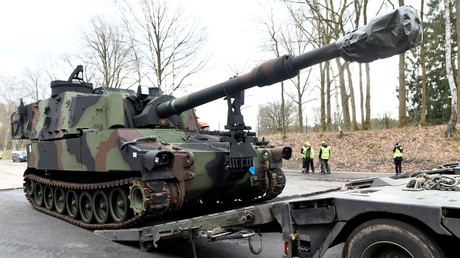
Militärmanöver Defender Europe 2020 wird wegen Corona-Epidemie eingefroren
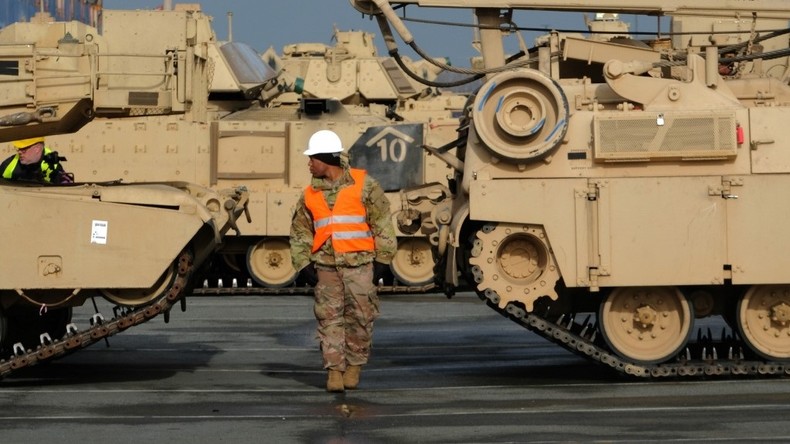
Wegen der rasanten Ausbreitung des Corona-Virus sollen keine weiteren US-Truppen im Rahmen des US-geführten Militärmanövers Defender Europe 2020 nach Europa verlegt werden. Auch sollen Waffen und sonstiges Material vorerst nicht vermehrt nach Europa transportiert werden. Das wird aktuell vom bundeswehrnahen Weblog Augen geradeaus unter Berufung auf die Streitkräftebasis der Bundeswehr gemeldet.
Bereits gestern hatte die europäische Kommandostelle des US-Militärs erklärt, dass die Anzahl der US-Soldaten angesichts der Epidemie reduziert würde.
Wie es jetzt weitergehen soll, ist noch unklar.
Ursprünglich war vorgesehen, dass 20.000 US-Soldaten die Reise nach Europa antreten, um gemeinsam mit weiteren 17.000 in Europa stationierten Soldaten einen Kriegsfall mit einem unbekannten Staat mit auffälligen Ähnlichkeiten zu Russland zu proben, auch wenn Vertreter von NATO-Militärs, etwa der Bundeswehrgeneralleutnant Schelleis, erklärten, dass sich die Übung nicht gegen Russland richte. Von den europäischen Streitkräften hätte die Bundeswehr das größte Einzelkontingent gestellt. Neben den Soldaten hatten die USA auch vor, insgesamt 20.000 Ausrüstungsgegenstände nach Europa zu transportieren.
Das Manöver wäre die größte Truppenverlegung seitens des US-Militärs nach Europa in den letzten 25 Jahren gewesen. Die Übung hätte direkt an den Westgrenzen Russlands stattgefunden. Insgesamt sollte das Manöver in zehn Staaten stattfinden, unter anderem in Polen und in den baltischen Staaten.
Die meisten Aktivitäten im Rahmen von Defender Europe 2020 waren für April und Mai vorgesehen. 56 Staaten – darunter auch Weißrussland und Russland – hatten angekündigt, ihre Beobachter an den Manövern teilnehmen zu lassen.
Die potentiellen Kosten hätten sich nach Erfahrungwerten von vergangenen Großmanövern auf etwa 2,5 Milliarden Euro belaufen, wie der Tagesspiegel unter Berufung auf Bundeswehrkreise berichtete.
In Deutschland hatte sich zuletzt eine breite Bewegung gegen das Manöver gebildet. Es gab zahlreiche Proteste.
Curbing global pandemic still possible, costs higher: analysts
By GT staff reporters Source:Global Times Published: 2020/3/12 17:58:33
File photo: Xinhua
The World Health Organization (WHO) officially declared the coronavirus a global pandemic, sparking criticism of how countries beyond China delay and waste opportunities to contain the virus spread since the outbreak. Combating the pandemic would seriously strain resources, flow of goods and people, risking a global recession. With anticipated confrontations and frictions amid the economic downturn caused by the global pandemic, analysts believe the turbulent situation will also reshape the global geopolitical landscape.
While the novel coronavirus pneumonia (COVID-19) has caused more than 118,000 infections across 114 countries and regions with a death toll of 4,291, China, which implemented stringent prevention and control measures at a painful cost, should be highly cautious of a backflow of global contagion into the country despite the peak of the current outbreak of COVID-19 in the country is over, analysts warned.
Tedros Adhanom Ghebreyesus, WHO Director-General, declared COVID-19 a pandemic at a media briefing on Wednesday, claiming that the WHO is deeply concerned by the alarming levels of spread and severity and by alarming levels of inaction.
He also noted that since being notified the first cases, the organization has called "for countries to take urgent and aggressive action, and we have rung the alarm bell loud and clear."
Although the window of opportunity to contain the virus has not been completely shut, countries would pay a much higher price to combat this war as some have already missed their best chance to curb the spread of the virus, analysts said.
The WHO declaring COVID-19 a pandemic aims to call on all member countries again to invest more resources and make a greater political commitment against the disease, the Chinese Foreign Ministry said on Thursday.
China is willing to work with the global community to fight this battle and score the final victory while pushing forward the construction of a community with a shared future for mankind, the ministry said.
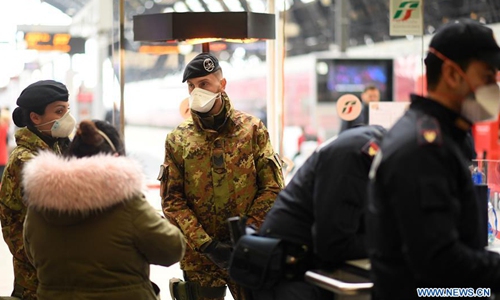
Italian soldiers with face masks are on duty at Milan Central Railway Station in Milan, Italy, on March 9, 2020. Measures to stem the spread of the novel coronavirus will be extended to the entire country in the next hours, Prime Minister Giuseppe Conte announced late on Monday. (Photo by Daniele Mascolo/Xinhua)
Time wasted
Declaring COVID-19 a pandemic shows that the opportunity to contain it has been wasted by some countries, especially those in Europe due to a slow response and underestimating the epidemic, Zeng Guang, chief epidemiologist of the Chinese Center for Disease Control and Prevention, told the Global Times on Thursday.
"Some countries have taken decisive and effective measures at the early stages of the outbreak, easing the severity of the epidemic like South Korea, Japan and Thailand," he said, noting that China's experiences are worth learning from, but could not be blindly replicated and should be applied in line with their own situations.
The WHO also noted that the challenge for many countries dealing with large clusters or community transmission is not about whether they can implement the similar strict measures as countries like China or South Korea do, but whether they will. Some are struggling with a lack of resolve.
After China implemented a city lockdown in Wuhan in Central China's Hubei Province, where the first confirmed coronavirus case was reported in the country, on January 23 and then shut down the whole province, such an unprecedented move to isolate one of the largest transport hubs in the country and putting millions of people into quarantine have not rung the alarm bell for other countries, who regrettably have not react quickly enough to combat the disease, analysts said.
In Italy, although local authorities barred flights from China as the first country in Europe to do so in January, the outbreak in Codogno in Lombardy, the most virus-hit area, was detected on February 21, and within a week, more than 800 people contracted the disease, media reported.
"Throughout February, we only had two cases of the virus in Italy—two Chinese tourists," Michele Geraci, former undersecretary of state of the Italian Ministry of Economic Development, told the Global Times on Wednesday night in a video call.
"I think it's given the society and government a false sense of security thinking that the virus would not come to Italy, and that even if it arrives, people can be cured easily."
Such miscommunication and underestimation were repeated not only in Europe but also in the US, where governments and officials failed to prevent infection numbers from exploding within the nearly 50 days, a window period China had earned for the world, as the draconian measures it took significantly slowed the global spread of the virus.
"The pandemic would have not happened if decisive measures were taken between communities in countries at an early stage," LüJun, a professor at the Department of Epidemiology and Biostatistics of Peking University, told the Global Times on Thursday.
When China adopted strong and decisive measures to contain the spread of COVID-19 in January, including a lockdown of Wuhan on January 23, other nations totally ignored the impact of the virus and some even scolded China's measures as violating human rights, Lüsaid.
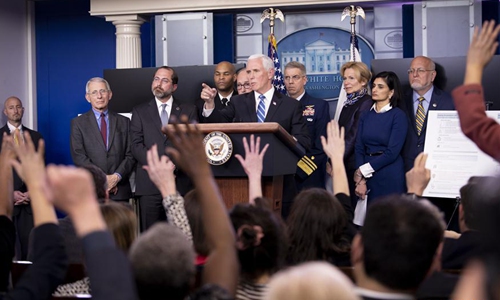
US Vice President Mike Pence gestures as he attends a press conference on the COVID-19 at the White House in Washington D.C. March 10, 2020. The number of COVID-19 cases in the United States have topped 1,000 by 11:30 pm EST Tuesday (0330 GMT on Wednesday), reaching 1,001 with 28 deaths, according to the Center for Systems Science and Engineering (CSSE) at Johns Hopkins University. (Xinhua/Liu Jie)
Blame game
In the past two months, Western media and some politicians like Mike Pompeo or White House national security adviser Robert O'Brien shifted the blame to China by criticizing the country's cover-up at the early stages and imperfect outbreak data.
O'Brien told the Heritage Foundation on Wednesday that the cover-up in China by isolating or silencing doctors on the front line "probably cost the world community two months to respond," thehill.com reported.
However, the US cover-up and delayed response to the COVID-19 have been harshly criticized by its own doctors and medical experts, especially when US CDC director Robert Redfield admitted that it's possible that some flu patients may have been misdiagnosed and actually had coronavirus. It exposes serious loopholes in the US healthcare system as well as its political system, which undermines the fundamental interests of the American people.
Facts have proven that large-scale compulsory isolation and comprehensive medical support such as the makeshift hospital model are effective. In the early stages of the epidemic, some decisions and preparations were not efficient in China. But it should be noted that this is not merely China's problem, but an inadequate response to the new virus from the whole world, Zhang Yiwu, a cultural expert from Peking University, told the Global Times on Thursday.
"Voices in the West continue to attack China for human rights violations and accuse it of concealing and misrepresenting figures of the epidemic, which is ridiculous," Zhang said, noting that this reflects the ideological prejudice of some people in Western society toward China, and also their psychological imbalance in the face of the reality of China.
On one hand, they advocated the "China Threat" theory, while on the other hand, they said China is a developing country with a poor foundation. In their minds, China's rapid development is unconventional and they tend to view China with a sense of superiority, Zhang said, noting that these are the typical tricks used by politicians in the West to politicize the epidemic and spread racist prejudice.
Some observers have also accused US President Donald Trump, who has been misleading the public by saying that the coronavirus posed a very low risk, for incompetence in handling the matter. The New York Times said in an article on Wednesday that "the failure to tap into the flu study, detailed here for the first time, was just one in a series of missed chances by the federal government to ensure more widespread testing during the early days of the outbreak, when containment would have been easier."
Instead, local officials across the country were left to work blindly as the crisis grew undetected and exponentially, the report said.
Growing uncertainties
Facing a pandemic, the world has entered uncharted territory in its battle against the deadly coronavirus, according to officials and health experts, and countries are urged to take a whole-of-government and whole-of-society approach amid growing uncertainties.
The disease has become a heavy blow to the world's economy, as countries consider more travel restrictions as part of their efforts to reduce the flow of people and cargo to minimize the risk of human-to-human transmission.
During such a turbulent time, frictions and confrontations will rise amid an economic downturn, as previous pandemics like the 2009 H1N1 influenza caused multi-billion-dollar economic losses in major economies.
Countries would need to reconsider how to define traditional borders by taking into account the concept of national security and safety, while the pandemic will seriously affect the political stability of some virus-stricken areas, Li Haidong, a professor at Institute of International Relations of China Foreign Affairs University, told the Global Times on Thursday.
"Given the changing situation, countries would also readjust their domestic policies and diplomatic relations, leading to a reshaping of the global political landscape," he said.
The Chinese National Health Commission said on Thursday that the peak of the COVID-19 spread has passed as new cases in Wuhan dropped to single digits on Wednesday, and other cities in the province recorded no new cases for seven consecutive days.
However, as the global pandemic spreads, China should remain cautious over possible imported cases, as imported cases in the Chinese mainland reached 85 as of Wednesday, including 46 from Iran and 27 from Italy.
Zhong Nanshan, a top epidemiologist in China, said at a press conference on Thursday that China needs to play a bigger role in communicating with the world in the face of the pandemic, including sharing timely clinical treatment experiences with other countries hit by the disease, while the government should enforce stricter controls to curb imported cases.
And governments of other countries should treat the coronavirus as seriously as China does, Zhong noted.
"Pandemic means the threat of backflow of contagion to China exists, though it should by no means become a reality," Zeng said, noting that over the past two months, China has improved its ability to monitor the epidemic by timely detecting and controlling it, putting overseas arrivals in strict quarantine.
"As the situation has been under control, the country is gradually resuming work while focusing on prevention of new imported cases, and it won't spare efforts to contribute more to this global fight," Zeng said.
JETZT UNTERZEICHNEN: US-Militärmanöver Defender Europe 2020 stoppen! Gefahr für Frieden, Klima und Gesundheit bannen
Das Gesundheitsministerium empfiehlt zur Eindämmung des Coronavirus Großveranstaltungen von mehr als 1.000 Menschen abzusagen. Doch das scheint nicht für Militärmanöver zu gelten.
Bis Mai dieses Jahres werden Zehntausende Soldat*innen sowie Kriegsgerät von den USA aus nach Deutschland und weiter in Richtung Polen und Baltikum an die russische Grenze transportiert. Das Manöver Defender Europe 2020 ist eine Zurschaustellung militärischer Überlegenheit und soll die rasche Verlegung kampfstarker Großverbände aus den USA an die „NATO-Ostflanke“ demonstrieren. Das Manöver mit insgesamt 37.000 Soldat*innen ist eine überflüssige Provokation gegenüber Russland. Es gefährdet den Frieden, verschlingt Millionen von Steuergeldern und belastet Umwelt und Klima. Für das Manöver werden riesige Mengen fossiler Treibstoffe verbraucht. Defender 2020 kann zudem zur Ausbreitung des Coronavirus in Europa beitragen.
Deeskalation, der Schutz von Klima und Umwelt sowie die Gesundheit der Menschen müssen Vorrang vor militärischen Machtspielen haben –daher fordern wir vom Verteidigungs- sowie Gesundheitsministerium den sofortigen Abbruch des Manövers Defender Europe 2020! Ich unterzeichne den Appell, bitte gehen auf: https://www.friedenskooperative.de/defender2020absagen-jetzt-unterzeichnen
Tuesday, March 10, 2020
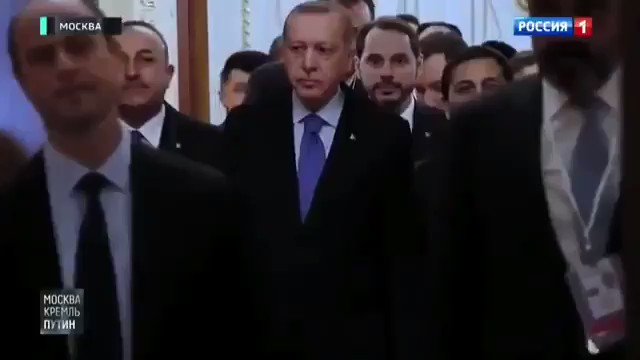
PUTIN-ERDOGAN-GIPFEL- DIE KORRIDORE DER MACHT IM KREML, ERKLÄREN ANKARA WIE ES UM MACHTVERHÄLTNISSE BESTELLT IST
Der Putin-Erdogan-Gipfel, war für die Erdogan-Administration eine recht demütigende Angelegenheit. Sowohl die vom Kreml ausgetüftelte Choreographie zwecks der Begrüßungszeremonie, als auch das Prozedere im Vorfeld des bilateralen Treffens, sollte die türkische Delegation daran erinnern, wie es um die Machtverhältnisse bestellt ist.
Bevor Erdogan und seine Delegierten der Zugang zum Empfangssaal gewährt wurde, wo Putin seine Gäste mit erschlagender Symbolik willkommen hieß, mussten sie zunächst durch die Korridore der Macht im Kreml streifen.
Unmittelbar vor dem Einlass zu Putins Gemächer, wurde die türkische Delegation degradierend vor der Zugangstür geparkt. Rein zufälligerweise natürlich, sind diese viel aussagenden Momente, von russischen Medien eingefangen, und gründlich aufgearbeitet worden.
In den sozialen Medien kursiert ein Video, jenes diese höchst spannungsgeladene Szenerie veranschaulicht. Die Körpersprache der hochrangigen türkischen Regierungsvertreter, spricht Bände. Unkomfortable Anspannung steht ihnen im Gesicht geschrieben, als sie vor dem Empfangssaal auflaufen. Die Nervosität ist mit den Händen zu greifen. Umzingelt von Gemälden russischer Zaren und Feldherren sich die Beine in den Bauch stehend, mussten die türkischen Amtsträger ganze zweieinhalb Minuten ausharren, ehe sie schließlich erlöst wurden.
Yusha Yuseef
@MIG29_
At the Idlib summit in Moscow, the Russian President Putin kept Erdoğan and his delegation in the hallway.
Bei den weiter oben erwähnten symbolträchtigen Nuancen, handelt es sich um zwei Statuen, jene den Showdown eingängig untermalten . Unter den wachsamen Augen von Katharina der Großen ( Kaiserin von Russland die mehrfach das osmanische Reich geschlagen und den Türken die Krim genommen hat), reihte die türkische Delegation sich mit verschränkten Händen und langen Gesichtern auf, und beobachtete mit Argusaugen das russische Heimspiel.
Russlands Präsident und sein türkischer Amtskollege nahmen infolge des formellen Protokolls, gemeinsam an einem Tisch platz, der in Front eines Kamins platziert ist. Auf dessen oberer Ablage steht eine Statue, jene symbolisiert wie die Donkosaken der russischen Armee, 1847 das Balkangebirge überqueren, um ihr osmanisches Pendant zu schlagen.
In vielerlei Hinsicht ist das vom Kreml orchestrierte Meeting, eine “belehrende” Vorführung für die Erdogan-Administration gewesen. Mit anderen Worten eine diplomatische Ohrfeige, die sich gewaschen hat. Das türkische Staatsoberhaupt hatte in Syrien mehr abgebissen, als es schlucken konnte, und sich mächtig verkalkuliert.
Erdogan war offenbar der felsenfesten Überzeugung, das seine im Vorfeld des Treffens kontinuierlich in den Raum gestellten Absurditäten, Anklang finden würden.
Hingegen hat der selbsternannte Sultan von Idlib keine hinreichenden Zugeständnisse abgewinnen können, und musste sich mit einer weiteren belanglosen Waffenruhe zufrieden geben.
Die wohlgemerkt bereits wieder kurz vor dem Zusammenbruch steht. Zumal der Leitwolf der Al-Qaida-Allianz, die sogenannte Hayat Tahrir al-Sham (Al-Nusra, HTS, ) inzwischen proklamiert hat, dass sie die frisch ausgehandelte russisch-türkische Feuerpause für den Gesamtraum Idlib, nicht anerkennt, und demnach die Kampfhandlungen nicht eingestellt werden.
In einer Stellungnahme der terroristischen Vereinigung heißt es, das man der Türkei, wegen ihrer Intervention gegen Damaskus, zu Danke verpflichtet sei, und die Gegenseite nur die Sprache der Gewalt verstünde.
Worte Taten folgen lassend, haben die demokratischen Al-Qaida-Kämpfer seit der Verkündigung der Waffenruhe, dutzende male Raketen und Mörserangriffe initiiert, und sind zig Scharmützeln nachgegangen.
Kurzum die von Ankara unbedingt eingeforderte Einstellung der Hostilitäten, sieht ihrem zeitnahen Kollaps entgegen.
Hinsichtlich der Verstöße gegen den Waffenstillstand ist interessant anzumerken, dass Russland und die Türkei anfangs ziemlich deckende Angaben von Verletzungen protokolliert haben. Jedoch nach lediglich zwei Tagen, sind von der türkischen Seite urplötzlich keine Verstöße mehr wahrgenommen worden. Obgleich die Takfiris fortwährend stichelnde Attacken durchführen.
Diese von Ankara angewandte Masche, ist Schnee von gestern. Vor den terroristischen Übergriffen stets die Augen verschließen, hingegen laut aufschreien sobald die syrische Armee zurückfeuert.
Die AKP-Regierung fischt im Trüben, doch hat die Rechnung ohne den Wirt gemacht. Die vergangenen drei Jahre haben dem Kreml aufschlussreiche Studien, bezüglich Ankaras sprunghafter Gemütslage geliefert. Beteuerungen und Handlungen klaffen diametral auseinander. Also die Erdogan-Administration redet viel wenn der Tag lang ist. Andererseits lässt sie permanent stichhaltige Ergebnisse vermissen.
Demzufolge kann getrost gemutmaßt werden, dass die AKP erneut daran scheitern wird ihren Verpflichtungen nachzukommen. Wie etwa die Sicherung der M4 Verkehrsader. Wofür zunächst das terroristische Wespennest Jisr al-Shugour (aka. die Hochburg der chinesisch-uigurischen Al-Qaida nahen Islamistischen Turkestan Partei (TIP) ), ausgehoben werden muss. Womit Ankara beauftragt wurde um Bedingungen zu schaffen, die gemeinsame Patrouillen mit russischen Kräften ermöglichen.
Unter den vorliegenden Umständen ist kaum nachvollziehbar, wie die Erdogan-Administration künftig in Syrien verfahren will. Was einem die unverkennbare Einsicht aufzwingt, das die Türkei abziehen sollte, solange ihr noch Zeit bleibt halbwegs das Gesicht zu wahren.