Thursday, May 9, 2019


Nuclear War vs. Belt and Road Initiative: Why China Will Prevail
FEATURED STORY


The global trend in international relations is often difficult to discern. But one can be helped in this task by looking at two events, organized in Washington and Beijing, comparing the different themes, participants, objectives, and broached for discussion. After all, we are talking about the two largest economies in the world, two colossi directing and shaping global culture, behavior and world opinion.
The last few weeks have offered the international community an opportunity to reflect. Two events took place in Washington and Beijing that, in terms of impact, depth, participation and issues discussed, are striking contrasts.
In Beijing at the Belt and Road Forum over 40 world leaders discussed the Belt and Road Initiative (BRI), a project that will transform the entire Eurasian continent, improving free trade between dozens of countries by investing in transport infrastructure as well as in energy and technological cooperation. The leader of this silent industrial revolution is China’s Xi Jinping, casting ancient ambitions and perspectives into the new millennium, anxious to once again acquire the leading role in global civilization.
The BRI is a gigantic project that will continue to expand in the years to come and at the rate the current technology allows, while of course remaining cognizant of the needs of the countries involved in the Chinese project. The numbers of participants at Beijing’s BRI event are astonishing, with more than 5,000 delegates, 37 heads of state (including that of G7 member Italy), and 10 of the most important members of ASEAN. A hundred and twenty-five countries have signed intentions to cooperate grand project, and 30 organizations have ratified 170 agreements that total a projected investment by the People’s Bank of China of over 1.3 trillion dollars from 2013 to 2027. This is what Robin Xing, Morgan Stanley’s Chief China Economist said:
“China’s investment in B&R countries will increase by 14% annually over the next two years, and the total investment amount could double to $1.2-1.3 trillion by 2027.”
It is a revolutionary project that will characterize the next few decades if not centuries. It will offer a stark contrast to the American drive for hegemonic domination by demonstrating the capacity of humanity to overcome conflicts and wars through cooperation and shared prosperity.
Washington is left demanding loyalty in exchange for nothing (but with Donald Trump, even this little is uncertain). Unable to inflict damage on Russia and China, the US focuses on pressuring her European allies through a trade war of duties, tariffs, technological bans ( Huawei’s 5G) and sanctions (against Iran and European banks) in order to favor US companies.
Reflecting the moral of Aesop’s fable “The North Wind and the Sun”, Beijing behaves in the opposite manner, offering in the BRI project win-win cooperation and the benefits that accrue from this. The project tends to improve people’s living standards through the huge loans extended to improve such basic infrastructure as railways, schools, roads, aqueducts, bridges, ports, internet connectivity and hospitals. Beijing aims to create a sustainable system whereby dozens of countries cooperate with each other for the collective benefit of their people.
The Eurasian continent has struggled over the last few decades to attain the same level of wealth as the West as a result of wars of aggression and economic terrorism committed by countries in search of a utopian global hegemony.
The Chinese initiative aims to offer to all the countries involved equal opportunities for development based not on military and/or economic power but on a real capacity to improve the well-being of all parties involved.
As Asia Times explained in an excellent article on Beijing’s most recent BRI forum:
“BRI is now supported by no less than 126 states and territories, plus a host of international organizations. This is the new, truthful, realistic face of the “international community” – bigger, more diversified and more representative than the G20.”
This Chinese initiative could have only taken place in a post-unipolar world with multiple centers of power. Washington is perfectly aware of the changes that have occurred over the last 10 years, and the accompanying change in attitude of policy makers can be seen in the drafting of two documents that are fundamental for every US administration, namely, the Nuclear Posture Review (NPR) and the National Defense Strategy (NDS).
These two documents explain how the United States sees the world and what it intends to do to fight the emerging multipolar world order. Compared to Obama and his administration, Trump, Bolton and Pompeo are more anchored to the current reality, understanding well that Russia and China are their equal militarily. Obama, of course, infamously dismissed Russia as a regional power no more than five years ago.
Trump cannot afford a conflict with Venezuela, Iran or North Korea, whether militarily or politically. In the case of Venezuela, Colombia and Brazil do not seem too keen on sacrificing themselves on behalf of Washington; and there are no jihadists to arm and launch against defenseless civilians as happened in the Middle East, so there is no force in the field capable of defeating a strongly patriotic nation dedicated to resisting US imperialism. Attacking Iran would result in a devastating Iranian response targeting US troops deployed in dozens of bases scattered throughout the Middle East and inflicting losses that would be too costly for Washington, making any gains made pyrrhic. As for North Korea, Kim cannot be touched thanks to nuclear deterrence.
What remains for Trump and his neocons are empty threats of war, documents declaring Russia and China as opponents to be defeated, and a great deal of war propaganda for the purposes of filling up the coffers of US arms manufacturers.
And now we come to the event organized in Washington as Beijing was busy discussing how to revolutionize three-quarters of the globe. The Brookings Institute, a think tank, organized a meeting that lasted several hours to discuss “The future of US extended deterrence“, focussing on the tools needed to deal with an attack from America’s opponents.
Quelle: Strategic-Culture-Foundation https://www.strategic-culture.org/news/2019/05/07/nuclear-war-vs-belt-and-road-initiative-why-china-will-prevail/
Quelle: Strategic-Culture-Foundation https://www.strategic-culture.org/news/2019/05/07/nuclear-war-vs-belt-and-road-initiative-why-china-will-prevail/
Ein „Nicht-Datum“ für die Deutschen: Tag der Befreiung in Berlin-Karlshorst – Video
Vor 74 Jahren wurde in Berlin-Karlshorst die Kapitulation des Dritten Reiches unterzeichnet. Doch für die meisten Deutschen habe der Befreiungstag keine Bedeutung. Das meint Jörg Morré, Direktor des Deutsch-Russischen Museums Karlshorst.
Die Stimmung beim Museumsfest und die Anzahl der Besucher am 8. Mai zeugen jedoch vom Gegenteil. https://de.sputniknews.com/gesellschaft/20190509324919784-tag-der-befreiung-berlin-karlshorst/ https://de.sputniknews.com/bilder/20190509324898737-tag-mit-traenen-sieg/
Hans-Georg Maaßen: "Der Begriff Verschwörungstheorie wurde von Geheimdiensten erfunden"
9.05.2019 • 06:30 Uhr

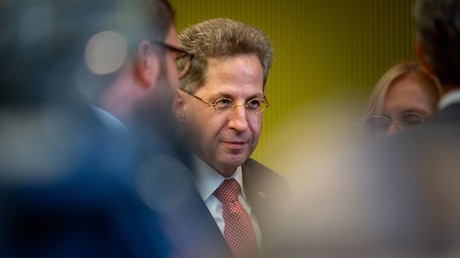
Quelle: AFP © Tobias Schwarz
Maaßen gemeinsam mit Bundesinnenminister Horst Seehofer im Juli 2018
Der Begriff Verschwörungstheorie wurde von Geheimdiensten erfunden – das gibt nicht irgendwer zu bedenken, sondern der frühere Verfassungsschutzchef Hans-Georg Maaßen in einem Interview. Auch sonst macht er in dem Gespräch einige bemerkenswerte Äußerungen.
Der frühere Präsident des Bundesamtes für Verfassungsschutz Hans-Georg Maaßen hat in einem Interview mit der Neuen Zürcher Zeitung (NZZ) einige bemerkenswerte Äußerungen gemacht. Gefragt, warum er seit seiner Entlassung verstärkt die Öffentlichkeit suche, erklärte Maaßen, dass er nach seiner Entlassung viel Zuspruch aus der Bevölkerung erfahren habe.
Mitarbeiter des Amtes hätten ihn ermutigt, auch in Zukunft seine Stimme zu erheben. Bestimmte von ihm geteilte Werte und Überzeugungen würden in der deutschen Politik kaum noch vertreten. Maaßen beklagt eine Verengung des politisch statthaften Meinungskorridors in Deutschland:
Ich glaube, wir in Deutschland leiden unter der Volkskrankheit des romantischen Idealismus, der Träumerei und der Besserwisserei. Und das verbunden mit einer Aggressivität, die im Grunde nur Fanatiker haben können. Das macht mir Sorgen, denn in anderen Ländern ist man viel gelassener im Umgang mit politischen Querdenkern.
Er selbst erlebe viele Anfeindungen. Für viele Linken sei er der "leibhaftige Satan". Von ihm durchgeführte Veranstaltungen an der Freien Universität Berlin zum Beispiel hätten unter Polizeischutz abgehalten werden müssen. Seine Kritik an Erklärungen auch aus Regierungskreisen, in Chemnitz habe es Hetzjagden auf Ausländer gegeben, verteidigte er ausdrücklich: "Es ist kein Fehler, die Wahrheit zu sagen."
Auf die Feststellung der NZZ, dass er in Deutschland von den einen als Held, von anderen als Verschwörungstheoretiker wahrgenommen werde, antwortete Maaßen mit der Feststellung:
Der Ausdruck "Verschwörungstheoretiker" ist von bestimmten ausländischen Geheimdiensten erfunden und verwendet worden, um politische Gegner zu diskreditieren. Ich bin erstaunt, mit was für einer Selbstverständlichkeit dieser Ausdruck ins Standardvokabular deutscher Journalisten aufgenommen wurde.
Schon seit längerem gibt es Berichte, wonach der Begriff in den sechziger Jahren vom US-Geheimdienst CIA eingeführt wurde, um Kritik und Zweifel an der offiziellen Version des Kennedy-Attentats zu diskreditieren. Maaßens Feststellung gibt nun solchen Berichten eine Art offizielle Bestätigung.
Der frühere Verfassungsschutzchef kritisierte im Gespräch mit der NZZ in deutlichen Worten die deutschen Medien, die nicht objektiv seien und eine bestimmte politische Richtung vertreten würden:
Medien sind in westlichen Demokratien unabhängig, aber nicht objektiv, sondern vertreten bestimmte subjektive Überzeugungen. Das ist nicht schlimm, dazu muss man sich nur bekennen, und die Kunden müssen dies auch für sich realisieren. Man muss allerdings sehen, dass über 70 Prozent der Journalisten von sich sagen, politisch den Grünen und der SPD nahezustehen, aber nur 11 Prozent der Union. Problematisch ist das ganz besonders bei den öffentlich-rechtlichen Sendern, die zur Meinungsvielfalt verpflichtet sind.
Auch die Flüchtlingspolitik von Bundeskanzlerin Angela Merkel kritisierte Maaßen, wieder einmal:
In der seit September 2015 im Wesentlichen unveränderten Migrationspolitik sehe ich erhebliche Risiken für die Sicherheit und den Zusammenhalt des Staates. Notwendig ist, dass Zurückweisungen an der Grenze durchgeführt werden. Wir müssen die Türen für diejenigen schließen, die nicht politisch verfolgt werden, und wir müssen die rund 240.000 Ausländer, die ausreisepflichtig sind, umgehend abschieben und uns nicht von den Herkunftsstaaten auf der Nase herumtanzen lassen.
Merkel werde auf absehbare Zeit ihr Amt aufgeben müssen. Er habe die Hoffnung, dass ihre wahrscheinliche Nachfolgerin Annegret Kramp-Karrenbauer hier eine klare Kurskorrektur vornehmen und Vorkehrungen für eine "neue, große Welle von Einwanderern" treffen werde.
Hans-Georg Maaßen war seit August 2012 Präsident des Bundesamtes für Verfassungsschutz. Im September 2018 geriet er in die Kritik, nachdem er Äußerungen über angebliche Hetzjagden auf Ausländer in Chemnitz kritisiert hatte. Nach einer Koalitionskrise wurde Maaßen im November in den einstweiligen Ruhestand versetzt.
In den sechs Jahren seiner Amtszeit hatte Maaßen zuvor etliche andere Gründe für eine mögliche Entlassung geliefert. Seine Rolle in der NSA-Affäre, im sogenannten NSU-Komplex, beim Terroranschlag auf dem Breitscheidplatz, zuvor im Fall Kurnaz, zum ZDF-Film über einen angeblichen FSB-Überläufer: Maaßen und sein Amt agierten in all diesen Fällen undurchsichtig und fragwürdig. Entlassen wurde er aber erst, als er seiner Regierung widersprach.
Mehr zum Thema - Maaßen muss gehen, weil er recht hat
Tuesday, May 7, 2019
"We’re All Actors In New Silk Road Play" By Pepe Escobar
from https://thesaker.is/were-all-actors-in-the-new-silk-road-play/ posted their with permission
Scores of nations across the Global South have adopted the Chinese development model over financing from the US or EU for very simple reasons
It’s the same old story: The dogs of demonization bark while the New Silk Road caravan advances. The Belt and Road Initiative (BRI), according to a projection by Anglo-Australian mining and metals giant BHP Billiton, will generate as much as US$1.3 trillion in myriad projects up to 2023 – only a decade after its official launch by Chinese President Xi Jinping in both Astana (now Nur-Sultan) and Jakarta.
It’s easy to forget that the BRI – a massive connectivity project, both geo-strategic and geo-economic, now in effect all across the Eurasian landmass, as well as straddling the South China Sea, plus the Indian Ocean all the way to East Africa – is less than six years old, and projected to last until 2049.
As I previously reported, the BRI is now configured as the authentic International Community 2.0 – much more representative than the Group of Twenty, not to mention the Group of Eight. Even before the start of the Belt and Road Forum in Beijing last week, 126 states and territories had signed BRI cooperation agreements. After the forum there are 131, plus Switzerland soon to join. The BRI is also engaged with no fewer than 29 international organizations, including the World Bank.
Considering only projects already being implemented, the World Bank estimates that BRI nations have reduced shipping times by up to 3.2%, and trade costs by up to 2.8%.
The BRI forum’s key takeaway was Beijing’s ability to execute a masterful geopolitical Sun Tzu maneuver – realizing that for the scheme to proceed more smoothly it would have to address key questions about debt sustainability, anti-corruption, consultative processes, plus emphasize “bottom-up” negotiations.
Scores of nations across the Global South, as well as some aspiring to developed world status, have adopted the Chinese investment and development model over financing from Washington or Brussels for three very simple reasons: no strings attached, no one-size-fits-all straitjacket, and no interference in their internal affairs.
That’s the case in BRI projects focused on the group of China plus Central and European nations, now called 17+1 (Greece just joined). The BRI has been on a roll implementing the China-Europe Land-Sea Express Line, from Athens to Hamburg via Skopje and Belgrade – with a branch out to the Mediterranean port of Bar in Montenegro, just across from Italy – and then to Budapest, the ultimate crossroads in Eastern Europe, and all the way north via the Czech Republic to Hamburg.
Additionally, the Land-Sea Express Line will connect to the Pan-European Corridor linking Bari, Bar, Belgrade and Timisoara in Romania.

- New Silk Roads stretch from China to Europe, Southeast Asia and Africa. Image: CFR
ASEAN goes BRI
The Association of Southeast Asian Nations is arguably the crucial front to ensure the BRI’s further success – side by side with the China-Pakistan Economic Corridor (CPEC). And all 10 ASEAN leaders attended the BRI forum.
Beijing’s strategic outlook involves the positioning of Thailand as ASEAN’s key transportation hub. Thus it needs to complete the $12 billion, multi-phase, 873-kilometer high-speed rail line linking central and northeastern Thailand to the rail line being built from Kunming to Vientiane, which is due to be completed in 2021.
This is the flagship project of the BRI’s China-Indochina Peninsula Economic Corridor, connecting southern China with mainland Southeast Asia all the way to Singapore.
At the recent BRI forum, China, Thailand and Laos signed a memorandum of understanding on building the stretch between Nong Khai and Vientiane. Now comes the hard slog of renegotiating the terms for building the 607km stretch from Bangkok to Nong Khai, on the Thai side of the Mekong.
Malaysia managed to renegotiate the budget and route of its Eastern Coast Rail Link. Plus, China and Myanmar are renegotiating the $3.6 billion Myitsone Dam project.
At least nine of no fewer than 23 projects, part of the China-Myanmar Economic Corridor, are rolling – including a special economic zone (SEZ) in Kyauk Phyu in the west, the Kyauk Phyu-Kunming railway and three border cooperation zones in Kachin and Shan states. Myanmar is absolutely key for China to enjoy strategic access to the Indian Ocean.
Elsewhere in maritime Southeast Asia, the $6 billion, 150km Jakarta-Bandung high-speed rail is a goer, despite facing accusations of non-transparency by Indonesia’s Investment Coordination Board. Still, the Joko Widowo administration’s second term is bound to be involved in no less than $91 billion worth of BRI-related projects to develop four different economic corridors.
One thing is common to these multiple BRI negotiation fronts – the Lost in Translation syndrome. Imagine terms and contracts mired in a maze of cross-references and a trilingual swamp (Mandarin, English and then Thai, Lao, Indonesian, etc).
Not to mention the clash between local red tape and the ultra-streamlined Chinese infrastructure-building juggernaut – perfected to the millimeter for the past few decades.
Still, Beijing is learning the key lessons, admitting it’s essential to renegotiate key terms, amend deals, pay close attention to local input, and, essentially, allow more transparency.
Chinese contractors must employ more local workers, encourage technology transfer, and be very aware of negative environmental impacts. There are suggestions that an overseas BRI arbitration court – for instance in neutral Geneva – could be set up in addition to BRI courts in Shenzhen and Xian, in the interests of more transparency.

- All aboard for a Silk Road journey. Photo: Pepe Escobar
Hop on a camel and join the band
Wang Huiyao, founder of the Center for China and Globalization think-tank in Beijing, correctly argues that the BRI “has become a plan for global development – the kind the world has been sorely lacking since the financial crisis of 2008.”
That was certainly the intent even during the long gestation period before the birth of the BRI in 2013. The Chinese system works like this. The top of the pyramid issues a guideline, or a plan, and then the subsequent layers of the pyramid come up with their own implementation strategies, tweaking the process non-stop. It’s always a variant of Little Helmsman Deng Xiaoping’s famous dictum “crossing the river while feeling the stones.”
As it stands, there’s no evidence the US government will be engaged with the BRI, not to mention “try to shape it to bring about a more multipolar Asia,” as my friend Parag Khanna argues. The BRI itself – along with other mechanisms such as the Eurasian Economic Union – is already configuring a multipolar Asia. And no one across Eurasia – apart from Hindutva fanatics and Japanese supremacists – is buying the Pentagon narrative of China as an existential threat.
It’s quite enlightening to pay attention to the words of former Hong Kong governor Tung Chee-hwa, who seems to display more wisdom in his 80s now, as chairman of the Chinese Consultative People’s Congress, than when he was lodged in Government House.
And then we could travel in time to the Ancient Silk Road – which as a trade and cultural exchange network between East and West was a de facto prototype of globalization.
We’ll find out that among the non-stop Ancient Silk Road travelers – and merchants, messengers, pilgrims – there was also a motley crew of jugglers, acrobats, musicians, dancers and actors. Centuries later, history strikes again, and we are all actors now in a massive, global development caravan.
Subscribe to:
Posts (Atom)