Friday, March 16, 2018

Sigmar Gabriel zur Skripal-Affäre: "Wie ganz schlechte James-Bond-Filme" (Video)

Sigmar Gabriel zur Skripal-Affäre: "Wie ganz schlechte James-Bond-Filme" (Video)
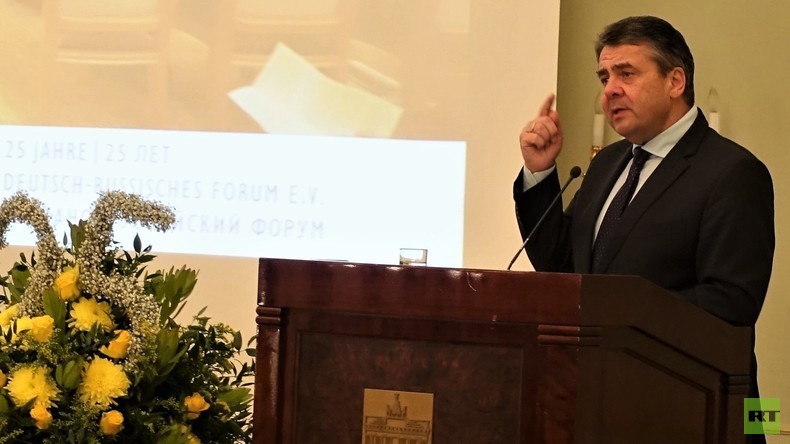
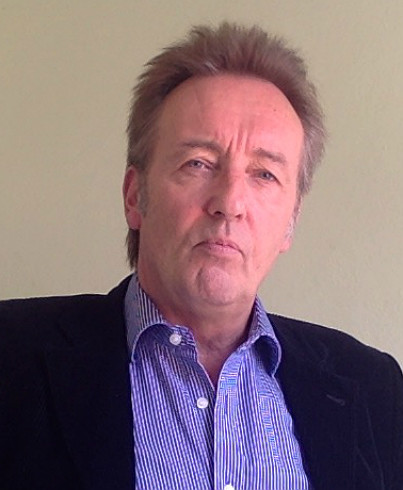
Der deutsche Außenminister a.D. Sigmar Gabriel bei seinem Auftritt am 15. März im Hotel Adlon anlässlich des 25-jährigen Jubiläums des Deutsch-Russischen Forums.
Bei seinem ersten Auftritt als Außenminister a.D. plädierte Sigmar Gabriel für Zurückhaltung bei gegenseitigen Anschuldigungen in der diplomatischen Krise zwischen Großbritannien und Russland. Vor allem mahnte er die Wahrung des rechtsstaatlichen Prinzips der Unschuldsvermutung an.
Der ehemalige Bundesaußenminister Sigmar Gabriel hat sich in seiner ersten öffentlichen Rede nach seinem Ausscheiden vor dem Deutsch-Russischen Forum von der offiziellen Haltung der Bundesrepublik zum aktuellen Skandal um den mutmaßlichen Giftgasanschlag im britischen Salisbury distanziert. Diese hatte sich bedingungslos den haltlosen Anschuldigungen der britischen Regierung gegen Russland angeschlossen. Großbritannien zufolge gebe es keine andere Erklärung, als dass Russland hinter den Anschlägen stecke. Das Nervengas etwa, das für den Anschlag verwendet wurde, stamme aus sowjetischer Produktion, heißt es in einer gemeinsamen Erklärung Großbritanniens, Frankreichs, Deutschlands und der USA. 
Gabriel kritisierte die Eskalationsspirale gegenseitiger Anschuldigungen zwischen Großbritannien und Russland und rief dazu auf, in der aktuellen Ermittlung zu dem Fall nach dem rechtsstaatlichen Prinzip der Unschuldsvermutung vorzugehen. Zudem mahnte er die Streitparteien, die Frage des Ursprungs des Gifts im Rahmen der Organisation für das Verbot chemischer Waffen (OPCW) zu klären. 
Tags: , , , , , ,, , , , https://deutsch.rt.com/international/66749-sigmar-gabriel-zur-skripal-affaere-wie-schlechte-james-bond-filme/

UK using Skripal case to divert attention from Brexit setback – Russian ambassadorhttps://www.rt.com/shows/rt-interview/421474-uk-skripal-brexit-yakovenko-rt/

22:18
22:18
The UK is using the Skripal case to divert attention from Brexit issues, Russia’s Ambassador to the UK Alexander Yakovenko told RT. London has actively engaged a NATO-led anti-Russian campaign for this purpose, he said.

Novichok – toxic questions about chemical at center of Skripal saga

Novichok – toxic questions about chemical at center of Skripal saga
The public has learnt a new Russian word: Novichok or novice, as the UK claims it is a nerve agent that poisoned former double agent Sergei Skripal. But, as with many elements of this saga, this chemical raises many questions.
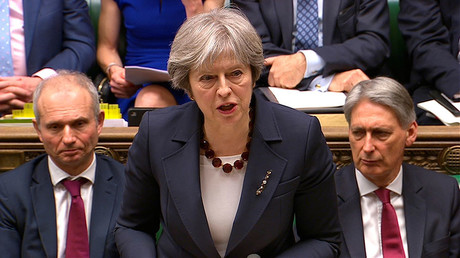
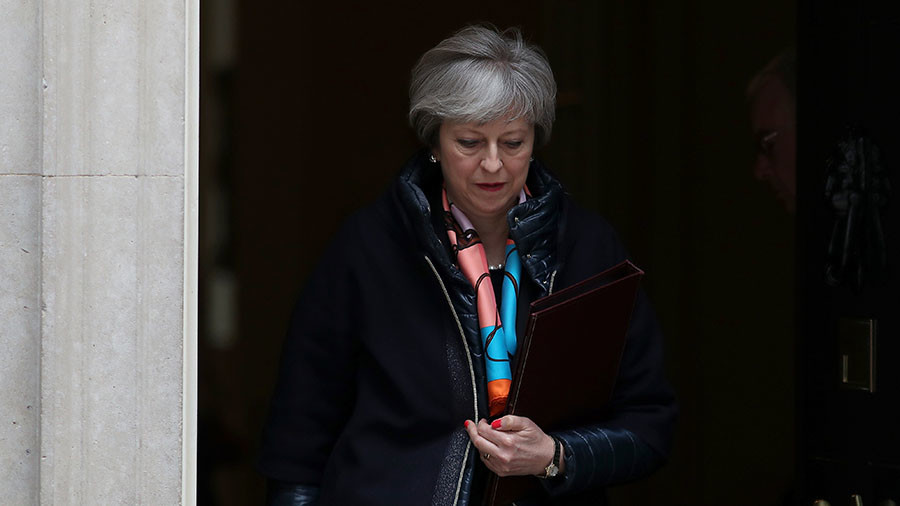
British Prime Minister Theresa May said Skripal and his daughter were poisoned by a military-grade nerve agent “Novichok,” allegedly developed by Russia. She claimed this was either “a direct action” by Moscow or the result of a loss of control over “its potentially catastrophically damaging nerve agent.” Speaking to MPs, she even said the cabinet had given Moscow one day to provide a “credible response” to the allegations.
The use of a military-grade secret nerve agent may sound like a James Bond movie and, as with many action dramas, there are some notable inconsistences in the plot that raise questions.

The killer agent that is not on chemical watchdog list?

The Organization for the Prohibition of Chemical Weapons (OPCW) carefully describes all known types of weapons-grade chemicals, including notorious sarin and VX, as well as their properties, mechanisms of action, and possible antidotes. But oddly enough, ‘Novichok’ – the substance supposedly deadlier than sarin or VX – is not on the OPSW nerve agents list.

Would you pay $30 for a secret chemical agent formula?

‘Novichok’ was first disclosed to the public by a Russian chemist named Vil Mirzayanov, who claimed in a 1992 article for Moskovsky Komsomolets daily that Moscow was developing extremely potent fourth-generation chemical weapons. The article was published prior to Russia's signing of the Chemical Weapons Convention, making the timing particularly interesting. 
Mirzayanov, who defected to the US several years later, reacted to the British prime minister’s accusations in a notable post on Facebook. “[May] said that ‘Novichok’ has been used in the assassination attempt on Skripal,” Mirzayanov wrote. “Its chemical formula has been published only in my book,” he said. 
His book, which allegedly contains the top-secret formula of the deadly nerve agent, is titled ‘State Secrets: An Insider's Chronicle of the Russian Chemical Weapons Program.’ Its paperback edition is available on Amazon and sells for just $30. If the formula is genuine, this is probably the first time a whistleblower has provided free access to a method of producing the highly poisonous weapon.

Is Russia the only place it could come from?

Mirzayanov also contributed to a 1995 report by the US-based Henry L. Stimson Center. The paper, which refers to the defector’s 1992 piece, noted multiple security flaws at Russia’s chemical weapons storage sites – a revelation unsurprising enough, given the poor state of Russian military at the time. While praising some basic security measures at the compounds, the report says: “By US standards, Russian chemical weapon storage facilities unquestionably appear vulnerable to attack from outside and theft from within.”
Nikolai Kovalev, who led Russia’s security service, the FSB, from 1996 to 1998, told RIA Novosti that the likes of ‘Novichok’ were “stockpiled in former Soviet Union republics.” Russian Senator Franz Klintsevich told the Zvezda TV Channel that the Soviet military sent the so-called “frontline packages” containing the agent to various parts of the country. “It could have been stored in any [post-Soviet] country, including Georgia and Ukraine,” he noted.
Back in 1999, it emerged that the Pentagon might gain access to one of the chemical plants that reportedly produced ‘Novichok.’ The New York Times reported that the US military was going to spend up to $6 million “to demilitarize the so-called Chemical Research Institute”located in the Uzbek city of Nukus. “Soviet defectors and American officials say the Nukus plant was the major research and testing site for a new class of secret, highly lethal chemical weapons called ‘Novichok,’ which in Russian means '’new guy,’” the piece said. 

How was it proven to have been Russia, if nerve agents can be produced anywhere?

‘Novichok’ is said to be a “binary agent,” meaning that it could be stored as two, less toxic chemicals. To produce the active toxic agent, the two must be mixed, and be allowed to react. This makes the ingredients easier to transport, as they only become fully toxic when mixed.
Anton Utkin, a Russian chemist who worked as a UN inspector in Iraq and developed technologies to destroy Russia’s chemical weapons, says it’s unclear “how they [Britain] could establish that it was produced in Russia.” He said that anyone familiar with the technology could have produced it. “You can’t find out who manufactured the chemical weapon – the content of the substance will be fully identical while using the same method,” he said. “There is no way to establish with full accuracy that a chemical comes from this or that country.”

What about the chemical watchdog confirming Russia destroyed its stockpiles?

In autumn last year, the OPCW confirmed that Moscow – a signatory to the Chemical Weapons Convention – had completely destroyed its stockpiles. The organization’s inspection teams verified the destruction at seven chemical weapons destruction facilities in Russia, and, on September 27, 2017, the last of these facilities officially ceased its operations. The six other facilities were closed between 2005 and 2015.
"The completion of the verified destruction of Russia's chemical weapons program is a major milestone in the achievement of the goals of the Chemical Weapons Convention,” the organization’s Head Ambassador Ahmet Uzumcu said at the time. He praised countries that assisted Russia with its destruction program, as well as OPCW staff who verified the destruction.

Timing is everything?

Russian officials say the timing of the allegations is particularly notable. “Presidential elections are looming in Russia, and the country is accused of committing every mortal sin,” Sergey Stepashin, former FSB director, told Interfax. “Tell me, which idiot in Russia could carry out such [an attack]? Where is the logic [in that]?”
He asserted that the story could have been “a primitive provocation by British intelligence services,” and noted that Moscow and London signed a 1998 agreement on mutual investigations in high-profile cases. “So, hand the files over to us and let us probe the crime together,” the former intelligence chief said. https://www.rt.com/news/421200-uk-novichok-agent-allegations/

Thursday, March 15, 2018

Britain’s presumption of guilt towards Russia invites conflict and chaos

Finian Cunningham
Finian Cunningham (born 1963) has written extensively on international affairs, with articles published in several languages. Originally from Belfast, Northern Ireland, he is a Master’s graduate in Agricultural Chemistry and worked as a scientific editor for the Royal Society of Chemistry, Cambridge, England, before pursuing a career in newspaper journalism. For over 20 years he worked as an editor and writer in major news media organizations, including The Mirror, Irish Times and Independent. Now a freelance journalist based in East Africa, his columns appear on RT, Sputnik, Strategic Culture Foundation and Press TV.
Britain’s presumption of guilt towards Russia invites conflict and chaos
Britain’s abandonment of due process has taken a dangerous and reckless leap, with Theresa May declaring economic sanctions and diplomatic expulsions for Russia’s “failure” to respond to allegations over the Skripal poisoning.
Provocatively, Moscow was given a 24-hour deadline to “answer” charges leveled by the British government that it was responsible for the attempted murder of a Russian double agent, Sergei Skripal, who had been living in England since 2010 after a spy-swap deal.
Skripal (66) and his 33-year-old daughter Yulia were apparently stricken with a deadly nerve agent in his adopted hometown of Salisbury on March 4 while strolling through a public park. The pair have been receiving treatment in intensive care ever since.
Earlier this week, the British prime minister asserted that the chemical weapon used was a Soviet-era nerve agent, Novichok, and – on that basis – the Russian state was implicated in the attempted murder of the former spy. Skripal had been exiled from Russia in 2010 after he was convicted of treason as a double agent for British intelligence MI6.
The new economic and diplomatic sanctions against Moscow, which were announced by May in the House of Commons on Wednesday, constitute a reckless escalation towards conflict between Britain, its NATO allies, and Russia.
Moscow has said it will not stand for British punitive measures and is vowing to take reciprocal actions.
Washington and European states have quickly followed Britain’s lead in ramping up hostile rhetoric towards Russia, and issuing statements of “solidarity.” Relations between Russia and NATO states had already plummeted to Cold War depths before the latest row.
The invitation for more chaos and conflict comes with the abandonment of any pretense at upholding legal principles and standards.
Britain and its allies are relying on the inverted principle of “presumption of guilt” as opposed to “innocence.” Within days of the apparent poison attack on the Sergei Skripal and his daughter, the British authorities and media had rushed to judgement that the alleged attack was the work of the Russian state in an act of revenge for past betrayal. That motive does not stand up to scrutiny, noted former British ambassador Craig Murray.
Furthermore, the hypothetical Soviet-era nerve agent identified by the British authorities has not been independently verified. We are relying on official British claims. The alleged chemical may or may not have been used in the attack.
As Russia’s Foreign Minister Sergei Lavrov revealed, all requests from Moscow for access to the alleged poison as evidence have been refused by London. Such a refusal is a violation of the Convention on Chemical Weapons treaty, which mandates joint inspection of alleged incidents.
So, the British government imposed an ultimatum on Russia to provide “answers” to provocative charges without Moscow being given a fair chance to ascertain those charges. On the basis of that contemptible lack of due process, the British are calling on its NATO allies to escalate punitive measures against Russia.
There are even British media reports of Britain invoking NATO’s Article Five clause, which mandates the military pact to come to the defense of another member deemed to be under attack.
One senior British cabinet minister was quoted anonymously by The Independent as saying: “What happens will be an economic war, these will be economic measures. Russia’s economy is only half that of the UK… That doesn’t give us any pleasure at all, but we need the nations of Europe to behave within the rule of law and not like gangsters.”
The logic is unhinged. British authorities are claiming to be acting within the rule of law against Russian “gangsters,” when in fact it is the British who are bludgeoning any legal standard of due process.
Paramount to due process is the presumption of innocence, which is the bedrock of international law and the United Nations’ Charter of Human Rights.
Canadian-based war crimes defense attorney Christopher Black says: “The presumption of innocence is the foundation stone of modern criminal justice. It is the pre-eminent factor in every trial. The accused is deemed to be innocent unless and until evidence that cannot be doubted establishes that the crime took place as claimed, and the accused is the person who committed it and had the intent to commit it.”
Black says that this is the exact opposite of what is taking place with regard to British claims over the latest alleged poisoning incident in Britain. The lawyer adds that the erosion of standard legal principle has been underway for several years due to political expedience by Western states. He points to the various ad-hoc war-crimes trials pushed by the United States and its NATO allies to convict political enemies in former Yugoslavia and Africa.
With regard to Russia and, in particular, the demonization of the government under President Vladimir Putin, the Western states have used the principle of “presumption of guilt” on numerous occasions, including the downing of the Malaysian airliner over Ukraine in 2014; implicating Russia in Ukraine’s conflict; smearing Russia over sports doping and banning it from the Olympics; allegations of Russian “interference” in US and European elections; and blackening Moscow for “war crimes” in Syria.
In all cases, allegations are simply leveled and repeated ad nauseam without evidence ever being presented. Indeed, sometimes in spite of plausible counter-evidence.
Christopher Black continues: “The accusations against Russia from the MH-17 Malaysian airliner, Crimea, Ukraine, electoral interference, and so on, are all part of carefully orchestrated propaganda warfare aimed at reducing Russia’s prestige in the world, its range of friends and allies, and to paint it as the ‘evil other’ for the Western public, who are having their minds conditioned to prepare them for war.”
The presumption of guilt towards Russia has now converged over chemical weapons and Syria.
In rallying Washington and European allies to back Britain’s “economic war” against Russia, British Foreign Secretary Boris Johnson this week said of conversations with his French counterpart: “The French government stressed particular concerns about Russia’s use of chemical weapons elsewhere, as is evident with their support to Assad’s murderous regime in Syria.”
On the basis of no evidence, dubious hearsay from terrorist-affiliated groups like the White Helmets, and the expedient presumption of guilt, Britain and its NATO allies are willing to go to war in Syria.
This week, US Ambassador to the UN Nikki Haley accused Syria and its Russian ally of carrying out chemical-weapons attacks, for which the “US is prepared to take military actions.”
All this should be a lesson on why there is such a thing as legal standards and due process as a safeguard for international order. Once certain states start to assert “presumption of guilt” towards others, then all pretense of upholding law and order collapses into a descent of chaos and conflict.
Attorney Christopher Black goes further. He says that Britain and its NATO allies are not just derelict in their duty to abide by law. “As in the latest reckless statements concerning Russia and the alleged poisoning in Britain, the case can be made that the British and their allies are in fact guilty of war crimes by inciting the conditions for war.”
Finally, there is one very obvious question that nobody seems to be asking, and that relates to the timing of Skripal’s alleged poisoning. Why would Russia do it now, just a week before the presidential election and three months before the World Cup?
It suggests total insanity on Moscow’s part. How could Russia possibly benefit from such an act? Skripal was previously in Russian custody and has lived in the UK for years. If Russia did want to poison him, as the UK has imagined, could it not have waited for a few more months?
It is not clear who benefitted from the inopportune timing of the incident, but certainly wasn’t Russia.
The statements, views and opinions expressed in this column are solely those of the author and do not necessarily represent those of RT.