Wednesday, August 5, 2015

“Europe Needs Russia and Russia Needs Europe”: Influencial German Figures Call for a New European Approach to the Crisis in Ukraine

In-depth Report: 

 5 
  5  0 

  73
europe-russia
A couple of weeks ago a group of influencial German figures, the members of Willy Brandt Circle, have signed an Open Letter to SPD (German Social-Democrats) Bundestag delegates and cabinet ministers urging them to abandon the confrontational course in relations with Russia. The authors reviewed the degrading EU-Russia ties in the context of Ukraine’s crisis which was the direct result of mutual misunderstandings and controversies. Hereby ORIENTAL REVIEW publishes an exclusive English translation of the Letter in full:
***
Europe is experiencing the worst crisis since the end of the East-West conflict. Not only dealing with Greece and the thousands of refugees heighten tenses across the continent, but also the ceasefire negotiation process in Ukraine remains fragile. As long as the conflict over the future of Ukraine is unsolved, the real danger of escalation is on the table.
A comprehensive peace treaty for Europe, envisioned by the Charter of Paris 1990, is still needed. Europe has no interest in aggravating old controversy between the United States and the USSR, bringing Russia to its knees. There is a difference between the European and the American interests: pan-European problems cannot be solved without Russia or even against Russia. Recent history shows: Russia and the peoples of the Soviet Union contributed more than anyone to the liberation of Europe from fascism and later to the unification of Germany. Therefore, Germany has a special responsibility to win Russia as a negotiating partner in the European peace order.
In 1990 it seemed that the answer to these questions is found once and for all: Russia became a co-architect of the European integration. Russia, alongside with the USA, would naturally become an anchor and an equal partner. Since then Russia’s expectations have been deeply disappointed: EU and, what’s more important, NATO enlargement policy totally excluded the possibility of Russia’s membership. It was too difficult, as the country was too big. Moreover, some Eastern European states claimed that their quick accession to NATO membership was a military precaution against Russia. Having no perspective to join NATO itself, more and more patriotic Russia sees the expansion of the structures of the Western alliance as a threat. NATO expansion nourished Russia’s old fear of being surrounded and it was gradually forced to thinking in geopolitical categories and zones of influence.
The Ukrainian crisis is a reflection of a major conflict between Russia and the Euro-Atlantic structures. It may lead to a catastrophe if the ongoing arms race, military provocations and confrontational rhetoric is not stopped. We strongly appeal to all responsible politicians and peace-loving citizens but first and foremost directly to the SPD:
In this situation bold political initiative is needed comparable to the initiatives that helped to stop the conflict spiral during Berlin Wall and Cuban Missile Crisis. It was German social democracy that paved the way to the new Willy Brandt’s Ostpolitik and the détente. In 2015 we require such courage and political wisdom to counter the threat of renewed confrontation and division of Europe. We call to stop the confrontation and restart our relations with Russia before it is too late for all of us.
  • The Ukraine crisis cannot be solved by political sanctions against Russia. The underlying causes of the Russian-European alienation should be discussed at EU-Russia summit talks. Lasting reconciliation of interests can only be achieved through dialogue and negotiation. The economic sanctions undermine the development of Europe as a common economic area. Cooperation is an engine of confidence building. Energy infrastructure that has already been affected by the current sharpening of contradictions is a vital part of our mutual interests and bilateral trade.
  • The European Union that is partially responsible for the roots of the crisis must contribute to its solution on the basis of consensus. The interaction of Germany, France and Poland with Ukraine and Russia in Minsk II Agreement is an innovative approach. Implementation of Minsk II may bridge the credibility gap. A wider European integration is needed. Germany must throw into the say its position as a future OSCE president and act in the spirit of dialogue.
  • The United States as the most important partner of the new Ukrainian government has also high responsibility to find a solution to the crisis. All available international fora should be used to bring Russia and the US together. In times of crisis we need to maintain close ties in order to communicate effectively. Therefore, G7 should involve Russia and the work of the NATO-Russia Council should continue as soon as possible. Essential ways to negotiate in crisis should not be limited but broadened.
  • The incorporation of the Crimea into Russia is a violation of international agreements. At the same time it is a political reality that cannot be undone against the will of the majority of Crimea’s voters. The status quo must not undermine the constructive cooperation with stakeholders of the common European interest.
  • Ukrainian crisis is also the result of a weak federal structure in a relatively new state. Only through a strong federal system the country can protect itself from ethnic strife and the threat of secession. The experience of other European countries with federal structure should be offered to Ukraine if needed.
  • NATO membership for Ukraine will not enhance Alliance’s security. It will fuel the flame of Russia’s fears about NATO objectives and increase the risks of unwanted military confrontation. The framework of the OSCE and the “Vienna Document” 2011 is vital in times of crisis and should be implemented to bring together political and military bodies of all European states.
  • The Ukraine crisis threatens the European arms control. Arms race, transfer of lethal military equipment and new troop deployments on both sides of the Russian border undermine the existing system of arms control treaties. The participation of German troops in the military training of the “intervention force” can trigger on the Russian side memories of the German invasion and aggravate tension, which is unnecessary. Disengagement of troops, non-proliferation and arms curbs are goals to be achieved as soon as possible.
  • During the Ukraine crisis we saw alarming rise of nuclear intent once again. There is a risk of rearming with medium range nuclear missiles in Europe as it happened in the 1980-es. Nuclear weapons must be finally outlawed. A matter of principle weapons of total annihilation should not be part of employable forces.
  • European peace order is not only an order of states. It is based on strong civil societies and, among other, international cooperation in the field of culture, media, sports and science. Restart of European youth exchange programs with Russia and Ukraine may help to overcome stereotyping and encourage better understanding of each other and, consequently, build better relations.
Europe needs Russia and Russia needs Europe. We stand at a tipping point. Either we enter a more or less Cold war with dim future or pave the way together the new common European peace order.
Now is the time to act!
Berlin, July, 21, 2015
Signers:
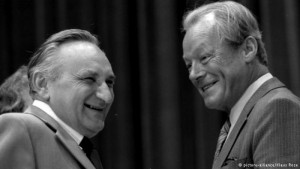
Egon Bahr and Willy Brandt
Prof. Egon Bahr was the creator of the “Ostpolitik” promoted by West German Chancellor Willy Brandt, for whom he served as Secretary of the Prime Minister’s Office from 1969 until 1972. Between 1972 and 1990 he was an MP in the Bundestag.
Prof. Dr. Walther Stützle was the Deputy Minister of Defense in 1998-2002.
Dr. Christoph Zöpel is the SPD politician, Foreign Minister in 1999-2002.
Prof. Dr. Ingomar Hauchler, Bundestag MP (SPD) from 1983 to 1998.
Antje Vollmer, is a member of the German Green Party. From 1994 to 2005, she was one of the vice presidents of the Bundestag.
Prof. Dr. Dieter Klein is the Head of the Commission on the Future of the Rosa Luxembourg Foundation and a member of its Board.
Prof. Dr. Gustav Horn is the Professor of Economics at the University of Flensburg, Scientific Director of the Institute of Macroeconomic Research in the Hans Böckler Foundation.
Dr. Rainer Land is the German social scientist and economist.
Prof. Dr. Götz Neuneck is the Deputy Director of the Institute for Peace Research and Security Policy at the University of Hamburg (IFSH) and Director of the Interdisciplinary Research Group Arms Control and Disarmament (IFAR).
Prof. Dr. Rolf Reissig is a member of the Scientific Advisory Board of the Rosa Luxembourg Foundation.
Prof. Dr. Elmar Brähler, was the Professor of Medical Psychology and Medical Sociology at the University of Leipzig.
Prof. Dr. Peter Brandt is the German historian and retired Professor for Modern and Contemporary History at the University of Hagen.
Prof. Dr. Michael Schneider is the German political journalist and literary critic.
Prof. Klaus Staeck is a German lawyer and publisher.
Dr. Friedrich Dieckmann is the author of essays, reviews, stories and radio features.
Prof. Dr. Hans-Joachim Gießmann is the Executive Director of Berghof Foundation.
Prof. Dr. Lutz Götze, Professor Emeritus of the University of Saarland.
Dr. Enrico Heitzer, Researcher of the Brandenburg Memorials Foundation.
Gunter Hofmann is the German journalist working for Die Zeit.
Dr. Hans Misselwitz is a functionary of the SPD and a founding member of the Institute Solidarity modernity.
Dr. Irina Mohr is the leader of Forum Berlin of the Friedrich Ebert Foundation.
Dr. Edelbert Richter is a Member of the European Parliament in 1991-1994, German Bundestag MP in 1994-2002, member of the Federation of German Scientists.
Dr. Friedrich Schorlemmer, is a German Protestant theologian, civil rights activist and member of the SPD.
Wolfgang Schmidt is the Hamburg Commissioner to the Federal Government, the European Union and of Foreign Affairs; Member of the Committee of the Regions.
Axel Schmidt-Gödelitz is the Chairman of the East-West Forum.
Volker Braun is the prominent German writer living in Berlin.
Daniela Dahn is the writer, journalist and essayist.
Ingo Schulze is a German writer from Dresden.

Sad Nuclear Anniversary

Brian CLOUGHLEY | 04.08.2015 | 00:00

On 1 September 1939 - the date of the beginning of the Second World War - the President of the United States of America, Franklin D. Roosevelt, wrote to «the Governments of France, Germany, Italy, Poland and His Britannic Majesty» saying that «The ruthless bombing from the air of civilians in unfortified centres of population during the course of the hostilities which have raged in various quarters of the earth during the past few years, which has resulted in the maiming and in the death of thousands of defenceless men, women, and children, has sickened the hearts of every civilized man and woman, and has profoundly shocked the conscience of humanity».
He was rightly appalled about the aerial slaughter of civilians and desired each country to which he addressed his appeal «to affirm its determination that its armed forces shall in no event, and under no circumstances, undertake the bombardment from the air of civilian populations or of unfortified cities, upon the understanding that these same rules of warfare will be scrupulously observed by all of their opponents».
We are now marking the seventieth anniversary of the explosion of the atomic bombs that destroyed the Japanese cities of Hiroshima on 6 August 1945 and Nagasaki three days later, killing a total of over 100,000 «defenceless men, women, and children,» prompting the nuclear scientist Robert Oppenheimer to quote from the Bhagavad Gita, the Hindu religious and philosophical text, that «Now I am become Death, the destroyer of worlds».
Development of the atomic bomb began in 1939 but went into high gear as the Manhattan Project three years later. What is intriguing is that President Roosevelt approved the programme on 9 October 1941, a full two months before the Japanese attacked America at Pearl Harbor killing 2,403 people — including civilians. The subsequent declaration of war by the US resulted in concentration on means of war-winning by any means, and resulted in development of the ultimate weapon.
Even before the atomic explosions it was apparent that the major nations involved in the Second World War had no qualms about inflicting devastation. The British considered that their «aim is, therefore, twofold: namely, to produce (i) destruction, and (ii) the fear of death» and to that end mercilessly bombed German cities. The rationale was that it was the Germans who started it and who in 1940-41 subjected London to a non-stop 60 days and nights of aerial bombardment that killed 30,000 people.
In a macabre game of explosive ping-pong the countries at war sought more and deadlier ways to wreak havoc on their opponents, and it would have been difficult to have found a citizen of any of these countries who would have failed to agree with the actions of their government. It was thus that Project Manhattan received its massive impetus, and in an amazing display of technical prowess and organisational proficiency its scientists designed and produced the Atom Bomb.
It was astonishing that President Roosevelt had not told his Vice-President, Harry Truman, one single thing about the bomb project which some well-informed people believed was a potentially catastrophic venture. The first bomb was tested on 16 July 1945 at Alamogordo in New Mexico and caused concern among the scientists who had been involved in its development, 70 of whom sent a letter to President Roosevelt pointing out that use of the atomic bomb would likely presage «an era of devastation on an unimaginable scale» and that «a nation which sets the precedent of using these newly liberated forces of nature for purposes of destruction may have to bear the responsibility of opening the door to an era of devastation on an unimaginable scale».
Their letter wasn’t allowed to reach the President. He never knew of its existence, but in any event was convinced that the A-bomb was essential and had written to Oppenheimer, who had grave doubts about the military’s attitude to nuclear developments, that «whatever the enemy may be planning, American science will be equal to the challenge». The Bomb was going to be used, no matter the consequences, although the president who gave the order to drop the bombs in August 1945 was Harry Truman, who learned of the project’s existence on 13 April 1945, the day after Roosevelt died.
As recorded by Eric Schlosser in his edifying bookCommand and Control, there had been air attacks on Japan of staggering intensity in the months before the atom bombs were employed. On the night of 9 March 1945, for example, «American planes struck Tokyo with 2,000 tons of bombs containing napalm and jellied gasoline... Within hours the firestorm consumed one quarter of the city. It killed about 100,000 civilians... «Worse was yet to come because Truman icily warned that the Japanese «may expect a rain of ruin from the air, the like of which has never been seen on this earth».
There were not many large concentrations of Japanese that had not been subjected to firebombing, and choosing the ultimate victims was not easy. Kyoto was removed from the list of four targets because the Secretary of War, Henry Stimson, pointed out that it was a major cultural centre of great importance to Japanese art and history — and Nagasaki was chosen instead. By such decisions are the fates of human beings decided. Countless thousands of Kyoto citizens were spared, but 39,000 in Nagasaki were condemned to death.
First came Hiroshima, where on 6 August «a firestorm engulfed the city» and 66,000 people were killed. Next on the target list was Kokura, and in yet another horrible twist of fate the city was covered in smoke and haze and the plane was diverted to Nagasaki where the second bomb, hideously named Fat Man, was dropped on 9 August.
The war against Japan then ended, but it should be remembered that between the destruction of the two cities there was a Charter was being approved, on 8 August in the German city of Nuremburg, signed by the victorious allies, that included guidelines for the forthcoming trial of German war criminals by the International Military Tribunal. In an alarming example of double standards, the judges were informed that «The following acts, or any of them, are crimes coming within the jurisdiction of the Tribunal for which there shall be individual responsibility... (b) War Crimes: namely, violations of the laws or customs of war. Such violations shall include... wanton destruction of cities, towns, or villages». It did not include the words of President Roosevelt, that it was sickening to «undertake the bombardment from the air of civilian populations or of unfortified cities,» but made it clear that such attacks were against the laws of war.
The Nuremburg Charter guided the conviction of German war criminals, and it is hideous coincidence that it was signed at the very time when «Death, the destroyer of worlds» was thundering down on Japan in what Truman called «a rain of ruin from the air».
Which goes to show that justice is reserved for those who win wars.

mh17-pilots-corpse-more-on-the-cover-up

Einspruch gegen friedenspolitische Zwiespältigkeit zum 70. Jahrestag der US-Atombombenabwürfe


70. Jahrestage der Atombomben auf Hiroshima und Nagasaki Statt atomarem Nachrüsten ein Zeichen der Abrüstung setzen
Im gegenwärtig eskalierenden West-Ost-Konflikt agieren die Mächte wieder verstärkt mit ihren Atomwaffen*. Und von Deeskalation keine Spur: So führt die NATO Manöver mit Atomwaffen(-attrappen) bzw. atomwaffenfähigen Flugzeugen in Polen durch. Der Ausbau des US-Raketenschildes gegen eine russische nukleare Zweitschlagskapazität wird weiter voran getrieben. Zugleich bringen Moskauer Diplomaten das russische Atomwaffenpotenzial zur Sprache und Präsident Putin setzt Truppenteile, wie die Nordmeerflotte, in volle Einsatzbereitschaft und erweitert gegen den Raketenschild den Bestand an strategischen Trägersystemen.**
Immer noch sind ca. 1.800 Atomwaffen in höchster Alarmbereitschaft. Sie könnten binnen weniger Minuten zum Einsatz kommen und eine globale Katastrophe auslösen. Wir wissen heute, dass die Welt seit dem Ersteinsatz von Atomwaffen vor 70 Jahren mehrmals nur knapp einem nuklearen Inferno entkommen ist. Die Friedensbewegung warnt vor einer Entwicklung, die die Welt erneut unter das Damoklesschwert absichtlicher oder versehentlicher atomarer Zerstörung bringt.
Der Bundesausschuss Friedensratschlag und die Kooperation für den Frieden solidarisieren sich mit allen nationalen und internationalen Aktionen und Kampagnen, die diese Jahrestage zum Anlass nehmen, um auf die Grundsatzforderungen hinzuweisen: Statt weiterer Rüstung und Modernisierung der Atomwaffen muss es einen Einstieg in ihre international verhandelte Verschrottung geben.
Um sich auf diesen Weg zu machen, stellen wir folgende Forderungen an die deutsche Bundesregierung:
  •   einen aktiven Beitrag zum „Miteinander reden“ der Konfliktparteien in Osteuropa (Ukraine, Russland, Baltikum u.a.) zu leisten, um damit die steigende Gefahr des Einsatzes von Atomwaffen herabzusetzen;
  •   den Abzug aller US-Atomwaffen aus Deutschland (am Standort Büchel) durchzusetzen und auf die „nukleare Teilhabe“ Deutschlands innerhalb der Nato zu verzichten;
  •   die Unterzeichnung des von der österreichischen Regierung entwickelten Plans für einen völkerrechtlich verbindlichen Vertrag, Atomwaffen zu verbieten („Humanitarian Pledge“), der bisher schon von 108 Regierungen unterstützt wird.
    Es bleibt dabei: Die Eliminierung der Atomwaffen ist ein unerlässlicher Beitrag zu einer Welt in Frieden!
    Es bleibt dabei: Nur eine Welt ohne Atomwaffen kann eine friedliche sein!
    Wir rufen friedensbewegte Menschen in Frankfurt auf, die Gedenktage der Atombomben- abwürfe auf die japanischen Städte Hiroshima und Nagasaki zum Anlass zu nehmen, ihre Ablehnung von Krieg und Rüstung sichtbar in die Öffentlichkeit zu tragen.
Hiroshima- und Nagasaki-Gedenken
am Donnerstag, den 6. August 2015 um 17:00 Uhr auf dem Römerberg

V.i.S.d.P.: Willi van Ooyen, Friedens- und Zukunftswerkstatt e. V. c/o Gewerkschaftshaus Frankfurt, Wilhelm.-Leuschner-Str. 69, 60329 Frankfurt am Main
Telefon: 069 – 24249950, E-Mail: frieden-und-zukunft@t-online.de
page1image23848
Weitere Infos: www.frieden-und-zukunft.de
____

* Welche Mächte? Wieder Angreifer und potentielle Opfer auf eine Stufe geatellt.
** Darf Russland sich nicht gegen die die größten NATO-Manöver aller Zeiten an seiner Grenze wehren?
page1image24536

LUFTPOST Kaiserslautern/Ramstein - höchst wichtige Informationsquelle für Friedensarbeiter

luftpost-logo
Friedenspolitische Mitteilungen
aus der US-Militärregion Kaiserslautern/Ramstein
STARTSEITELuftpost 2004 - 2014

 2013f201220112010200920082007200620052004

 2015

12 Info-Tafeln zur US Air Base Ramstein
Kurzinfo über die Air Base Ramstein der U.S. Air Force 
Wir rufen mit auf zu der Kampagne: Stopp Ramstein: Kein Drohnenkrieg! "Von deutschem Boden darf nie wieder Krieg ausgehen"
Ehemalige US-Geheimdienstler fordern den Präsidenten Obama erneut auf, endlich die geheimdienstlichen Erkenntnisse über den Abschuss des Fluges MH-17 zu veröffentlichen. 
Ein Dokumentarfilm weist nach, dass die Story über die "serbischen Konzentrationslager in Bosnien" auf gefälschten Bildern beruhte.
Während in der Ostukraine immer wieder Kampfhandlungen aufflammen, spielen auf dem ukrainischen Truppenübungsplatz Jawirow an der polnisch-ukrainischen Grenze unter Führung der U.S. Army in Europa Soldaten aus 18 Staaten Krieg. 
Die U.S. Army in Europa hat in Moldawien ein Manöver durchgeführt, an dem auch Soldaten aus Moldawien und Georgien beteiligt waren, die beide nicht der NATO angehören. 
Der US-Autor Mike Whitney untersucht, warum die Obama-Regierung dem Atomabkommen mit dem Iran doch noch zugestimmt hat.

Kampagne Stopp Ramstein: Kein Drohnenkrieg!

„Von deutschem Boden darf nie wieder Krieg ausgehen.“

Aufruf

Der US-Militärstützpunkt Ramstein ist ein zentrales Drehkreuz für die Vorbereitung und Durchführung völkerrechtwidriger Angriffskriege. Die meisten tödlichen Einsätze US-amerikanischer Kampfdrohnen, u.a. in Irak, Afghanistan, Pakistan, Jemen, Syrien und Afrika, werden über die Satellitenrelaisstation auf der US-Air-Base Ramstein durchgeführt.
US-Drohnenpiloten auf verschiedensten Militärbasen nutzen Ramstein für die Steuerung der Killerdrohnen in weltweiten und illegalen Kriegseinsätzen. In Ramstein analysieren und aktualisieren ca. 650 MitarbeiterInnen ständig die Überwachungsdaten der vermeintlichen Zielpersonen und leiten ihre Daten dann weiter.
Die US-Regierung hat mittels Drohnen in Pakistan, Jemen und Somalia fast 5000 Menschen außergerichtlich getötet sowie über 13.000 im Afghanistan-Krieg. Ungezählte Opfer gab es durch US-Drohnen im Irak, in Syrien und in Libyen. Die große Mehrzahl der Opfer waren Unbeteiligte wie Frauen, Kinder und alte Menschen. Die Mordbefehle werden per Joystick über die Satelliten-Relaisstation in Ramstein an die jeweiligen Drohnen übermittelt. Ohne Ramstein würde der gesamte Drohnenkrieg auf unbestimmte Zeit empfindlich behindert.
Zugleich war Ramstein logistisch unverzichtbar für die Durchführung des brutalen US/NATO-Kriegs in Afghanistan und des US-Angriffskriegs in Irak. Gleiches gilt für drohende US-Interventionskriege, einschließlich an den Grenzen zu Russland.
Die Komponenten des US-Raketenabwehrschildes sind in verschiedenen NATO-Staaten stationiert, eine seiner Befehlszentralen ist in das AIRCOM, das Hauptquartier aller NATO-Luftwaffen, auf der US-Air Base Ramstein integriert.
Außergerichtliches Töten von BürgerInnen anderer Staaten auf deren Territorien verstößt nicht nur gegen die Menschenrechts-Charta der UNO und gegen das Völkerrecht, sondern auch – wenn das Verbrechen von deutschem Hoheitsgebiet ausgeht – gegen unser Grundgesetz. Das wollen wir nicht länger hinnehmen, weder das illegale Treiben der USA in Deutschland noch deren Völkerrechtsverbrechen von deutschem Boden aus, noch deren Unterstützung durch die Bundesregierung.
Wir fordern daher vom Deutschen Bundestag und von der Bundesregierung, den USA die Nutzung von Ramstein als Basis zur Drohnenkriegsführung zu verbieten und die Satelliten-Relaisstation zu schließen, zugleich selbst auf die Anschaffung von Kampfdrohnen für die Bundeswehr zu verzichten und die Einführung von Kampfrobotern im Militär zu ächten, sowie die illegalen Ausspähpraktiken der NSA in Zusammenarbeit mit dem BND, wofür Ramstein ein Kristallisationspunkt ist, zu beenden.
Ohne persönlichen Einsatz und demonstrative Aktionen kann die brandgefährliche Militärpolitik der Bundesregierung und die Kriegshandlungen der US/NATO nicht gestoppt werden.
Deswegen rufen wir im Rahmen einer längerfristigen und umfassenden Kampagne auf zur Demonstration und Kundgebung vor der Air Base Ramstein am 26.09.15 sowie zu einer großen öffentlichen Veranstaltung in Kaiserslautern am 25.09. und einem Auswertungs- und Zukunftstreffen am 26.09. abends.

ErstunterzeichnerInnen (Stand 30.07.15)(Organisations-Zugehörigkeiten dienen nur der Information)
Roland Blach (DFG-VK Baden-Württemberg); Reiner Braun (IALANA); Monique Broquard (NaturFreunde Saarland); Dr. Diether Dehm (MdB, Liedermacher, Schatzmeister der Europäischen Linkspartei); Dr. Sabine Farrouh (IPPNW); Leonore Fuger (Mahnwache Berlin); Wolfgang Gehrcke (MdB, DIE LINKE); Karin Gottlieb(Freidenkerverband Rheinland-Pfalz/Saarland); Toni Große (Friedensforum Erfurt, Friedenskreis Wanfried); Andreas Grünwald (Hamburger Forum für Völkerverständigung und weltweite Abrüstung); Klaus Hartmann(Deutscher Freidenker-Verband); Claudia Haydt (IMI); Klothilde Hinz (VVN/BdA Kreisvereinigung Bad Kreuznach); Inge Höger (MdB, DIE LINKE); Willi Hoffmeister (Ostermarsch Rhein Ruhr); Andrej Hunko (MdB, DIE LINKE); Matthias Jochheim (IPPNW); Peter Jüriens (Mahnwache Bochum, Friedenskreis Wanfried); Wolfgang Jung (LUFTPOST); Kristine Karch (No to War – No to NATO); Hans Georg Klee (OCCUPEACE München); Dr. Ansgar Klein (Aachener AG „Frieden jetzt!“); Helene Klein (Würselener Initiative für den Frieden); Anna Kowalke(Mahnwache Berlin); Bruno Kramm (Piratenpartei Berlin); Sabine Leidig (MdB, DIE LINKE); Ekkehard Lentz(Bremer Friedensforum); Ulrich Lenz (Jenny Marx Gesellschaft für politische Bildung e.V. Rheinland-Pfalz) Manfred Lotze (IPPNW); Pascal Luig (NaturwissenschaftlerInnen-Initiative – Verantwortung für Frieden und Zukunftsfähigkeit); Jürgen Lutterkordt (Bildung für Frieden e.V., RegenbogenTv, Friedenskreis Wanfried); Prof. Dr. Mohssen Massarrat (Wissenschaftlicher Beirat Attac); Prof. Dr. Maria Mies (international bekannte Autorin, Ökofeministin, Friedensaktivistin); Dr. Amir Mortasawi (Arzt, Autor); Albrecht Müller (NachDenkSeiten); Michael Müller (NaturFreunde Deutschlands); Mike Nagler (Attac); Dr. Alexander Neu (MdB, DIE LINKE); Prinz Chaos II (Liedermacher); Doris Pumphrey (Antikriegsaktivistin); George Pumphrey (Antikriegsaktivist); Christiane Reymann (Autorin); Prof. Dr. Werner Ruf (Politikwissenschaftler, Friedensforscher); Rainer Rupp(Autor); Dr. Sabine Schiffer (Institut für Medienverantwortung); Torsten Schleip (DFG-VK Landesverband Ost); Pedram Shahyar (Redner Mahnwache); Fee Strieffler (Ramsteiner Appell); Tanja Tede (Heidelberg zieht in den Frieden); Hannelore Tölke (Landessprecherin DFG-VK NRW); Bernhard Trautvetter (GEW, Friedensaktivist); Alexander Ulrich (MdB, DIE LINKE); Kathrin Vogler (MdB, DIE LINKE); Peter Wahl (Wissenschaftlicher Beirat Attac); Renate Wanie (Mitarbeiterin Werkstatt für Gewaltfreie Aktion); Gunda Weidmüller (AGORA Hamburg); Jens Wernicke (NachDenkSeiten); Lucas Wirl (NaturwissenschaftlerInnen-Initiative – Verantwortung für Frieden und Zukunftsfähigkeit)