Sunday, January 19, 2014

The Imperial Agenda in Syria: Professor MichelChossudovsky live from Berlin 1/12/14

  1. Michel Chossudovsky Syria - YouTube

    www.youtube.com/watch?v=k-Uhi2yRnuU
    vor 7 Tagen - Hochgeladen von Maria Kvantrishvili
    24:27The Imperial Agenda in Syria: Professor MichelChossudovsky on Global Research TV.by Syrie*Syria ...

Michel Chossudovsky zum Syrien-Konflikt

Heute führte der russische Nachrichtensender Russia Today ein Interview mit Prof. Michel Chossudovsky zum Syrien-Konflikt. 

Dienstag, 3. April 2012


Michel Chossudovsky ist Professor für Wirtschaftswissenschaften an der Universität Ottawa in Kanada. Hierzulande ist er vor allem als Experte für die Militärpolitik der USA bekannt. Er ist der Direktor der Seite Global Research.ca - Centre for Research on Globalization, die sehr gute Analysen zu geopolitischen und militärischen Themen liefert.

Hier das Interview:

Syrian Opposition Coalition Finally Agrees to Attend Geneva II Peace Talks - But What Do They Really Want There?

"The Assad government has insisted on shifting the agenda for the Swiss peace talks from power transition to fighting terrorism. The idea was not welcome by the opposition. "

Russia Today
Published time: January 18, 2014 17:20
Edited time: January 19, 2014 09:38

Photo from www.facebook.com/SyrianNationalCoalition
Following two days of heated debate, the Syrian National Coalition of opposition forces has voted in favor of going to Switzerland for peace talks scheduled for January 22, Reuters reports.
The National Coalition for Syrian Revolutionary and Opposition Forces (SNC), the main Western-back political opposition group, on Saturday agreed to attend the Geneva 2 peace conference. Of the 73 National Coalition members who took part in the vote, 58 backed the motion to attend Geneva 2 and 14 voted against it.
Following the vote, the head of the opposition group’s media office, Khalid Saleh, said the SNC understands the aim of the peace conference as the “forming of a transitional governing body that has full authority and is free of Assad and his inner circle.”
The group is now forming a delegation that will go to Switzerland for talks, the coalition’s Secretary General, Badr Jamous, told RIA Novosti. He added that a list of participants will be sent to the UN’s special envoy to Syria, Lakhdar Brahimi, before Sunday.
The decision was made in Istanbul, where the deeply divided group has been debating the prospects for its participation in the talks, brokered by the UN, US and Russia.
The tough talks started Friday but were interrupted and postponed. The meeting was complicated by a group of 44 members who threatened to resign over the “lack of transparency” in the recent re-election of the coalition leader Ahmad Jarba, according to Reuters.
Several major Syrian rebel groups also met in Ankara on Saturday to try and agree on a common stance regarding the Geneva 2 talks. The groups decided they “are not against a political solution” and three of them released statements, an opposition source told the news agency. However, there remained some“questions” on the issue, he added.
Earlier, Syrian opposition figure and coalition member Fayez Sara told Al Arabiya he was confident the decision has already been taken in support of the talks.

According to Sara, the National Coalition will go Geneva 2 to defend “the true interests of the Syrian people and the revolution.”

The so-called Geneva-2 conference, scheduled to start Wednesday in the Swiss town of Montreux, will bring the Assad government and the opposition to the negotiating table for the first time since the conflict began three years ago.
AFP Photo / Louai Abo Al-Jo

Syrian government officials have promised to participate in the talks. On Friday, Foreign Minister Walid Moallem said the government was ready to negotiate a ceasefire agreement with opposition forces in the flashpoint city of Aleppo. A list of rebel prisoners has also been drawn up in preparation for a proposed exchange.

The Assad government has insisted on shifting the agenda for the Swiss peace talks from power transition to fighting terrorism. The idea was not welcome by the opposition.

“In these conditions we would be bringing legitimacy to Assad and breaking his isolation. We are giving the regime the biggest platform to tell the world that it is fighting terrorism when it helped create the problem,” Jamal al-Ward, head of the Supreme Military Council's military office said speaking to Reuters.

US, Britain and other Western powers had been pressuring the fractured group to go to the peace talks seeing them as the only way out of the crisis.

“The decision on Geneva is a big deal for us. We will not be happy if they say no,” a Western diplomat in Istanbul, speaking on the condition of anonymity, told the Washington Post ahead of the voting.

Russia, responsible for bringing the Syrian government to the negotiating table, has long before voiced concerns over who exactly was going to come to Geneva 2, with Sergey Lavrov arguing new groups within the Syrian opposition have lately “sprung up like mushrooms,” some of them having ties to terrorist organizations.

Lavrov said the reason behind the National coalition’s initial inability to agree upon participation in the peace talks were “inner squabbles between different groups of the coalition, supported by different foreign sponsors.”

Saturday, January 18, 2014

Geneva II - A Syrian Perspective


Syrianews: Geneva II

1) Syrian Opposition in Istanbul to Discuss Participation in Peace Talks 

183300781 300x170 Geneva 2
The divided Syrian opposition factions are meeting in Istanbul to decide whether to join landmark peace talks due in Geneva on January 22.
On the eve of the National Coalition’s meeting, US Secretary of State John Kerry made a plea to the exiled group to decide in favor of the talks.
“The Syrian people need to be able to determine the future of their country, their voice must be heard,” AFP quoted him as saying.
The Geneva-II peace conference is aimed at finding a way to end war in Syria.
Syria was hit by a violent unrest since mid-March 2011, where the Syrian government accuses foreign actors, mainly the Saudi Arabia and Turkey, of orchestrating the conflict by supporting the militant opposition groups with arms and money.
2) Moallem Says Syria to Exert Efforts to Ensure Geneva II - Lavrov Slams Opposition
Syrian Foreign Minister Walid al-Moallem expressed his country’s readiness to make ecery effort in order to ensure a planned international peace conference.
Meanwhile,  his Russian counterpart slammed the foreign-backed opposition for failing to take decision on whether it will participate in Geneva II or not.
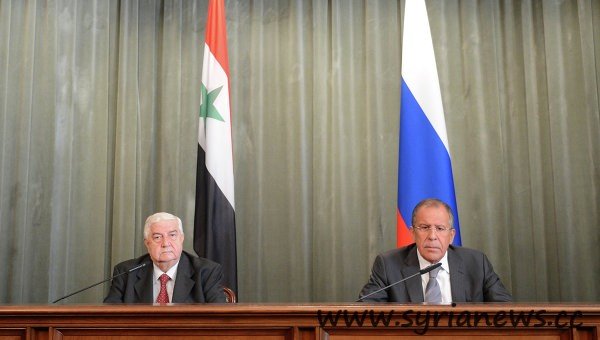
During a joint press conference, Moalle Lavrov and Moallemm confirmed his government’s plans to send a senior delegation to the Swiss lakeside city of Montreux where the long-delayed peace conference — the first since June 2012 — is due to begin.
Syria “will take part in Geneva II and make every effort to ensure this event is a success and meets the aspirations of the Syrian people and the direct orders of President Bashar al-Assad,” said Moallem.
He added that Assad will send his representatives to Switzerland “irrespective of the situation around the participation or the non-participation of the National Coalition at this conference.”
The Syrian FM also expressed his country’s readiness to swap prisoners with the insurgents.
“I informed Lavrov of our principled position in favor of an agreement to exchange those held in Syrian prisons for those taken by the other side.”
However, he did not how many prisoners such a swap would involve or when it might begin. But it would represent a concession to one of the opposition’s key demands before it agreed to peace talks.
“We are ready to exchange lists and develop the necessary mechanism for accomplishing these goals,” Moallem said in remarks translated from Arabic into Russian.
Meanwhile Moallem did not address the ceasefire call directly but said he had handed Lavrov “a plan concerning measures for ensuring security in Aleppo.”
For his part, FM Lavrov said Moallem had informed him of Assad’s readiness “to take a series of humanitarian steps” that would lead to the speedy delivery of assistance to those suffering from the 34-month civil war.
The Russian diplomat further criticized the so-called Syrian National Coalition (SNC) for delaying their decision for participation in the forthcoming Geneva II talks, saying the delay is “going beyond the limits of what is reasonable.”
Lavrov stressed that “the main reason [for the delay] is internal conflicts between various coalition groups , which are supported by various external sponsors, not a desire to be better prepared for the conference.”
“This concerns specific proposals that are already being implemented concerning the delivery of humanitarian supplies to settlements in the Eastern Ghuta region and other areas, including the suburbs of Damascus and Aleppo,” Lavrov added.

Zähneknirschend nach Genf II - Harrers Analysen auf der Standard ...

  1. Zähneknirschend nach Genf II - Harrers Analysen auf der Standard ...

    derstandard.at › ... › Nahost › Harrers Analysen auf derStandard.at
    vor 2 Tagen - Die Erwartungen an die Syrien-Konferenz sind sehr bescheiden - Auch weil die Interessen der USA und Saudi-Arabiens mittlerweile ...

President al-Assad: "Syrian Society Will not Accept Wahabi and Takfiri Mentality"


Jan 18, 2014
Damascus, (SANA) –
President Bashar al-Assad said that the Syrian society, that has been known for its amity and tolerance
 for centuries, will never accept the wahabi and takfiri mentality, adding that this dangerous mentality does not only threaten 
Syria but also all of the region’s countries.
The remarks came during President al-Assad’s meeting with a delegation of the Anglican Church comprising clergymen
 from 
USA, Sweden, Switzerland, Lebanon and Syria, headed by Amgad Beblawi, Mission Coordinator for the Middle East
 at
 Presbyterian Church in the USA.
President al-Assad said that one of the main problems regarding the western, and particularly the US, approach in dealing
 with 
the region’s issues is that most of their leaders are far from comprehending the reality and nature of the region and the 
interests
 of its peoples.
President al-Assad stressed that the majority of the western leaders are working to achieve their narrow interests which
 are far 
from the interests of their peoples and countries.
For their part, members of the delegation expressed their solidarity with Syria and rejection of any foreign intervention
 in the
 Syrian affairs, hoping that peace and security will prevail again in this country, which represents a model for cultural and 
religious variety.

M. Nassr/ F. Allafi

"Women Lead to Peace "Summit to Pressure Geneva II Talks

 "There are over 50 Syrian women in Geneva this week demanding a ceasefire in Syria" 

 On the 21st WILPF, CODEPINK andMADRE have a round table of women from Syria and from other war zones and peace processes, discussing their experiences and how to get women to the table. Two Nobel laureates will be there, Shirin Ebadi and Mairead Maguire. We will all be demanding the same thing.

From: marina litvinsky [mailto:marina.codepink@gmail.com]