Thursday, November 14, 2013

Einstein Letter - Refusal to Support Terrorists

In 1948, prior to the creation of the State
 of Israel, Albert Einstein was solicited by the Stern Gang to raise
 money and support for its terrorism against the British and the
 Palestinians.

In the United States, the Stern Gang operated under the title of
 "American Friends of the Fighters for the Freedom of Israel." Here is
 Einstein's response written the day after the massacre at
 Deir Yassin, the same day
 it was first reported in The New York Times. The original letter is
 slated to become part of the Deir
 Yassin Remembered Archives.

Scanned letter that Albert Einstein sent to the Stern terror gang when it solicitated him to raise fund in the United stated

http://www.palestineremembered.com/Jerusalem/Dayr-Yasin/Story8497.html

Wednesday, November 13, 2013

"There’s No Political Solution to the Syrian Crisis" Arabi Souri


The article posted on Syrianews may seem extreme. However,  it refers to the application of law and international conventions, therefore we think it needs to be analysed and discussed from an unbiased scholarly position.


"Geneva 2 is just a compensation for the west and their stooges to gain what they couldn’t through killing Syrians in a political process agreed by the Syrian government under extreme pressure from its allies.
Looking at the parties that will sit at the table in the presumed ‘international peace conference for Syria’ will give us an idea what the whole game is, and it’s definitely not the Syrian people aspiration nor the aspiration of any independent people.
The USA: A terror sponsor regime, a record breaker of International Law and United Nations violations, never hesitated to invade any sovereign country and never stopped from meddling in the internal affairs of any other sovereign country. Wasn’t Alqaeda created by the USA? How many other groups have the US created worldwide? A country built on the skulls of millions of people starting of its own original people. A country that openly sponsors the only official apartheid regime in the world, Israel, which in turn is the world’s record breaker of UNSC resolutions’ violator. The US regime never had the interests of other people, not even their own people, in their concern. The elite gets it all.
Muslim Brotherhood Theres No Political Solution to the Syrian Crisis
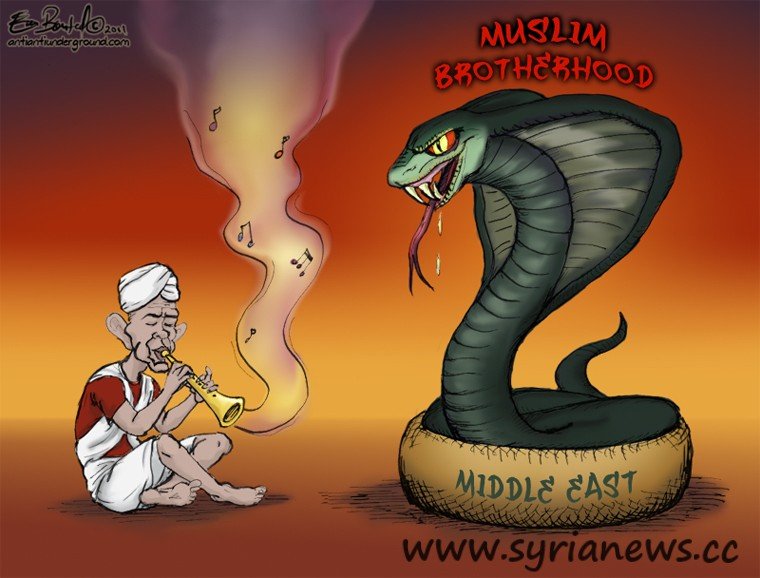
When Obama Raised the Muslim Brotherhood
The UK: A former imperial power with a bloody history of colonizing, enslaving and destabilizing other countries. The one country that committed the 20th century and maybe the world’s biggest crime by offering a land they don’t own to who doesn’t deserve on the account of its own people, leading to the mass suffering and killing of the Palestinian people and the ongoing Middle East crisis since more than a 100 years. Its domination of the financial market through its monetary system and its control of the US Feds, the owners of the US dollar.
France: Not better than the UK but not worse. Has a horrible history of colonization and the has occupied Syria for about 25 years before the Syrians managed to kick them out. Its occupation to Algeria cost that peaceful country over 1 million of its own people.
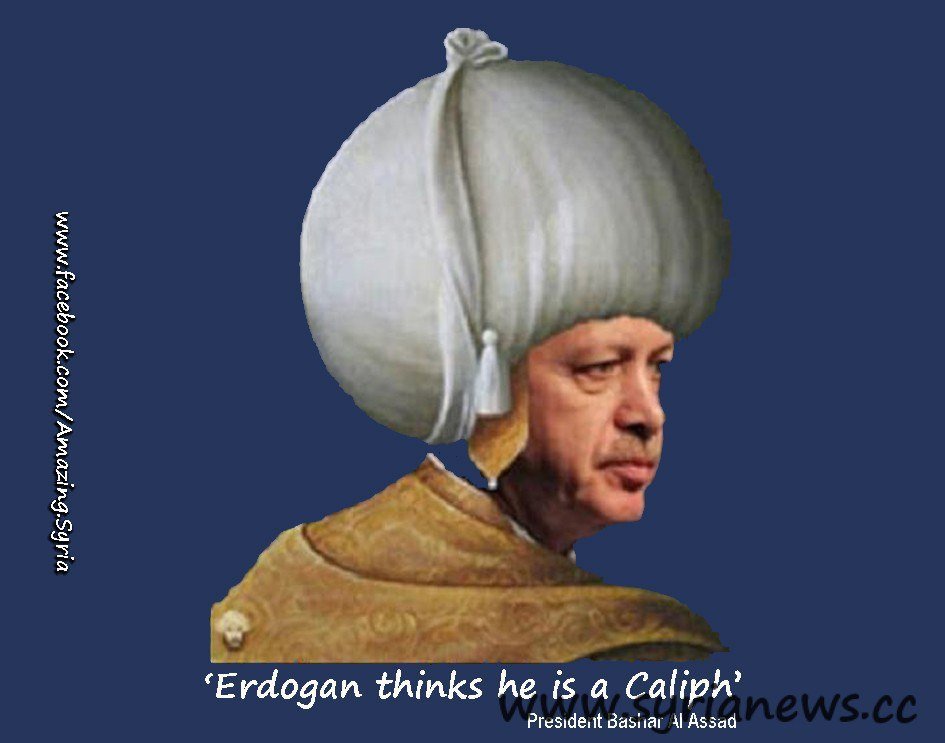
Turkey: Former Turkish leader Ataturk managed to preserve what’s left of the Ottoman empire, although holding on parts of other countries under Turkish rule, but at least didn’t go as mad as hoping to revive the Ottoman Empire, a goal sought hard after by the current anti-Islamic pro NATO Islamist AKP junta ruling NATO’s member state Turkey. Turkey, the world’s biggest prison for political journalists, the oppressor of entire ethnic and religious groups, the Kurds and Alawites, whom both form more than half of the population. Needless to remind the stance the Islamist junta ruling Turkey has in rejecting to recognize the Armenian massacres, not to mention the Ottoman massacres against the Syrians, Lebanese, Greek, Caucasians, Europeans and everywhere they reached. The junta which turned their country to a main base for anti-Islamic radical Jihadists imported from all sides of the world to kill the Syrian people and destroy their country.
erdo Theres No Political Solution to the Syrian Crisis
‘Erdoğan thinks he’s a Muslim Caliph‘
President Assad
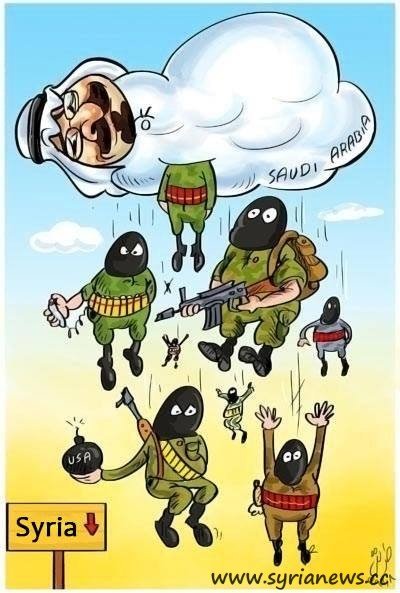
Saudi Arabia: Trying hard to topple the Syrian government, the Iranian government, the Lebanese resistance and oppressing any movement that ever fought or thinking of fighting the Zionist state of Israel. Using the anti-Islamic Wahhabi religion to distort Islam and use the brainwashed followers of that British introduced religion, one more crime to be added to the British record. ‘The country with the world’s most retard political system’ as the Syrian president Dr. Bashar Assad put it. The country with vast wealth where a prince dies leaving $272 billion to his heirs at the same time having more than 3 million Saudi families, more than one third of the population do not own their own houses.
Saudi Raining Theres No Political Solution to the Syrian Crisis
Terrorists Sent to Liberate Syria from its People
Qatar: For no reason this tiny gas station wants a seat at the Geneva 2 table, but nevertheless its protector, the US regime, wants it to be present.
Jordan: A US protectorate that turned into another base for Jihadists and its king of British mother who barely speaks Arabic and who turned his army to a mercenary forces for hire. The country that used to live and still on the Syrian people account receiving fresh water, food, most of its consumable products and electrical power from Syria before the Syrian crisis started, yet one of the leading countries in abusing the Syrian refugees suffering living in camps its erected for them in the middle of the desert. If there’s any main reason the Jordanians want a role in the Geneva 2 conference is to get further money from promised aid meant to be for the Syrian refugees and from any amount that might be collected to rebuild Syria.
Lebanon: The country that has everything except a normal political system, which is split into two halves, one pro US and pro Saudi Arabia and consequently pro Israel by default, the other half is against the first half. Both Lebanese halves interfered in the Syrian affair and want some guarantees the Syrians don’t make them pay for their interference. The pro US and its stooges half operate only as hired agents and have no real goals except some commissions they earn, while the other half, the anti-first half, shows a staunch support to the Syrian state but does nothing really to stop the first half. The best they did was inviting their other half to fight their battles in the Syrian territories and not in Lebanon. Of course we cannot ignore Hizbullah’s assistance militarily to the Syrian Arab Army in a couple of places like in Qussayr and near Sayyedeh Zainab shrine in Damascus countryside, but had they stopped their other half inside Lebanon from meddling in the Syrian affairs for 2 years while Hizbullah had a control over the Lebanese government, their military help would not have been needed at all, thousands of Syrians would have not been killed as terrorists were hosted in Lebanon under the nose of Hizbullah and then smuggled with shipments of weapons into Syria.
Iraq: A sectarian based government ruling two thirds of the country and the one third left is ruled by an ethnic group, what a wonderful example to lead for a Syrian future?! The Iraqi government who came on US & UK tanks lecture the Syrians about patriotism and democracy. Still accuse the Syrian government of assisting Al Qaeda fighters during the 8 years US occupation, while the Syrian state only sponsored the Iraqi resistance to that occupation, and the US, UK, Saudi Arabia and Israel were the ones sponsoring Alqaeda in Iraq..!
Iran: A very weird political system that doesn’t accept any former Western sponsored political opposition against its own government but presses hard to have one in Syria..! The democracy ruled by one person. A Beardocracy that sees in any bearded man a promise of an Islamic awakening, even if that man is from the anti-Islamic Wahhabi religion like the Saudis or from the Muslim Brotherhood terrorist organization, or like the ones appointed by the US to rule occupied Libya, or like the Iraqi government also which came on US tanks. We all remember how the Iranian mullahs handled their version of the Arab Spring in the year 2009, yet they keep on pressing the Syrian government to accept a deal with the Muslim Brotherhood.
Russia: The same Putin who introduced a law recently labeling any political entity receiving foreign aid as traitors and agents of enemies, this same Putin wants the Syrians to accept the western created and backed opposition in a power sharing deal. The same Putin who handles very hard the Chechen Islamists but accept their role in Syria. Russia Putin with vast and growing investments in each foe country to Syria like Israel and Turkey, seeking better investments in others as well. Putin who never misses a chance when asked about Syria to criticize the Syrian president and the Syrian state for doing exactly what he did against the Chechen fighters and facing the terror operations like in the case of the Beslan school massacre, while the Syrian government is obviously fighting foreign, not internal terror groups, unlike the case of Russia. The Russian Putin who refused to deliver air defense missile system to Syria due to pressure from his allies in Israel leaving the Syrian space vulnerable to the Israeli aggression, time after another, the same air-defense system the Syrian state bought one year before the crisis started in Syria.
The Syrian Opposition Abroad: In any other country such an opposition would be arrested, lined up against a wall and fired at by a firing squad, other members of it would be tried and hanged in public, except in the Syrian case of course, where the Syrian government has to negotiate a power sharing deal with agents of foreign powers who do not hide, rather they brag about their relations with enemies of the Syrian state, the Syrian people, the Syrian heritage, culture, infrastructure, and enemies of humanity like the case of the Saudi ‘progressive regime against freedoms’. The opposition that uses terror attacks against the Syrian people to bargain with the Syrian government the need to hand them the power in Syria. The opposition that stays at 5 stars hotels worldwide while the Syrian people they cry about are staying in tents in the deserts and in remote areas under severe circumstances and being exploited, again, by the Wahhabi Saudis and Qataris. The opposition that sees its country’s army as ‘occupiers’ and sees in Nusra Front, the terrorist organization that carries out suicide bombings in churches, mosques, schools, residential blocks, as their best fighters against their own army. The opposition that base their entire existence on lies, propaganda, fabrications and western mainstream media polishing. The opposition that criticizes the Syrian state for not starting a war with Israel directly in the Golan Heights but met with Israeli officials, and promised to end the enmity between Syria and the Zionist state. This opportunist group of a couple of hundreds of never heard of before oppositionists want to lead Syria or have a say in leading Syria, just like their Iraqi counterparts did.
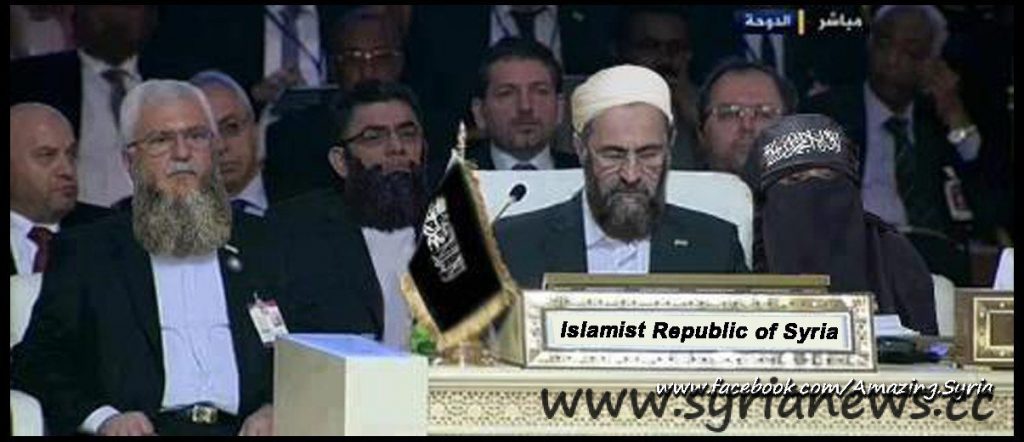
Islamist RS 1024x441 Theres No Political Solution to the Syrian Crisis
The future they want for Syria: Islamist Syriastan
The Syrian Opposition Inside Syria: A group of opportunists who kept opposing their government while their country is under invasion by herds of tens of thousands of radical fanatic Wahhabi suicide bombers and under the constant threat of an ‘invasion for peace’ by the US and its stooges. A group of figures, they don’t have a real base to depend on that’s why they keep boycotting any political process called for by the Syrian state during the past 32 months, including a call for parliament elections, local municipal elections, country-wide open political dialogue, committees formed to rewrite the constitution, the media law, the political parties law and other laws introduced since the beginning of the crisis by the Syrian government. The group of individuals that kept accusing the Syrian state and the Syrian security and armed forces for each terror attack carried out by Al Qaeda and affiliates in Syria until recently when they started accusing the Syrian state for allowing Al Qaeda to justify their coming to Syria to carry out such attacks.
The ‘rebels’: This is interesting, as these are the only party on the ground that all of the above are depending on in order to get some gains in shaping Syria’s future each by their own method. Thousands of terrorist cells formed basically from outlaws and augmented by imported Jihadists operating against the Syrian people and against their state, with the blessing, financing, supervising and support from the foes of Syria. Tens of thousands of mostly foreign terrorists whom some of which wants to establish a NATO-backed Islamist caliphate/s, others want to rule portions and enclaves of Syria tribal style with each terrorist group commander called an Emir with absolute power.
But what could be the solution to the Syrian crisis if a political solution would be a suicide for the Syrian state in the light of the above factors? Well, definitely not a political solution to share power with the current so called opposition in both its internal and external branches and especially in its external branch. The only solution would be simply applying international and national laws.
The international law would be used against the states sponsoring terror in Syria, and mainly the neighboring countries like Turkey, Jordan, Lebanon and Iraq, then the terrorists finances the Saudis and Qataris and of course stopping the US regime from further shutting-down their government to come up with more funds of the terrorists in Syria, their contribution of US taxpayers money already exceeded $1 billion early September 2013.
The national law will be used against the terrorists and their local sponsors, and the penal code already established in Syria since 1949 and which is very similar to the penal code in any other country, this penal code is more than enough to fight the outlaws within. The SAA, the Syrian Arab Army and other Syrian Armed Forces can then take care of the fighting groups while the Syrian security agencies can take care of the terror cells inside the country.
Does applying law sound as a bad idea? Maybe, when the west is involved. Meanwhile, everybody else is fine while the Syrian crisis is confined within Syrian borders."

One comment

  1. Perfect analysis.
    Maybe too tough on Iran, since Iran is the main supporter of Syria. Without the $ billions and arms from Iran, Syria would not have made it. But certainly some groups in Iran are wacky.
    • Important is the mentioning of Iraqi regime, which supports the anti-Syrian rebels (or parts of the Maliki regime).
    • And of course the treacherous Russia. Putin doesn’t do anything to stop the Russian and Chechen terrorists from going to Syria. Russian spy agencies are not that weak to be unable to stop it. They allow this.
    Russia is responsible for the anti-Syrian terrorists using Russian anti-tank weapons. Russia didn’t make anything to stop the buyers of its weapons from sending those to anti-Syrian terrorists. Not even a public protest at the UN.
    There is no peaceful solution. Only war can liberate Syria from the US terrorist proxies. It’s a miracle that Syria has been able to resist such a vast sinister conspiracy.

Un prédicateur bruxellois appelle au djihad en Syrie


CHRISTOPHE LAMFALUSSY Publié le mercredi 13 novembre 2013 à 05h40 - Mis à jour le mercredi 13 novembre 2013 à 06h46


BELGIQUE Iliass Azaouaj apparaît dans une vidéo authentifiée. Mais parle-t-il librement ?
Un prédicateur bruxellois parti en Syrie pour convaincre de jeunes Belges de revenir au pays apparaît depuis quelques jours dans une vidéo où il appelle - au contraire - ses "frères moudjahidine"belges à combattre le régime syrien.
Iliass Azaouaj, 24 ans, est masqué dans la vidéo mais il a été identifié par les services de l’antiterrorisme belge, avec l’aide de la famille. "Les gens doivent savoir aujourd’hui que le seul moyen de transmettre la parole, c’est par le combat. Car le dialogue, c’est terminé, on ne parle plus", dit-il notamment. Il précise qu’il abandonne argent et célébrité pour se ranger du côté des djihadistes et "pour tuer ceux qui nous tuent et combattre ceux qui nous combattent".
L’homme est un prédicateur d’Anderlecht, fort écouté des jeunes musulmans. Il s’était distingué l’an dernier en prenant publiquement position contre Sharia4Belgium et l’instrumentalisation de l’islam par ce groupe salafiste radical.
Parti en avril dernier , il avait rapidement disparu. Il aurait été arrêté par un groupe radical peu après le passage de la frontière turco-syrienne. En août, sa famille affirmait que son compte Twitter avait été piraté. Menaçant la Belgique, Azaouaj se disait "membre d’al-Qaida" et qu’il fallait s’attendre "à des surprises".
Le prédicateur belgo-marocain aurait été jugé et condamné par un tribunal islamique constitué par l’un des nombreux groupes djihadistes locaux, selon le député bruxellois Fouad Ahidar (SP.A).
La vidéo est apparue sur le Net le 7 novembre. Elle a été examinée par l’antiterrorisme belge. Celui-ci estime qu’il s’agit bien d’Iliass Azaouaj mais ne peut pas se prononcer sur la spontanéité de ses propos."Pourquoi a-t-il fait cela ?", s’interroge un policier. "A-t-il viré sa cuti ? A-t-il dit cela sous la menace ?"
Azaouaj affirme qu’il doit rester masqué dans la vidéo pour échapper à ceux qui le combattent. Il déclare aussi avoir travaillé "quelque temps" pour les services secrets marocains, et avoir eu "une relation" avec la police fédérale, puis avec la Sûreté de l’État.
Curieusement, aucun logo n’apparaît dans la vidéo, tournée dans le salon d’une grande villa située sans doute dans le nord de la Syrie. Azaouaj porte sur lui un pistolet et, dit-il, une ceinture d’explosifs.
Contrairement à son (faux ?) compte Twitter, Iliass Azaouaj ne profère aucune menace précise à l’encontre de la Belgique dans la vidéo de 5 minutes mais déclare que les États-Unis, l’Europe et l’Occident "ne comprennent pas" pourquoi de jeunes musulmans venus selon lui de 70 pays viennent se battre en Syrie. Contacté mardi par La Libre Belgique, son frère cadet Ibrahim n’a voulu faire "aucun commentaire".
Azaouaj a-t-il parlé sous la contrainte ? Difficile à dire. Les vidéos sont en tout cas l’outil de propagande le plus efficace des groupes salafistes. Ils tentent de capter l’attention des jeunes musulmans belges et de jouer sur leur mauvaise conscience.
Et à en croire Bahar Kimyongür, un Belge originaire d’Antioche (Turquie) qui tente d’aider les familles de ceux qui sont partis, les départs continuent malgré le fait que plusieurs jeunes Belges ont été tués sur place. "Deux pôles de recrutement existent à Bruxelles, à Vilvorde et à la place du Pavillon à Schaerbeek",dit-il. "Avant de devenir des machines à tuer, nos jeunes sont d’abord des victimes de sectes qui prônent le suicide collectif."
Les autorités belges parlent, elles, d’un flux "continu" de djihadistes qui partent et qui reviennent. Les tracer est difficile car beaucoup quittent la Belgique en bus ou en train, rejoignent Düsseldorf ou Cologne d’où ils prennent un avion pour Istanbul.

"Syrian refugees as combatants" Asia Times

. SPEAKING FREELY
Syrian refugees as combatants
By John Rosenthal

Speaking Freely is an Asia Times Online feature that allows guest writers to have their say. Please click here if you are interested in contributing.

Apart from the over 100,000 people estimated to have been killed in Syria, the most dramatic statistic illustrating the humanitarian crisis entailed by the ongoing war is surely the over two million Syrians estimated to be living as refugees in neighboring countries. Many are being housed in camps set up under the auspices of the UN High Commissioner for Refugees (UNHCR). Details in a recent report in the French daily Le Figaro [1] reveal that one of the largest such camps, the Zaatari camp in Jordan, is, in effect, a safe haven for rebel forces fighting to overthrow Syrian President Bashar al-Assad.

The Zaatari camp is located just over the Syrian border, about 50

kilometers from Daraa, one of the cradles of the anti-Assad uprising. According to the latest UNHCR statistics, it is currently home to nearly 123,000 people.

The details about the camp in the Le Figaro report are particularly significant in light of the presence in Zaatari of a French military hospital. The hospital opened in August 2012 to great fanfare in the French media as a humanitarian initiative aimed at alleviating the suffering of civilian victims of the war. The Le Figaro report makes it clear that at least some of the patients being treated there are not civilians, but rebel fighters.

The report highlights the activities of one Ghassem, a member of the so-called Yarmouk Martyrs Brigade, who has accompanied a severely wounded comrade to Zaatari to receive medical attention. Ghassem's fellow fighter, Omran, has had his legs blown off by a landmine. The report notes that Ghassem "regularly comes to the aid of the revolution's wounded," i.e. presumably by bringing them to Zaatari for treatment. Per his own declarations, Ghassem will soon be slipping back across the border and on his return trip he will be carrying drugs to treat presumably less severely wounded comrades still in Syria.

That members of the Yarmouk Martyrs Brigade would be receiving medical treatment on the grounds of a UN-run refugee camp is at least ironic. The Yarmouk Martyrs Brigade is the same group that caused an international stir last March when it took 20 UN peacekeepers hostage near the Golan Heights. Shortly before that incident, videos were posted on pro-rebellion YouTube pages that documented the summary execution of captured Syrian soldiers by self-described members of the brigade. [2] The 1951 Convention on the Status of Refugees, which serves as the basic statute of the UNHCR, specifically excludes people suspected of war crimes from enjoying protection as refugees under international law.

But the treatment of wounded fighters appears not to be the only benefit rebel forces derive from the Zaatari camp. According to Le Figaro, "mafias" have come to control a burgeoning black market in the camp. One such "mafia," for instance, is reported to be pirating the camp's UNHCR-funded electricity supply and selling electricity to private customers in the tents and prefabricated housing units that make up the camp. According to Le Figaro, these mafias are in turn "funneling money to the rebels."

Perhaps most astonishing of all, however, are the observations of Kilian Tobias Kleinschmidt, the German UNHCR official who is in charge of the Zaatari camp. "Up until Ramadan in July, come evening young men would announce over megaphones that arms had arrived and that potential fighters had then to present themselves," Kleinschmidt told Le Figaro. Kleinschmidt insisted that these calls-to-arms have now ceased. But the receipt of arms shipments at a UNHCR camp and the apparent organization of fighting units from within the camp calls into question the neutrality that is essential to the UNHCR's humanitarian mission.

Returning to the matter of the French military hospital, according to Le Figaro, some 80 French military personnel are assigned to the facility. "But," the paper notes somewhat enigmatically, "only a handful have medical functions." [4] Le Figaro and other French media have reported that French Minister of Defense, Jean-Yves Le Drian, would like to close the Zaatari hospital as a money-saving measure. French Foreign Minister Laurent Fabius, however, is reportedly committed to maintaining the facility

Notes:
1. Le camp de Zaatari entre mafias et detresse, Le Figaro, October 22, 2013.
2. For the videos and a discussion, see Syria Exclusive: The Western-Armed Insurgents Who Executed POWs and Captured UN Peacekeepers, EAWorldview, March 11, 2013.
3. See Convention and Protocol relating to the Status of Refugees, Article 1, paragraph f(a).
4. L'hopital militaire francais, ouvert en 2012, pourrait fermer avant la fin de l'annee, Le Figaro, October 22, 2013.

Speaking Freely is an Asia Times Online feature that allows guest writers to have their say. Please click here if you are interested in contributing. Articles submitted for this section allow our readers to express their opinions and do not necessarily meet the same editorial standards of Asia Times Online's regular contributors. 

John Rosenthal is a European-based journalist and political analyst who writes on transatlantic security issues. His new book is The Jihadist Plot: The Untold Story of Al-Qaeda and the Libyan Rebellion. His articles have appeared in such publications as World Affairs, Al-Monitor, Policy Review, The Wall Street Journal Europe, Les Temps Modernes and Die Weltwoche. You can follow his work at Transatlantic Intelligencer or on Facebook.

(Copyright 2013 John Rosenthal)

Comment by  aydemir guler
Perhaps most astonishing of all, however, are the observations of Kilian Tobias Kleinschmidt, the German UNHCR official who is in charge of the Zaatari camp. "Up until Ramadan in July, come evening young men would announce over megaphones that arms had arrived and that potential fighters had then to present themselves," Kleinschmidt told Le Figaro. Kleinschmidt insisted that these calls-to-arms have now ceased. But the receipt of arms shipments at a UNHCR camp and the apparent organization of fighting units from within the camp calls into question the neutrality that is essential to the UNHCR's humanitarian mission. 

Tuesday, November 12, 2013

The Biggest Lie About Syria - II


Neither an army nor free


The “Free Syrian Army”, acting as an umbrella organization for the rebels, is composed of dozens of factions, each of which is distinct from the other and is independent of a central leadership. Being infamous for their war crimes, these groups act upon the interests of the countries that fund them.
One of the most widespread fallacies in the war, which is about to leave behind 30 months now in Syria, is to comprehend the so-called Free Syrian Army (FSA) as a homogenous formation. In fact, the FSA is composed of different factions, which act under the leadership of their own commanders and determine their priorities according to the interests of the countries that back them. Moreover, this organization consists of a wide range of commanders competing with each other, who have become the voice of their financier countries.
It seems that the US, Turkey, Saudi Arabia and Qatar have recently agreed on a single name. It is none other than Salim Idris, who is the leader of the Supreme Military Council (SMC) that was formed last December in Antalya with the aim of turning it to the general staff of the FSA. Idris, former member of the Syrian Army, has no effect in the field even though he is the key to the arm flow to Syria.

Who comprises the FSA?
The first armed groups emerged towards the end of March in 2011 when the events in Syria had just begun. Armed militants, particularly backed by Salafist movement in Lebanon, began attacking Syrian security forces in Tel Kelah in Homs and in Banyas in Tartus. However, the greatest attack came in Jisr al-Shughur in Idlib in 6 June 2011, which became the turning point of the conflict in Syria. This attack, in which 120 troops and policemen were killed, was initially reported as a “massacre by the Syrian Army in rebel towns”. Yet, the journalists in the region reported that the townsfolk were blaming the militants infiltrated Syria from the Turkish border.
As the attacks increased in June, so did the defectors from the Syrian Army. While a part of these figures was close to the Muslim Brotherhood undertaking underground activities, the other part was taking the advantage of “generous” donations of Saudi Arabia and Qatar. On the 29th of June, Riad Al-Assad, former member of the Syrian Army, escaped to Hatay and announced that he had also defected. Along with other defectors, he declared the formation of the Free Syrian Army in Hatay in July 2011.
The first militants of the Free Syrian Army consisted Salafi groups in Lebanon, the Muslim Brotherhood and various tribes affiliated with trafficking along the border with Turkey and Lebanon.
Upon the Syrian Army’s victory in the summer of 2012, resulting in the removal of the FSA from its stronghold in Bab Amr in the province of Homs, the flow of mercenary fighters began with the help of financial aids by the countries that backed these groups.
Jihadists pouring in from Tunisia, Libya, Egypt, Jordan, Saudi Arabia and even Afghanistan quickly strengthened the groups united under the FSA. However, these mercenaries soon began joining the fighting forces linked with Al Qaeda and other radical Islamist groups.

So-called titles
The swift growth of the FSA resulted in insufficient leadership of Riad Al-Assad. Hundreds of brigades consisting of a handful of militants had been formed by the end of 2012. These groups usually declared that they were affiliated with the FSA in order to guarantee the flow of money and weapons. In most cases, however, they continued to operate independently. It was this time during which the FSA’s commandership in Turkey began falling apart and the higher ranks of the FSA, which had aligned itself to various financior countries, ended up in a power struggle.
Today, the FSA’s Riad Al-Essad, Ahmad Al-Hijazi and Malik Al-Kurdi group do not recognize Salim Idris. Apart from this group, which is close to the Muslim Brotherhood, Mustafa Al-Sheikh, commander of Suqoor al-Sham, one of the biggest brigades in the battlefield, stays distant from both Riad Al Assad and Salim Idris.
Also, there is another force formed under Salafi Sheikh Adnan Al-Aroor from Saudi Arabia, which calls itself the Joint Command of the Revolutionary Military Council.

Different Strategies
The power struggle between these factions on the command-level usually reflects itself in the field with deadly internal competition among these groups. Because of lack of coordination, the FSA-affiliated brigades receive major losses at the hand of the Syrian Army. Speaking of the the FSA’s presence totally becomes impossible particularly in northern Syria. In this region, there are various big brigades mostly operating independently, although they claim that they act under the FSA. Most of these brigades cooperate with Al Qaeda-linked groups and with other radical Islamist brigades. Al Tawhid and Suqoor al-Sham with 15.000 militants participated in attacks particularly against Kurds and Alawites in cooperation with Al Qaeda-linked Islamic State of Iraq and Sham (ISIS).
Moreover, these groups can remain neutral in violences of ISIS and other FSA brigades. When the FSA-affiliated Northern Storm Brigade, consisting former traffickers, was attacked by the ISIS in September in Azaz-Aleppo, the Tawhid Brigade, the strongest fighting force in the region, declared its “neutrality” and acted as a mediator for ceasefire between the two groups. The Northern Storm, identified as “moderate” due to the attack it exposed, later joined the Islamic coalition, which was formed at the end of September and also consisted Al Nusra Front, another Al Qaeda-linked group. Declaring that it will fight for Islam, this new coalition does not recognize the Syrian National Coalition and involves the largest brigades of the FSA. This fact contradicts with the claim that the FSA has a contrary line to Al Qaeda.
In South Syria, in Daraa, hundreds of militants from the brigades affiliated with the Supreme Military Council, which was formed through vigorous efforts of the US, have joined Al Nusra Front because it is equipped with high quality weapons and a better financial structure. Yet, it was claimed that these groups trained by CIA in Jordan were composed of the “tribes distant to Al Qaeda”.

Ali Örnek - soL

International Network for Justice

Nuclear talks with Iran reach point of no return


Sergey Strokan is a journalist, essayist and a poet
Published time: November 12, 2013 12:19 by Russia Today
http://rt.com/op-edge/geneva-talks-iran-nuclear-590/
The Geneva talks on a landmark nuclear deal with Iran, between Tehran and the six world powers, are in the final stage, with most parties signaling that agreement is no longer a phantom but a reality realizable within months, if not weeks.
As the day of the crucial negotiating round slated for Nov 20 nears, both diplomats and media are overwhelmed with a feeling of history being made in the walls of the Geneva Intercontinental hotel. 
Is the process really irreversible, as some believe it to be? And if the deal is reached, what will it mean for Tehran and the whole world – an end of a decades-long Iranian crisis, or a new disaster, a “bad deal”, to quote Israeli Prime-Minister Benjamin Netanyahu? 
To spell out Israeli concerns, can it be a deal which would only trigger a nuclear arms race in the vast Middle East region and finally force the Jewish state into a desperate move – to act unilaterally against Iran?
A cup of coffee in the Intercontinental hotel costs $9, but what the real price and the outcome of the enigmatic nuclear deal presumably made on its premises will be is as yet unknown. What is clear is that the moment for such a deal today is the most appropriate since the 1979 Islamic revolution in Iran, with all sides playing high stakes for diplomacy, not war.
To start with, what gives the diplomacy a unique chance is the phenomena of the two leaders in Washington and Tehran.  As for Barack Obama, it is an open secret that he has developed the reputation of “the most anti-Israeli president in US history” (this is how he is seen in Tel-Aviv). While the Israeli leadership was very unhappy with President Obama’s Middle East initiatives from the very start, Obama turned a blind eye on most of Israel’s concerns. Obama made it clear that despite strong bonds of strategic alliance, the US and Israel see different ‘red lines’ in the Iranian crisis. Obama signaled that he can put up with some limited Iranian nuclear program, the scale of which is currently being negotiated in Geneva. However, Netanyahu denies the very idea of Iran enriching uranium and keeping its centrifuges working. According to Netanyahu, the deal with Iran would backlash and America would also find itself vulnerable to future Iranian nuclear strike

During the 2012 US presidential race it was not Barack Obama, but Republican presidential hopeful, Mitt Romney, who Netanyahu put his hopes on – and Obama is probably paying him back today. Moreover, the 2009 Noble Peace Prize granted to Mr. Obama as an advance for something not yet achieved is probably forcing him to prove that the decision of the Noble committee was something not to be mocked or ridiculed, as is happening today, but a prophetic move. 
However, it is not only “the most anti-Israeli American president” in Washington, but also “the most pro-Western president” sitting in Tehran who are giving diplomacy a golden opportunity and making all sides reinforce their efforts to reach compromise. The landslide victory of the Islamic reformist cleric, Hassan Rowhani, in June’s presidential election in Iran has revitalized nuclear talks between Tehran and the big six world powers, which had degenerated into a pointless, torturous process and lost its steam under the former Iranian president, Mahmud Ahmadinejad. 
Mr. Rowhani has to produce something tangible for Islamist hardliners at home who are warning him of betraying national interests. His trump card could be an end to the nuclear standoff and the era of isolation and suffocating sanctions.  The same way Mr.Obama has to outwit US neocons and the army of his critics abroad by telling them that his stick-and-carrot policy did work, while the war scenario with Iran proved irrelevant. 

All in all, as both Presidents Obama and Rowhani have invested heavily in the present day’s big nuclear gamble; they find themselves in the same boat and should stick together. Their domestic political considerations and their international standing mean they can’t allow themselves a last-minute failure of the much-anticipated deal.  
And finally, what we also see today in Geneva is an unprecedented unanimity within the ranks of the big six world powers, with US and Russian diplomats not trading jabs or making grim statements, as it used to be, but praising each other’s roles regarding Iran. This week, Russia’s Foreign minister, Sergei Lavrov, went as far as acknowledging the leading role of the American delegation during the latest round of talks in Geneva, headed by State Secretary Kerry.  I can hardly recall a similar moment of harmony in US-Russian relations and it was only this September when President Putin called Mr.Kerry “a liar”.  
As for France, which is somehow standing aside and playing bad cop in Geneva, it alone can surely not go as far as putting the brakes on a nuclear deal with Iran. It may sound like gossip, but one of the political Cassandras here this week whispered into my ear that in Geneva the “French are working for Saudi money”, hinting at lucrative contacts and other business interests.
So, it looks like the negotiating process with Iran has already crossed the point of no return and the question of the historic nuclear deal is a matter of not “if”, but “when”. There is no doubt that in the days and weeks to come we will witness desperate attempts by Israel to step on the brakes and press all the alarm buttons, but it looks like it is too late now.  
A nuclear Iran is a fast-growing reality, so the task of the day for the world community is not to deny, but to harness the Iranian atom – to put it under well-calculated international scrutiny, free of any prejudice and paranoia.
The statements, views and opinions expressed in this column are solely those of the author and do not necessarily represent those of RT.

Monday, November 11, 2013

Israel boosts attack on Iran nuclear deal after ‘productive’ Geneva talks


Israel boosts attack on Iran nuclear deal after ‘productive’ Geneva talks

News | 11.11.2013 | 06:01
Israel is ramping up its effort to prevent a deal with Iran, which is seen as a serious threat to its national security. It comes after French intervention stalled high-level talks aimed at resolving the conflict over Iran’s nuclear program.
As delegations from Iran and six leading nations were locked in negotiations in Geneva, the government of Israeli Prime Minister Benjamin Netanyahu was continuing to advocate against dealing with Tehran. Over the weekend, Netanyahu called British PM David Cameron and German Chancellor Angela Merkel to promote Tel Aviv’s position, he told his Cabinet on Sunday.
“I told them that according to the information reaching Israel, the deal that appears to be in the offing is bad and dangerous,” Netanyahu said. “Not just for us but also for them. I suggested that they wait and give it serious consideration, and it’s good that that is indeed what was decided. We will do everything we can to convince the leaders not to reach a bad agreement.”
"I asked them what was the rush? I suggested they wait," he said in remarks relayed by his office.
Netanyahu added that he spoke on the phone to French President Francois Hollande on the Iranian talks. France took the lead in stalling negotiations with Iran this weekend, and the French leader is to visit Israel next Sunday.
Netanyahu himself is to visit Moscow on November 20 just as talks are to resume in Geneva.
Israel will also be able to voice its objections to a delegation of senior US officials, led by Wendy Sherman, the U.S. Undersecretary of State for political affairs, which is due to arrive in Jerusalem on Sunday. The officials are to update Netanyahu’s government on the developments in Geneva.
In addition to lobbying President Obama’s administration, Israel is planning a lobbying campaign aimed at the US Congress, Israeli Economy Minister Naftali Bennett said Sunday.
"Before the talks resume, we will lobby dozens of members of the US Congress to whom I will personally explain during a visit beginning on Tuesday that Israel's security is in jeopardy," he told Israeli army radio.
Iran was engaged in marathon talks with the P5+1 group of nations in Geneva this week, which it was hoped would produce an agreement on Tehran’s nuclear power program. Iran was expected to offer more transparency and agree to limitations on uranium enrichment in exchange for an eventual lifting of crippling economic sanctions imposed by the US and the EU.
Netanyahu’s government has been extremely vocal in objecting to the Obama administration’s rapprochement with Iran after the election of Hassan Rouhani as the country’s new president. Apparently, stalling tactics is what the Netanyahu government sees as a solution in the situation.
"In another two and a half years there will be someone else in the White House, but we will still be here,"Israel's deputy Defense Minister, Danny Danon, told public radio Sunday.
A failure to strike a deal that would at least partially lift economic sanctions against Iran may also undermine Rouhani’s power base at home. The conservative section of the Iranian establishment is far from approving his policy towards the US, and a lack of concrete results in the talks may cost the Iranian president support.
The possible recovery of Iran, a leading Shiite nation in the Middle East, is also viewed with disdain by the Sunni monarchies such as Saudi Arabia and the United Arab Emirates. US Secretary of State John Kerry will be flying to Abu Dhabi to meet his counterpart in the UAE, Sheikh Abudllah bin Zayed Al Nahyan, and is expected to discuss the Iran negotiations.
Israel reportedly forged a shaky alliance with these usually strictly anti-Israel nations, as they are united in their common goal to undermine Iran.